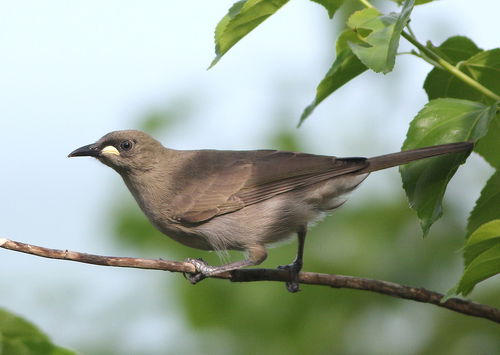
White-bellied Cuckooshrike

White-bellied Cuckooshrike

Coracina papuensis

Silhouette: PhyloPic

LCLeast ConcernNTVUENCR
Daily sighting probability ~50% · Likely
at Litchfield National Park

In 3 days ~90% in a week >90%

201 Verified sightings at Litchfield National Park From 2019 to 2026
1,910 In all 8 parks
September Best month
☀️ Diurnal When it's spotted

About the White-bellied Cuckooshrike

The white-bellied cuckooshrike (Coracina papuensis) is a species of bird in the family Campephagidae. It is found in Australia, the Moluccas, New Guinea and the Solomon Islands. The white-bellied cuckooshrike was formally described in 1788 by the German naturalist Johann Friedrich Gmelin in his revised and expanded edition of Carl Linnaeus's Systema Naturae. He placed it with the crows in the genus Corvus and coined the binomial name Corvus papuensis. Gmelin based his description on "Le Choucari de la Nouvelle Guinée" that had been described in 1775 by the French polymath the Comte de Buffon and illustrated with a hand-coloured engraving by François-Nicolas Martinet. The type location was restricted to Manokwari in the Indonesian province of West Papua by Erwin Stresemann in 1913. The white-bellied cuckooshrike is now one of 22 species placed in the genus Coracina that was introduced in 1816 by French ornithologist Louis Pierre Vieillot.

Fourteen subspecies are recognised. Wikipedia →

Sounds

Call0:36

Indonesia · 2026

© Ding Li Yong · XC1164382 · CC BY-NC-ND 4.0

Alarm call0:36

Papua New Guinea · 2025

© Jan-Uwe Schmidt · XC1106209 · CC BY-NC-SA 4.0

Uncertain0:16

Papua New Guinea · 2022

© Sofia Medellín · XC738550 · CC BY-NC-SA 4.0

Global Distribution

Parks Where Found

# Park Country Daily sighting probability
1 Kakadu National Park 🇦🇺 Australia
~60%
2 Litchfield National Park 🇦🇺 Australia
~50%
3 Nitmiluk National Park 🇦🇺 Australia
~50%
4 Springbrook National Park 🇦🇺 Australia
~10%
5 Daintree National Park 🇦🇺 Australia
~10%
6 Raja Ampat 🇮🇩 Indonesia
<5%
7 Lamington National Park 🇦🇺 Australia
<5%
8 Blue Mountains National Park 🇦🇺 Australia
<5%

Cities Where Found

# City Country Daily sighting probability
1 Brisbane 🇦🇺 Australia
<5%

Before you go

What are the chances of seeing a White-bellied Cuckooshrike in Litchfield National Park?

Likely

About 50% of wildlife watchers report a White-bellied Cuckooshrike sighting in Litchfield National Park on a given day, based on 201 verified sightings from GBIF citizen-science data from 2019 to 2026. It is the 10th most-seen of the 110 birds we can rate there. Over three days the chance rises to about 90%, and over a week to over 90%, if each day is a fresh chance.

When is the best time to see a White-bellied Cuckooshrike in Litchfield National Park?

February–March, May and August–September

In those months about 60% of wildlife watchers report a White-bellied Cuckooshrike in Litchfield National Park on a given day, against about 40% in April and October–December, the lowest months.

What time of day is best to see a White-bellied Cuckooshrike?

Between 7 and 10 am

Across all the parks we cover, that three-hour window holds the most White-bellied Cuckooshrike sightings with a recorded time, and about 9 in 10 of them come between 6 am and 6 pm: it is a daytime animal.

Is Litchfield National Park the best place to see a White-bellied Cuckooshrike?

2nd of 8

Of the 8 parks where we can rate White-bellied Cuckooshrike sightings, Litchfield National Park ranks 2nd at about 50%. The best odds are in Kakadu National Park (Australia, about 60%).

Where does the White-bellied Cuckooshrike sighting chance come from?

GBIF citizen-science records

It is estimated from how often the White-bellied Cuckooshrike is recorded against all the birds logged in Litchfield National Park (201 verified sightings from 2019 to 2026), calibrated against known sighting rates. Figures are rounded to the nearest 10% because citizen-science data supports honest approximations, not decimals, and months with records from fewer than five people show "—". How it works.

← Back to Litchfield National Park