Rainbow Pitta

Rainbow Pitta

Pitta iris

Silhouette: Rachael Joakim · PhyloPic

LCLeast ConcernNTVUENCR Endemic
Daily sighting probability ~10% · With luck
at Litchfield National Park

In 3 days ~20% in a week ~50%

29 Verified sightings at Litchfield National Park From 2019 to 2026
247 In all 2 parks
November Best month
☀️ Diurnal When it's spotted

About the Rainbow Pitta

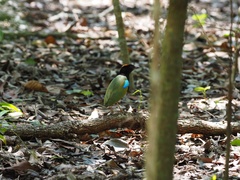
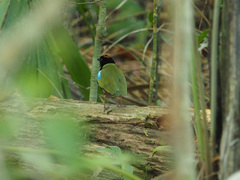
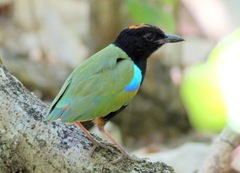
The rainbow pitta (Pitta iris) is a small passerine bird in the pitta family, Pittidae, endemic to northern Australia, most closely related to the superb pitta of Manus Island. It has a velvet black head with chestnut stripes above the eyes, olive green upper parts, black underparts, a bright red belly and an olive green tail. An Australian endemic, it lives in the monsoon forests and in some drier eucalypt forests.

Like other pittas, the rainbow pitta is a secretive and shy bird. Its diet is mainly insects, arthropods and small vertebrates. Pairs defend territories and breed during the rainy season, as that time of year provides the most food for nestlings. The female lays three to five blotched eggs inside its large domed nest. Both parents defend the nest, incubate the eggs and feed the chicks. Although the species has a small global range, it is locally common and the International Union for Conservation of Nature (IUCN) has assessed it as being of least concern.

The rainbow pitta was described by the English ornithologist and bird artist John Gould in 1842, which is based on a specimen collected on the Cobourg Peninsula in the Northern Territory... Wikipedia →

Sounds

Song0:41

Australia · 2021

© James Lambert · XC692323 · CC BY-NC-ND 4.0

Call0:05

Australia · 1990

© Vicki Powys · XC30648 · CC BY-NC-ND 2.5

Song0:07

Australia · 2023

© nick talbot · XC829617 · CC BY-NC-SA 4.0

Global Distribution

Parks Where Found

# Park Country Daily sighting probability
1 Kakadu National Park 🇦🇺 Australia
~10%
2 Litchfield National Park 🇦🇺 Australia
~10%

Before you go

What are the chances of seeing a Rainbow Pitta in Litchfield National Park?

With luck

About 10% of wildlife watchers report a Rainbow Pitta sighting in Litchfield National Park on a given day, based on 29 verified sightings from GBIF citizen-science data from 2019 to 2026. It is the 71st most-seen of the 110 birds we can rate there. Over three days the chance rises to about 20%, and over a week to about 50%, if each day is a fresh chance.

When is the best time to see a Rainbow Pitta in Litchfield National Park?

September and November

In those months about 20% of wildlife watchers report a Rainbow Pitta in Litchfield National Park on a given day, against under 5% in February–March and May–July, the lowest months.

What time of day is best to see a Rainbow Pitta?

Between 8 and 11 am

Across all the parks we cover, that three-hour window holds the most Rainbow Pitta sightings with a recorded time, and about 8 in 10 of them come between 6 am and 6 pm: it is a daytime animal.

Is Litchfield National Park the best place to see a Rainbow Pitta?

Among the best

Of the 2 parks where we can rate Rainbow Pitta sightings, Litchfield National Park ranks 2nd at about 10%, level with the leaders once rounded. The best odds are in Kakadu National Park (Australia, about 10%).

Which relatives of the Rainbow Pitta live in Litchfield National Park?

Same order: Passeriformes

The closest relatives of the Rainbow Pitta that you can see in Litchfield National Park (order Passeriformes, Perching Birds) are Torresian Crow (about 60%), Spangled Drongo (about 50%) and Varied Triller (about 50%), with each one's daily chance of a sighting.

Where does the Rainbow Pitta sighting chance come from?

GBIF citizen-science records

It is estimated from how often the Rainbow Pitta is recorded against all the birds logged in Litchfield National Park (29 verified sightings from 2019 to 2026), calibrated against known sighting rates. Figures are rounded to the nearest 10% because citizen-science data supports honest approximations, not decimals, and months with records from fewer than five people show "—". How it works.

← Back to Litchfield National Park