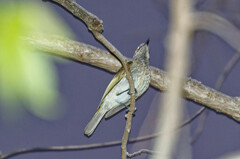
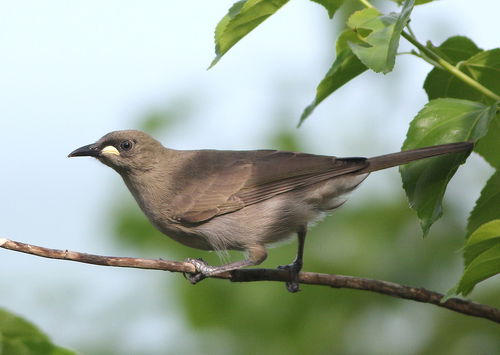
Brown Honeyeater

Brown Honeyeater

Lichmera indistincta

Silhouette: Rachael Joakim · PhyloPic

LCLeast ConcernNTVUENCR
Daily sighting probability ~30% · Possible
at Litchfield National Park

In 3 days ~70% in a week ~90%

131 Verified sightings at Litchfield National Park From 2019 to 2026
1,644 In all 14 parks
July Best month
☀️ Diurnal When it's spotted

About the Brown Honeyeater

The brown honeyeater (Lichmera indistincta) is a species of bird in the family Meliphagidae. It belongs to the honeyeaters, a group of birds which have highly developed brush-tipped tongues adapted for nectar feeding. Honeyeaters are found mainly in Australia, New Guinea, and parts of Indonesia, but the brown honeyeater is unique in that it also occurs on the island of Bali, making it the only honeyeater to be found west of the Wallace Line, the biogeographical boundary between the Australian-Papuan and Oriental zoogeographical regions.

It is a medium-small brownish bird, with yellow-olive panels in the tail and wing, and a yellow tuft behind the eye. It is widespread across western, northern and eastern Australia, New Guinea and surrounding islands, and the Lesser Sundas of Indonesia. Throughout this range, the brown honeyeater occupies a range of habitats from mangroves to eucalypt woodlands. It is seasonally nomadic within its local area, following flowering food plants. While it usually forages alone, it also feeds in small groups, or flocks of mixed honeyeater species. Nectar and insects form its diet. It occupies the same breeding territory each year, and lays two or three eggs in a cup-shaped nest woven from grass and soft bark. Both sexes contribute to nest building and feeding the young. It has a loud, clear, musical song, described as the best of all the honeyeaters.

While the brown honeyeater is declining in some areas, such as the Wheatbelt region of Western Australia, overall its population levels and distribution are sufficient to have it described by the IUCN as being of least concern for conservation. Wikipedia →

Sounds

Call0:07

Australia · 2024

© Tom Cooney · XC1103325 · CC BY-NC-SA 4.0

Song1:09

Australia · 2025

© Peter Boesman · XC1066625 · CC BY-NC-ND 4.0

Dawn song1:05

Australia · 2023

© James Lambert · XC791441 · CC BY-NC-ND 4.0

Global Distribution

Parks Where Found

# Park Country Daily sighting probability
1 Nitmiluk National Park 🇦🇺 Australia
~60%
2 Noosa National Park 🇦🇺 Australia
~40%
3 Litchfield National Park 🇦🇺 Australia
~30%
4 Kakadu National Park 🇦🇺 Australia
~30%
5 Cape Range 🇦🇺 Australia
~30%
6 Bali Barat National Park 🇮🇩 Indonesia
~20%
7 Ningaloo Marine Park 🇦🇺 Australia
~20%
8 Springbrook National Park 🇦🇺 Australia
~10%
9 Komodo National Park 🇮🇩 Indonesia
<5%
10 Uluru-Kata Tjuta National Park 🇦🇺 Australia
<5%
11 Rottnest Island 🇦🇺 Australia
<5%
12 Daintree National Park 🇦🇺 Australia
<5%
13 Lamington National Park 🇦🇺 Australia
<5%
14 Royal National Park 🇦🇺 Australia
<5%

Cities Where Found

# City Country Daily sighting probability
1 Perth 🇦🇺 Australia
~60%
2 Brisbane 🇦🇺 Australia
~50%
3 Jakarta 🇮🇩 Indonesia
~20%
4 Sydney 🇦🇺 Australia
<5%
5 Denpasar 🇮🇩 Indonesia
<5%

Before you go

What are the chances of seeing a Brown Honeyeater in Litchfield National Park?

Possible

About 30% of wildlife watchers report a Brown Honeyeater sighting in Litchfield National Park on a given day, based on 131 verified sightings from GBIF citizen-science data from 2019 to 2026. It is the 19th most-seen of the 110 birds we can rate there. Over three days the chance rises to about 70%, and over a week to about 90%, if each day is a fresh chance.

When is the best time to see a Brown Honeyeater in Litchfield National Park?

July

In that month about 60% of wildlife watchers report a Brown Honeyeater in Litchfield National Park on a given day, against about 10% in October and November, the lowest months. That is one of Litchfield National Park's driest months, with almost no rain against 400 mm in January.

What time of day is best to see a Brown Honeyeater?

Between 8 and 11 am

Across all the parks we cover, that three-hour window holds the most Brown Honeyeater sightings with a recorded time, and nearly all of them come between 6 am and 6 pm: it is a daytime animal.

Is Litchfield National Park the best place to see a Brown Honeyeater?

3rd of 14

Of the 14 parks where we can rate Brown Honeyeater sightings, Litchfield National Park ranks 3rd at about 30%. The best odds are in Nitmiluk National Park (Australia, about 60%) and Noosa National Park (Australia, about 40%). All parks ranked.

Which relatives of the Brown Honeyeater live in Litchfield National Park?

Same family: Meliphagidae

The closest relatives of the Brown Honeyeater that you can see in Litchfield National Park (family Meliphagidae, Honeyeaters) are White-throated Honeyeater (about 50%), Dusky Honeyeater (about 40%) and White-gaped Honeyeater (about 40%), with each one's daily chance of a sighting.

Where does the Brown Honeyeater sighting chance come from?

GBIF citizen-science records

It is estimated from how often the Brown Honeyeater is recorded against all the birds logged in Litchfield National Park (131 verified sightings from 2019 to 2026), calibrated against known sighting rates. Figures are rounded to the nearest 10% because citizen-science data supports honest approximations, not decimals, and months with records from fewer than five people show "—". How it works.

← Back to Litchfield National Park