Red-collared Lorikeet

Red-collared Lorikeet

Trichoglossus rubritorquis

Silhouette: Farelli (photo), John E. McCormack, Michael G. Harvey, Brant C. Faircloth, Nicholas G. Crawford, Travis C. Glenn, Robb T. Brumfield & T. Michael Keesey · PhyloPic

LCLeast ConcernNTVUENCR Endemic
Daily sighting probability ~50% · Likely
at Litchfield National Park

In 3 days ~90% in a week >90%

177 Verified sightings at Litchfield National Park From 2019 to 2026
1,374 In all 3 parks
April Best month
☀️ Diurnal When it's spotted

About the Red-collared Lorikeet

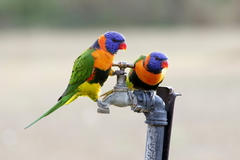
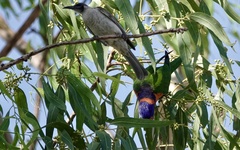
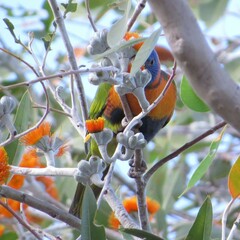
The red-collared lorikeet (Trichoglossus rubritorquis) is a species of parrot found in wooded habitats in northern Australia (north-eastern Western Australia, northern Northern Territory and far north-western Queensland). It was previously considered a subspecies of the rainbow lorikeet, but today most major authorities consider them as separate species. No other member of the rainbow lorikeet group has an orange-red collar over the nape.

Every year at the end of the dry season in Darwin, many of them display symptoms of apparent drunkenness. What causes this condition is unclear, though it is thought to be most likely due to a seasonal virus. Intoxication with fermented nectar has been ruled out.

Nicholas Aylward Vigors and Thomas Horsfield described the red-collared lorikeet in 1827. The species name is derived from the Latin words ruber "red" and torquis "neck". Molecular analysis using mitochondrial cytochrome b showed the red-collared lorikeet is most closely related to a lineage that gave rise to the marigold lorikeet and sunset lorikeet of Indonesia. It is more distantly related to the rainbow lorikeet, the two distinct lineages colonising Australia independently... Wikipedia →

Sounds

Call0:18

Australia · 2023

© James Lambert · XC791433 · CC BY-NC-ND 4.0

Flight call0:26

Australia · 2012

© Marc Anderson · XC172143 · CC BY-NC-ND 4.0

Call1:21

Australia · 2009

© Simon Elliott · XC595329 · CC BY-NC-ND 4.0

Global Distribution

Parks Where Found

# Park Country Daily sighting probability
1 Nitmiluk National Park 🇦🇺 Australia
~80%
2 Litchfield National Park 🇦🇺 Australia
~50%
3 Kakadu National Park 🇦🇺 Australia
~40%

Cities Where Found

# City Country Daily sighting probability
1 Perth 🇦🇺 Australia
<5%

Zoos & Centres Where Found

# Zoo / Centre Country
1 Busch Gardens Tampa 🇺🇸 United States In captivity
2 Australia Zoo 🇦🇺 Australia In captivity
3 Lion Country Safari 🇺🇸 United States In captivity
4 Dierenpark Hoenderdaell 🇳🇱 Netherlands In captivity
5 Night Safari 🇸🇬 Singapore In captivity
6 JOJOZOO PARK 🇹🇼 Taiwan In captivity
7 Singapore Zoo 🇸🇬 Singapore In captivity
8 Melbourne Zoo 🇦🇺 Australia In captivity
9 Bird Paradise 🇸🇬 Singapore In captivity
10 Green World Ecological Farm 🇹🇼 Taiwan In captivity
11 Rainforest Wild Asia 🇸🇬 Singapore In captivity
12 Loro Parque 🇪🇸 Spain In captivity
13 Buin Zoo 🇨🇱 Chile In captivity
14 River Wonders 🇸🇬 Singapore In captivity
15 Hong Kong Zoological and Botanical Gardens 🇨🇳 China In captivity
16 Bird Park Steinen 🇩🇪 Germany In captivity
17 Featherdale Sydney Wildlife Park 🇦🇺 Australia In captivity
18 Millcreek Bird Park 🇳🇿 New Zealand In captivity
19 Farma 🇸🇰 Slovakia In captivity
20 Sea Life Sydney Aquarium 🇦🇺 Australia In captivity
21 Edward Youde Aviary 🇭🇰 Hong Kong SAR China In captivity
22 Wild Life Sydney 🇦🇺 Australia In captivity
23 Birdworld Kuranda 🇦🇺 Australia In captivity
24 Kuranda Koala Gardens 🇦🇺 Australia In captivity
25 Park Edukacyjny Zoo-Egzotyczne Kaszuby 🇵🇱 Poland In captivity
26 Landgoed Hoenderdaell 🇳🇱 Netherlands In captivity
27 Wildlife Habitat Port Douglas 🇦🇺 Australia In captivity

Before you go

What are the chances of seeing a Red-collared Lorikeet in Litchfield National Park?

Likely

About 50% of wildlife watchers report a Red-collared Lorikeet sighting in Litchfield National Park on a given day, based on 177 verified sightings from GBIF citizen-science data from 2019 to 2026. It is the 7th most-seen of the 110 birds we can rate there. Over three days the chance rises to about 90%, and over a week to over 90%, if each day is a fresh chance.

When is the best time to see a Red-collared Lorikeet in Litchfield National Park?

April and August

In those months about 70% of wildlife watchers report a Red-collared Lorikeet in Litchfield National Park on a given day, against about 30% in November, the lowest month. Those are among Litchfield National Park's driest months, with about 25 mm of rain a month against 400 mm in January.

What time of day is best to see a Red-collared Lorikeet?

Between 8 and 11 am

Across all the parks we cover, that three-hour window holds the most Red-collared Lorikeet sightings with a recorded time, and about 8 in 10 of them come between 6 am and 6 pm: it is a daytime animal.

Is Litchfield National Park the best place to see a Red-collared Lorikeet?

2nd of 3

Of the 3 parks where we can rate Red-collared Lorikeet sightings, Litchfield National Park ranks 2nd at about 50%. The best odds are in Nitmiluk National Park (Australia, about 80%).

Which relatives of the Red-collared Lorikeet live in Litchfield National Park?

Same family: Psittacidae

The closest relatives of the Red-collared Lorikeet that you can see in Litchfield National Park (family Psittacidae, New World and African Parrots) are Sulphur-crested Cockatoo (about 50%), Red-tailed Black-Cockatoo (about 40%) and Red-winged Parrot (about 30%), with each one's daily chance of a sighting.

Where does the Red-collared Lorikeet sighting chance come from?

GBIF citizen-science records

It is estimated from how often the Red-collared Lorikeet is recorded against all the birds logged in Litchfield National Park (177 verified sightings from 2019 to 2026), calibrated against known sighting rates. Figures are rounded to the nearest 10% because citizen-science data supports honest approximations, not decimals, and months with records from fewer than five people show "—". How it works.

← Back to Litchfield National Park