Smoke-colored Pewee

Smoke-colored Pewee

Contopus fumigatus

Silhouette: Andy Wilson · PhyloPic

LCLeast ConcernNTVUENCR
Daily sighting probability ~10% · With luck
at Los Nevados National Natural Park

In 3 days ~20% in a week ~30%

311 Verified sightings at Los Nevados National Natural Park From 2019 to 2026
516 In all 6 parks
May Best month
☀️ Diurnal When it's spotted

About the Smoke-colored Pewee

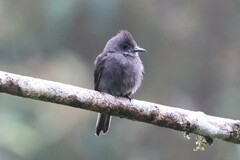
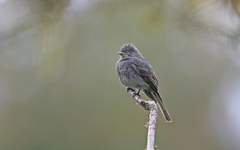
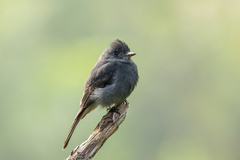
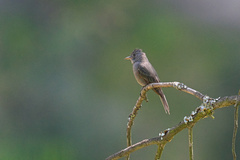
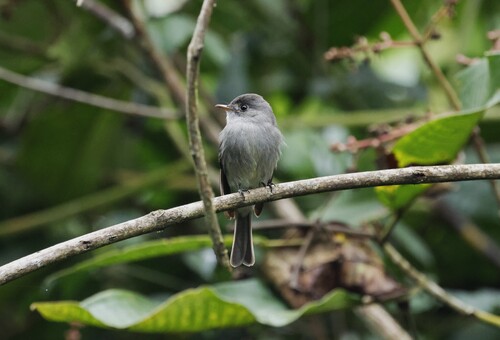
The smoke-colored pewee (Contopus fumigatus) is a species of bird in the family Tyrannidae. The species is characterized by a uniform dusky-grey plumage. Smoke-colored pewees are found in Argentina, Bolivia, Brazil, Colombia, Ecuador, Guyana, Peru, and Venezuela. Their natural habitats are subtropical or tropical dry forests, subtropical or tropical moist montane forests, and heavily degraded former forests.

The smoke-colored pewee belongs to the family Tyrannidae, known as the tyrant flycatchers. The Tyrannidae are considered to be the largest family of birds on earth, containing over 400 species. The group shows large variation in form and plumage and can be found in every country in the Americas.

The species was first formally described by the French naturalists Alcide d'Orbigny and Frédéric de Lafresnaye in 1837, based on a specimen found in the Bolivian Yungas. The generic name Contopus derives from the Ancient Greek kontos (pole) and pous (foot). The specific name fumigatus comes from the Latin fumus (smoke).

Six subspecies are recognized: Wikipedia →

Sounds

Song0:53

Ecuador · 2020

© Nunes-de-Almeida · XC544525 · CC BY-NC-SA 4.0

Call0:33

Ecuador · 2017

© Jerome Fischer · XC386730 · CC BY-NC-SA 4.0

Dawn song0:16

Ecuador · 2006

© Patricio Mena Valenzuela · XC275451 · CC BY-NC-SA 4.0

Global Distribution

Parks Where Found

# Park Country Daily sighting probability
1 Henri Pittier National Park 🇻🇪 Venezuela
~10%
2 Los Nevados National Natural Park 🇨🇴 Colombia
~10%
3 Podocarpus National Park 🇪🇨 Ecuador
<5%
4 Chingaza National Natural Park 🇨🇴 Colombia
<5%
5 Amboró National Park 🇧🇴 Bolivia
<5%
6 Farallones de Cali National Natural Park 🇨🇴 Colombia
<5%

Cities Where Found

# City Country Daily sighting probability
1 Quito 🇪🇨 Ecuador
~10%
2 Bogota 🇨🇴 Colombia
<5%

Before you go

What are the chances of seeing a Smoke-colored Pewee in Los Nevados National Natural Park?

With luck

About 10% of wildlife watchers report a Smoke-colored Pewee sighting in Los Nevados National Natural Park on a given day, based on 311 verified sightings from GBIF citizen-science data from 2019 to 2026. It is the 144th most-seen of the 424 birds we can rate there. Over three days the chance rises to about 20%, and over a week to about 30%, if each day is a fresh chance.

When is the best time to see a Smoke-colored Pewee in Los Nevados National Natural Park?

May

In that month about 20% of wildlife watchers report a Smoke-colored Pewee in Los Nevados National Natural Park on a given day, against under 5% in June, September and December–April, the lowest months.

What time of day is best to see a Smoke-colored Pewee?

Between 6 and 9 am

Across all the parks we cover, that three-hour window holds the most Smoke-colored Pewee sightings with a recorded time, and about 9 in 10 of them come between 6 am and 6 pm: it is a daytime animal.

Is Los Nevados National Natural Park the best place to see a Smoke-colored Pewee?

Among the best

Of the 6 parks where we can rate Smoke-colored Pewee sightings, Los Nevados National Natural Park ranks 2nd at about 10%, level with the leaders once rounded. The best odds are in Henri Pittier National Park (Venezuela, about 10%).

Where does the Smoke-colored Pewee sighting chance come from?

GBIF citizen-science records

It is estimated from how often the Smoke-colored Pewee is recorded against all the birds logged in Los Nevados National Natural Park (311 verified sightings from 2019 to 2026), calibrated against known sighting rates. Figures are rounded to the nearest 10% because citizen-science data supports honest approximations, not decimals, and months with records from fewer than five people show "—". How it works.

← Back to Los Nevados National Natural Park