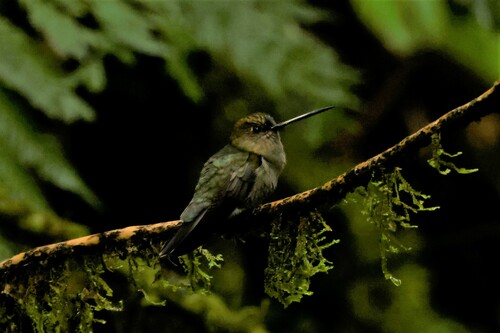
Scintillant Hummingbird

Scintillant Hummingbird

Selasphorus scintilla

Silhouette: Ferran Sayol · PhyloPic

LCLeast ConcernNTVUENCR
Daily sighting probability ~40% · Likely
at Los Quetzales National Park

In 3 days ~80% in a week >90%

3,724 Verified sightings at Los Quetzales National Park From 2019 to 2026
9,763 In all 9 parks
November Best month
☀️ Diurnal When it's spotted

About the Scintillant Hummingbird

The scintillant hummingbird (Selasphorus scintilla) is a hummingbird endemic to Costa Rica and Panama. This species is replaced at higher elevations by its relative, the volcano hummingbird, S. flammula. It inhabits brushy forest edges, coffee plantations and sometimes gardens at altitudes from 900–2,000 m (3,000–6,600 ft), and up to 2,500 m (8,200 ft) when not breeding.

It is only 6.5–8 cm (2.6–3.1 in) long, including the bill. The male weighs 2 g (0.071 oz) and the female 2.3 g (0.081 oz). This is one of the smallest birds in existence, marginally larger than the bee hummingbird. The black bill is short and straight.

The adult male scintillant hummingbird has bronze-green upperparts and a rufous and black-striped tail. The throat is brilliant red, separated from the cinnamon underparts by a white neck band. The female is similar, but her throat is buff with small green spots and the flanks are richer rufous. Young birds resemble the female but have rufous fringes to the upperpart plumage.

The female scintillant hummingbird is entirely responsible for nest building and incubation. She lays two white eggs in her tiny plant-floss cup nest... Wikipedia →

Sounds

Call0:19

Costa Rica · 2014

© Mike Nelson · XC166213 · CC BY-NC-SA 3.0

Call0:11

Costa Rica · 2009

© Chris Clark · XC70115 · CC BY-NC-ND 2.5

Global Distribution

Parks Where Found

# Park Country Daily sighting probability
1 Volcán Barú National Park 🇵🇦 Panama
~50%
2 Los Quetzales National Park 🇨🇷 Costa Rica
~40%
3 La Amistad International Park (Panama) 🇵🇦 Panama
~20%
4 Poás Volcano National Park 🇨🇷 Costa Rica
~20%
5 Irazú Volcano National Park 🇨🇷 Costa Rica
~20%
6 Tapantí-Macizo de la Muerte National Park 🇨🇷 Costa Rica
~10%
7 Chirripó National Park 🇨🇷 Costa Rica
~10%
8 Braulio Carrillo National Park 🇨🇷 Costa Rica
~10%
9 Monteverde Cloud Forest Reserve 🇨🇷 Costa Rica
<5%

Cities Where Found

# City Country Daily sighting probability
1 San José 🇨🇷 Costa Rica
<5%

Before you go

What are the chances of seeing a Scintillant Hummingbird in Los Quetzales National Park?

Likely

About 40% of wildlife watchers report a Scintillant Hummingbird sighting in Los Quetzales National Park on a given day, based on 3,724 verified sightings from GBIF citizen-science data from 2019 to 2026. It is the 36th most-seen of the 252 birds we can rate there. Over three days the chance rises to about 80%, and over a week to over 90%, if each day is a fresh chance.

When is the best time to see a Scintillant Hummingbird in Los Quetzales National Park?

November and December

In those months about 50% of wildlife watchers report a Scintillant Hummingbird in Los Quetzales National Park on a given day, against about 30% in March–May and August–September, the lowest months.

What time of day is best to see a Scintillant Hummingbird?

Between 11 am and 2 pm

Across all the parks we cover, that three-hour window holds the most Scintillant Hummingbird sightings with a recorded time, and about 9 in 10 of them come between 6 am and 6 pm: it is a daytime animal.

Is Los Quetzales National Park the best place to see a Scintillant Hummingbird?

2nd of 9

Of the 9 parks where we can rate Scintillant Hummingbird sightings, Los Quetzales National Park ranks 2nd at about 40%. The best odds are in Volcán Barú National Park (Panama, about 50%). All parks ranked.

Where does the Scintillant Hummingbird sighting chance come from?

GBIF citizen-science records

It is estimated from how often the Scintillant Hummingbird is recorded against all the birds logged in Los Quetzales National Park (3,724 verified sightings from 2019 to 2026), calibrated against known sighting rates. Figures are rounded to the nearest 10% because citizen-science data supports honest approximations, not decimals, and months with records from fewer than five people show "—". How it works.

← Back to Los Quetzales National Park