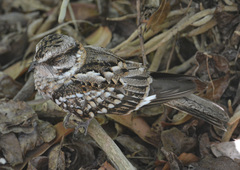
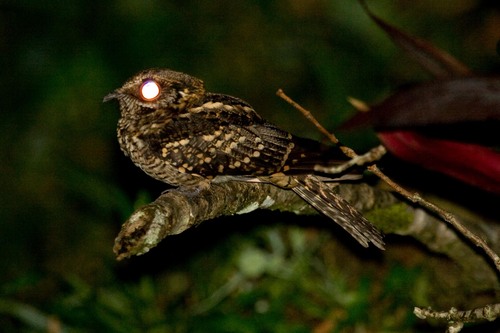
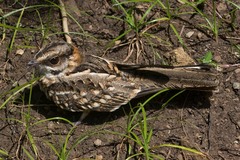
White-tailed Nightjar

White-tailed Nightjar

Hydropsalis cayennensis

Silhouette: Sheatherius · PhyloPic

LCLeast ConcernNTVUENCR
Daily sighting probability ~20% · Possible
at Main Ridge Forest Reserve

In 3 days ~50% in a week ~80%

199 Verified sightings at Main Ridge Forest Reserve From 2019 to 2026
208 In all 2 parks
June Best month
🌙 Nocturnal When it's spotted

About the White-tailed Nightjar

The white-tailed nightjar (Hydropsalis cayennensis) is a species of nightjar in the family Caprimulgidae. It is found in the tropic regions of Central and South America. The white-tailed nightjar was formally described in 1789 by the German naturalist Johann Friedrich Gmelin in his revised and expanded edition of Carl Linnaeus's Systema Naturae. He placed it with all the other nightjars in the genus Caprimulgus and coined the binomial name Caprimulgus cayennensis. Gmelin based his description on "L'engoulevent varié de Cayenne" that was described in 1779 by the French polymath Georges-Louis Leclerc, Comte de Buffon in his Histoire Naturelle des Oiseaux. A hand-coloured illustration was also published.

Based on a molecular phylogenetic study by Kin-Lan Han and collaborators published in 2010, the white-tailed nightjar is now placed with three other species in the genus Hydropsalis. This genus was introduced in 1832 by the German naturalist Johann Georg Wagler. The genus name combines the Ancient Greek hudro- meaning "water-" with psalis meaning "pair of scissors". The specific epithet cayennensis is from Cayenne, French Guiana, the type locality.

Six subspecies are recognised... Wikipedia →

Sounds

Song0:54

French Guiana · 2025

© Paul Lenrumé · XC998443 · CC BY-NC-SA 4.0

Call1:30

Brazil · 2024

© JAYRSON ARAUJO DE OLIVEIRA · XC939578 · CC BY-NC-SA 4.0

Dawn song0:35

Ecuador · 2022

© Charlie Vogt · XC712140 · CC BY-NC-SA 4.0

Global Distribution

Parks Where Found

# Park Country Daily sighting probability
1 Main Ridge Forest Reserve 🇹🇹 Trinidad and Tobago
~20%
2 Tayrona National Natural Park 🇨🇴 Colombia
<5%

Cities Where Found

# City Country Daily sighting probability
1 Cali 🇨🇴 Colombia
<5%
2 Caracas 🇻🇪 Venezuela
<5%
3 Panama City 🇵🇦 Panama
<5%
4 Medellín 🇨🇴 Colombia
<5%

Closest Relatives at Main Ridge Forest Reserve

No species of the same family or order lives in Main Ridge Forest Reserve, so these are its closest relatives here: other birds.

Before you go

What are the chances of seeing a White-tailed Nightjar in Main Ridge Forest Reserve?

Possible

About 20% of wildlife watchers report a White-tailed Nightjar sighting in Main Ridge Forest Reserve on a given day, based on 199 verified sightings from GBIF citizen-science data from 2019 to 2026. It is the 59th most-seen of the 103 birds we can rate there. Over three days the chance rises to about 50%, and over a week to about 80%, if each day is a fresh chance.

When is the best time to see a White-tailed Nightjar in Main Ridge Forest Reserve?

June

In that month about 40% of wildlife watchers report a White-tailed Nightjar in Main Ridge Forest Reserve on a given day, against about 10% in February and August–October, the lowest months.

What time of day is best to see a White-tailed Nightjar?

Between 6 and 9 pm

Across all the parks we cover, that three-hour window holds the most White-tailed Nightjar sightings with a recorded time, and about 7 in 10 of them come between 6 pm and 6 am: it is mostly seen at night.

Is Main Ridge Forest Reserve the best place to see a White-tailed Nightjar?

Yes

Of the 2 parks where we can rate White-tailed Nightjar sightings, Main Ridge Forest Reserve has the highest daily chance: about 20%. Next come Tayrona National Natural Park (Colombia, under 5%).

Where does the White-tailed Nightjar sighting chance come from?

GBIF citizen-science records

It is estimated from how often the White-tailed Nightjar is recorded against all the birds logged in Main Ridge Forest Reserve (199 verified sightings from 2019 to 2026), calibrated against known sighting rates. Figures are rounded to the nearest 10% because citizen-science data supports honest approximations, not decimals, and months with records from fewer than five people show "—". How it works.
← Back to Main Ridge Forest Reserve