
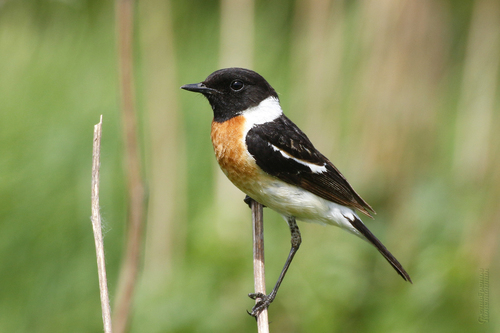
Rosy Minivet

Rosy Minivet

Pericrocotus roseus

Silhouette: PhyloPic

LCLeast ConcernNTVUENCR
Daily sighting probability ~20% · Possible
at Manas National Park

In 3 days ~50% in a week ~80%

365 Verified sightings at Manas National Park From 2019 to 2026
1,224 In all 9 parks
June Best month
☀️ Diurnal When it's spotted

About the Rosy Minivet

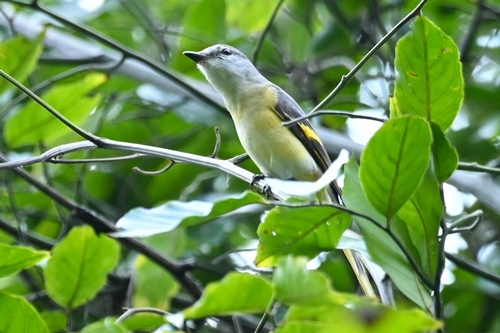
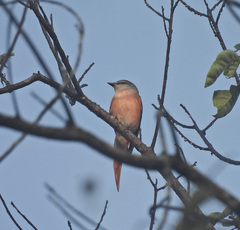
The rosy minivet (Pericrocotus roseus) is a species of bird in the family Campephagidae. It is omnivorous. The male is distinguished from other minivets by having a deep pink/light red shade in wings and tail and the female having an olive/olive yellow rump as against bright yellow in other minivets. Both male and female are grey above.

It is found in Afghanistan, Bangladesh, Bhutan, China, India, Laos, Myanmar, Nepal, Pakistan, Thailand, and Vietnam. In India, it is found in the Himalayas from west to east to Arunachal Pradesh and hills of Nagaland and Manipur. In winter in peninsula.

Its natural habitats are subtropical or tropical moist lowland forest, and subtropical or tropical moist montane forest. Wikipedia →

Sounds

Call1:01

China · 2026

© Bo Shunqi 薄顺奇 · XC1172736 · CC BY-NC-SA 4.0

Song0:08

China · 2026

© Dave Guo · XC1148887 · CC BY-NC-SA 4.0

Recording0:26

India · 2022

© Suniti Bhushan Datta · XC714325 · CC BY-NC-SA 4.0

Global Distribution

Parks Where Found

# Park Country Daily sighting probability
1 Manas National Park 🇮🇳 India
~20%
2 Khao Yai National Park 🇹🇭 Thailand
~10%
3 Jim Corbett National Park 🇮🇳 India
~10%
4 Doi Inthanon National Park 🇹🇭 Thailand
~10%
5 Kaziranga National Park 🇮🇳 India
<5%
6 Chitwan National Park 🇳🇵 Nepal
<5%
7 Royal Bardia National Park 🇳🇵 Nepal
<5%
8 Kaeng Krachan National Park 🇹🇭 Thailand
<5%
9 Royal Manas National Park 🇧🇹 Bhutan
<5%

Cities Where Found

# City Country Daily sighting probability
1 Kunming 🇨🇳 China
<5%
2 Dehradun 🇮🇳 India
<5%
3 Bangkok 🇹🇭 Thailand
<5%

Before you go

What are the chances of seeing a Rosy Minivet in Manas National Park?

Possible

About 20% of wildlife watchers report a Rosy Minivet sighting in Manas National Park on a given day, based on 365 verified sightings from GBIF citizen-science data from 2019 to 2026. It is the 62nd most-seen of the 377 birds we can rate there. Over three days the chance rises to about 50%, and over a week to about 80%, if each day is a fresh chance.

When is the best time to see a Rosy Minivet in Manas National Park?

March–April and June

In those months about 40% of wildlife watchers report a Rosy Minivet in Manas National Park on a given day, against under 5% in December and January, the lowest months. Those are among Manas National Park's wettest months, with about 490 mm of rain a month against 10 mm in December.

What time of day is best to see a Rosy Minivet?

Between 10 am and 1 pm

Across all the parks we cover, that three-hour window holds the most Rosy Minivet sightings with a recorded time, and about 9 in 10 of them come between 6 am and 6 pm: it is a daytime animal.

Is Manas National Park the best place to see a Rosy Minivet?

Yes

Of the 9 parks where we can rate Rosy Minivet sightings, Manas National Park has the highest daily chance: about 20%. Next come Khao Yai National Park (Thailand, about 10%) and Jim Corbett National Park (India, about 10%).

Which relatives of the Rosy Minivet live in Manas National Park?

Same genus: Pericrocotus

The closest relatives of the Rosy Minivet that you can see in Manas National Park (genus Pericrocotus, Minivets) are Scarlet Minivet (about 40%), Long-tailed Minivet (about 10%) and Small Minivet (about 10%), with each one's daily chance of a sighting.

Where does the Rosy Minivet sighting chance come from?

GBIF citizen-science records

It is estimated from how often the Rosy Minivet is recorded against all the birds logged in Manas National Park (365 verified sightings from 2019 to 2026), calibrated against known sighting rates. Figures are rounded to the nearest 10% because citizen-science data supports honest approximations, not decimals, and months with records from fewer than five people show "—". How it works.

← Back to Manas National Park