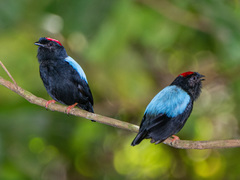
Blue-backed Manakin

Blue-backed Manakin

Chiroxiphia pareola

Silhouette: Edwin Price · PhyloPic

LCLeast ConcernNTVUENCR
Daily sighting probability <5% · Rare
at Manu National Park

In 3 days <5% in a week ~10%

52 Verified sightings at Manu National Park From 2019 to 2026
1,078 In all 6 parks
January Best month
☀️ Diurnal When it's spotted

About the Blue-backed Manakin

The blue-backed manakin (Chiroxiphia pareola) is a small passerine bird which breeds in tropical South America, its range extending from Colombia and Tobago to southeastern Brazil. It is found in deciduous forests but not evergreen rainforests. It is a small, plump bird about 13 centimetres (5 in) long. Males have black plumage with a bright blue back and a red or yellow crown. Females and juveniles are olive-green with paler underparts. At breeding time, males are involved in a cooperative lekking behaviour during which they jump and twirl. This is a fairly common species with a wide range, and the International Union for Conservation of Nature has rated its conservation status as being of "least concern".

It is found in southern Colombia, eastern Venezuela, the Guyanas, northeast Brazil, the Amazon Basin in Brazil, Bolivia, Ecuador and Peru; and in Tobago. A disjunct population exists on the coastal strip of southeast Brazil, about 3000 km long. The blue-backed manakin is absent in the northwest Amazon Basin, a region from central Venezuela to the southern border of Colombia. This manakin is a fairly common bird of dry and moist deciduous forests, but... Wikipedia →

Sounds

Song1:21

Ecuador · 2025

© Manuel Sánchez-Nivicela · XC1153688 · CC BY-NC-ND 4.0

Call0:31

Brazil · 2025

© JAYRSON ARAUJO DE OLIVEIRA · XC1044968 · CC BY-NC-SA 4.0

Canto/chamado0:22

Brazil · 2014

© Caio Brito · XC427204 · CC BY-NC-SA 4.0

Global Distribution

Parks Where Found

# Park Country Daily sighting probability
1 Main Ridge Forest Reserve 🇹🇹 Trinidad and Tobago
~60%
2 Chapada Diamantina National Park 🇧🇷 Brazil
~20%
3 Amacayacu National Natural Park 🇨🇴 Colombia
~10%
4 Yasuní National Park 🇪🇨 Ecuador
<5%
5 Tambopata National Reserve 🇵🇪 Peru
<5%
6 Manu National Park 🇵🇪 Peru
<5%

Cities Where Found

# City Country Daily sighting probability
1 Maceió 🇧🇷 Brazil
<5%
2 João Pessoa 🇧🇷 Brazil
<5%

Zoos & Centres Where Found

# Zoo / Centre Country
1 Paris Zoological Park 🇫🇷 France In captivity
2 Aquarium du palais de la Porte Dorée 🇫🇷 France In captivity
3 Schönbrunn Zoo 🇦🇹 Austria In captivity

Before you go

What are the chances of seeing a Blue-backed Manakin in Manu National Park?

Rare

Under 5% of wildlife watchers report a Blue-backed Manakin sighting in Manu National Park on a given day, based on 52 verified sightings from GBIF citizen-science data from 2019 to 2026. It is the 448th most-seen of the 641 birds we can rate there. Over three days the chance rises to under 5%, and over a week to about 10%, if each day is a fresh chance.

When is the best time to see a Blue-backed Manakin in Manu National Park?

January

In that month about 10% of wildlife watchers report a Blue-backed Manakin in Manu National Park on a given day, against under 5% in February to December, the lowest months.

What time of day is best to see a Blue-backed Manakin?

Between 7 and 10 am

Across all the parks we cover, that three-hour window holds the most Blue-backed Manakin sightings with a recorded time, and about 9 in 10 of them come between 6 am and 6 pm: it is a daytime animal.

Which relatives of the Blue-backed Manakin live in Manu National Park?

Same family: Pipridae

The closest relatives of the Blue-backed Manakin that you can see in Manu National Park (family Pipridae, Manakins) are Fiery-capped Manakin (about 10%), Band-tailed Manakin (about 10%) and Dwarf Tyrant-Manakin (about 10%), with each one's daily chance of a sighting.

Where does the Blue-backed Manakin sighting chance come from?

GBIF citizen-science records

It is estimated from how often the Blue-backed Manakin is recorded against all the birds logged in Manu National Park (52 verified sightings from 2019 to 2026), calibrated against known sighting rates. Figures are rounded to the nearest 10% because citizen-science data supports honest approximations, not decimals, and months with records from fewer than five people show "—". How it works.

← Back to Manu National Park