Olivaceous Siskin

Olivaceous Siskin

Spinus olivaceus

Silhouette: Andy Wilson · PhyloPic

LCLeast ConcernNTVUENCR
Daily sighting probability <5% · Rare
at Manu National Park

In 3 days <5% in a week ~10%

42 Verified sightings at Manu National Park From 2019 to 2026
69 In all 3 parks
November Best month
☀️ Diurnal When it's spotted

About the Olivaceous Siskin

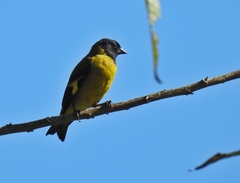
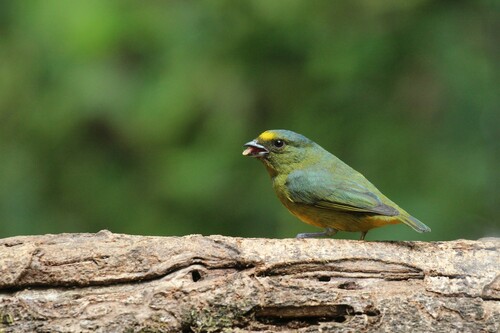
The olivaceous siskin (Spinus olivaceus) is a species of finch in the family Fringillidae. It is found in Bolivia, Ecuador, and Peru, where its natural habitats are subtropical or tropical moist montane forests and heavily degraded former forest.

The adult male olivaceous siskin has a black face, head, nape, throat and upper breast. It has a narrow collar of yellow and the rest of the upper parts, apart from the yellow rump, are olive green streaked with black. The greater wing coverts have a yellow edge, and this, with the yellow bases to the flight feathers, form a yellow panel when the bird is in flight. Underparts are yellowish-green with a dull yellow lower breast and belly. The tail is brownish-black, with the bases of the outer feathers yellow. The head of the adult female lacks the black of the male, and it and the upper parts are mainly yellowish-olive. The yellow rump, wings and tail are similar to those of the male. Beaks in both sexes are grey and legs are pinkish-brown or brown. Juvenile coloration is similar to the female's but is generally more brownish with the yellow parts being duller, buff or streaked with brown.

This... Wikipedia →

Sounds

Song0:38

Bolivia · 2021

© Jacob Wijpkema · XC638693 · CC BY-NC-SA 4.0

Call0:09

Ecuador · 1998

© Mitch Lysinger · XC261331 · CC BY-NC-SA 4.0

Call0:10

Ecuador · 2004

© John V. Moore · XC260078 · CC BY-NC-SA 4.0

Global Distribution

Parks Where Found

# Park Country Daily sighting probability
1 Podocarpus National Park 🇪🇨 Ecuador
<5%
2 Manu National Park 🇵🇪 Peru
<5%
3 Amboró National Park 🇧🇴 Bolivia
<5%

Before you go

What are the chances of seeing an Olivaceous Siskin in Manu National Park?

Rare

Under 5% of wildlife watchers report an Olivaceous Siskin sighting in Manu National Park on a given day, based on 42 verified sightings from GBIF citizen-science data from 2019 to 2026. It is the 459th most-seen of the 641 birds we can rate there. Over three days the chance rises to under 5%, and over a week to about 10%, if each day is a fresh chance.

When is the best time to see an Olivaceous Siskin in Manu National Park?

November

In that month about 10% of wildlife watchers report an Olivaceous Siskin in Manu National Park on a given day, against under 5% in December to October, the lowest months. That is one of Manu National Park's wettest months, with about 240 mm of rain against 60 mm in August.

What time of day is best to see an Olivaceous Siskin?

Between 9 am and noon

Across all the parks we cover, that three-hour window holds the most Olivaceous Siskin sightings with a recorded time, and about 9 in 10 of them come between 6 am and 6 pm: it is a daytime animal.

Is Manu National Park the best place to see an Olivaceous Siskin?

Among the best

Of the 3 parks where we can rate Olivaceous Siskin sightings, Manu National Park ranks 2nd at under 5%, level with the leaders once rounded. The best odds are in Podocarpus National Park (Ecuador, under 5%).

Where does the Olivaceous Siskin sighting chance come from?

GBIF citizen-science records

It is estimated from how often the Olivaceous Siskin is recorded against all the birds logged in Manu National Park (42 verified sightings from 2019 to 2026), calibrated against known sighting rates. Figures are rounded to the nearest 10% because citizen-science data supports honest approximations, not decimals, and months with records from fewer than five people show "—". How it works.

← Back to Manu National Park