
Purple-throated Cotinga

Purple-throated Cotinga

Porphyrolaema porphyrolaema

Silhouette: Edwin Price · PhyloPic

LCLeast ConcernNTVUENCR
Daily sighting probability <5% · Rare
at Manu National Park

In 3 days <5%

9 Verified sightings at Manu National Park From 2019 to 2026
129 In all 4 parks
May Best month
☀️ Diurnal When it's spotted

About the Purple-throated Cotinga

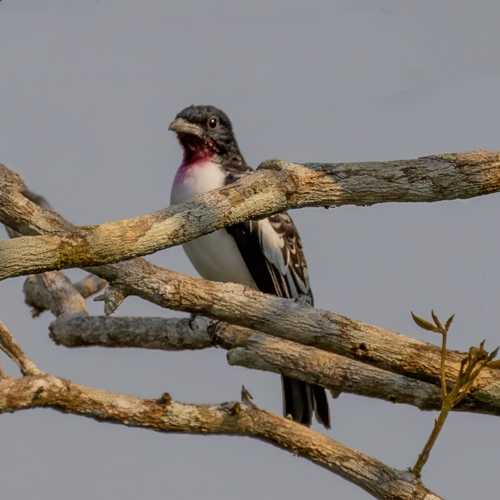
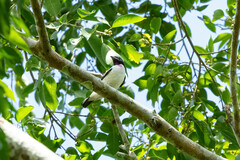
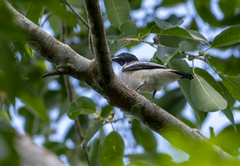
The purple-throated cotinga (Porphyrolaema porphyrolaema) is a species of bird in the cotinga family, Cotingidae. It is found in the western Amazon rainforest of South America; its range extends from southern Colombia south through eastern Ecuador and Peru and east through extreme northwestern Bolivia and into western Amazonian Brazil. It lives in the canopy or along the borders of humid forest throughout its range. The purple-throated cotinga is monotypic within the genus Porphyrolaema and has no known subspecies. It is one of the smaller cotinga species and expresses strong sexual dimorphism. Males have black upperparts with a bold white wingstripe and white edges to the tertial feathers and a white belly with some black barring on the rear flanks. The throat is a deep purple, giving the bird both its common and scientific names. Females are dark brown with pale buffy margins on the upperparts, buffy cinnamon with black barring on the underparts, and rufous on the throat. The male has a powerful voice.

Little research has been done on this species, and not much is known about its ecology. The purple-throated cotinga is primarily frugivorous, although it does occasionally eat small insects. A solitary male attracts a female by perching in the canopy and letting the sunlight reflect off its iridescent feathers. It is suspected to breed year-round and is non-migratory. Despite being considered naturally uncommon or rare across its vast range, the purple-throated cotinga is listed as a species of Least Concern. Wikipedia →

Sounds

Song0:06

Ecuador · 2025

© Marc Anderson · XC981679 · CC BY-NC-ND 4.0

Call0:40

Peru · 2010

© Peter Boesman · XC270921 · CC BY-NC-ND 4.0

Song0:14

Ecuador · 1993

© John V. Moore · XC259075 · CC BY-NC-SA 4.0

Global Distribution

Parks Where Found

# Park Country Daily sighting probability
1 Yasuní National Park 🇪🇨 Ecuador
<5%
2 Amacayacu National Natural Park 🇨🇴 Colombia
<5%
3 Tambopata National Reserve 🇵🇪 Peru
<5%
4 Manu National Park 🇵🇪 Peru
<5%

Before you go

What are the chances of seeing a Purple-throated Cotinga in Manu National Park?

Rare

Under 5% of wildlife watchers report a Purple-throated Cotinga sighting in Manu National Park on a given day, based on 9 verified sightings from GBIF citizen-science data from 2019 to 2026. It is the 595th most-seen of the 641 birds we can rate there. Over three days the chance rises to under 5%, if each day is a fresh chance.

When is the best time to see a Purple-throated Cotinga in Manu National Park?

Any time of year

In every month with enough records, under 5% of wildlife watchers report a Purple-throated Cotinga in Manu National Park on a given day, so our monthly data shows no clear season.

What time of day is best to see a Purple-throated Cotinga?

Between 9 am and noon

Across all the parks we cover, that three-hour window holds the most Purple-throated Cotinga sightings with a recorded time, and about 8 in 10 of them come between 6 am and 6 pm: it is a daytime animal.

Is Manu National Park the best place to see a Purple-throated Cotinga?

Among the best

Of the 4 parks where we can rate Purple-throated Cotinga sightings, Manu National Park ranks 4th at under 5%, level with the leaders once rounded. The best odds are in Yasuní National Park (Ecuador, under 5%), Amacayacu National Natural Park (Colombia, under 5%) and Tambopata National Reserve (Peru, under 5%).

Which relatives of the Purple-throated Cotinga live in Manu National Park?

Same family: Cotingidae

The closest relatives of the Purple-throated Cotinga that you can see in Manu National Park (family Cotingidae, Cotingas) are White-winged Becard (about 10%), Screaming Piha (about 10%) and Bare-necked Fruitcrow (about 10%), with each one's daily chance of a sighting.

Where does the Purple-throated Cotinga sighting chance come from?

GBIF citizen-science records

It is estimated from how often the Purple-throated Cotinga is recorded against all the birds logged in Manu National Park (9 verified sightings from 2019 to 2026), calibrated against known sighting rates. Figures are rounded to the nearest 10% because citizen-science data supports honest approximations, not decimals, and months with records from fewer than five people show "—". How it works.

← Back to Manu National Park