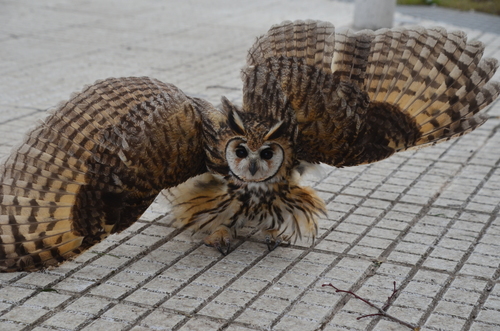
Tawny-bellied Screech-Owl

Tawny-bellied Screech-Owl

Megascops watsonii

Silhouette: Jason Dilworth · PhyloPic

LCLeast ConcernNTVUENCR
Daily sighting probability ~20% · Possible
at Manu National Park

In 3 days ~40% in a week ~70%

660 Verified sightings at Manu National Park From 2019 to 2026
1,734 In all 8 parks
September Best month
🌙 Nocturnal When it's spotted

About the Tawny-bellied Screech-Owl

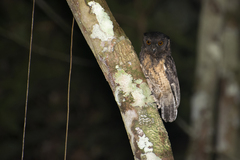
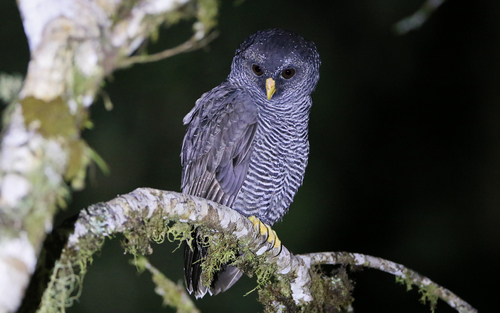
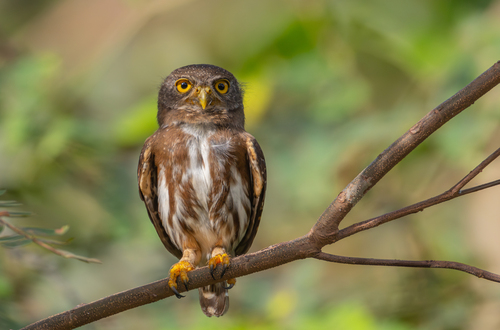
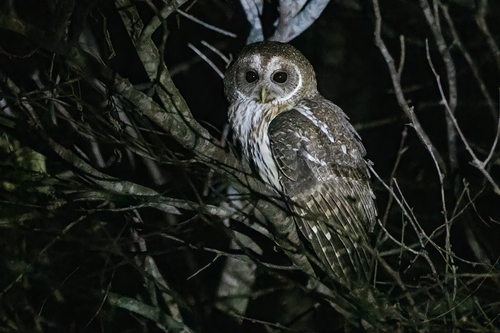
The tawny-bellied screech owl (Megascops watsonii) is a species of owl in the family Strigidae. It is found in Bolivia, Brazil, Colombia, Ecuador, French Guiana, Guyana, Peru, Suriname, and Venezuela. The tawny-bellied screech owl was described by the American ornithologist John Cassin in 1849 and given the binomial name Ephialtes watsonii. It was later placed in genus Otus and later still the New World members of that genus were transferred to Megascops.

The tawny-bellied screech owl is part of a complex of species that includes the Santa Marta screech owl (M. gilesi), West Peruvian screech owl (M. roboratus), black-capped screech owl (M. atricapilla), and perhaps other undescribed species. The latter has been suggested as a species in its own right.

The tawny-bellied screech owl is 19 to 24 cm (7.5 to 9.4 in) long. The nominate subspecies weighs 114 to 155 g (4.0 to 5.5 oz) and M. w. usta 115 to 141 g (4.1 to 5.0 oz). The nominate has a dark buff facial disc with a thin darker border, dark buff brows over dark yellow eyes, and longish broad "ear" tufts. The crown... Wikipedia →

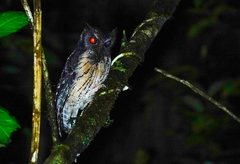
Sounds

Song0:21

Brazil · 2026

© JAYRSON ARAUJO DE OLIVEIRA · XC1186104 · CC BY-NC-SA 4.0

Call0:15

Ecuador · 2025

© Marc Anderson · XC982955 · CC BY-NC-ND 4.0

Shortsong (atypical)0:13

Ecuador · 1999

© Paul Coopmans · XC264435 · CC BY-NC-SA 4.0

Global Distribution

Parks Where Found

# Park Country Daily sighting probability
1 Manu National Park 🇵🇪 Peru
~20%
2 Tambopata National Reserve 🇵🇪 Peru
~10%
3 Amacayacu National Natural Park 🇨🇴 Colombia
~10%
4 Yasuní National Park 🇪🇨 Ecuador
~10%
5 Cuyabeno Wildlife Reserve 🇪🇨 Ecuador
~10%
6 Amboró National Park 🇧🇴 Bolivia
~10%
7 Anavilhanas National Park 🇧🇷 Brazil
<5%
8 Brownsberg Nature Park 🇸🇷 Suriname
<5%

Zoos & Centres Where Found

# Zoo / Centre Country
1 Mangal das Garças 🇧🇷 Brazil In captivity

Before you go

What are the chances of seeing a Tawny-bellied Screech-Owl in Manu National Park?

Possible

About 20% of wildlife watchers report a Tawny-bellied Screech-Owl sighting in Manu National Park on a given day, based on 660 verified sightings from GBIF citizen-science data from 2019 to 2026. It is the 93rd most-seen of the 641 birds we can rate there. Over three days the chance rises to about 40%, and over a week to about 70%, if each day is a fresh chance.

When is the best time to see a Tawny-bellied Screech-Owl in Manu National Park?

September

In that month about 30% of wildlife watchers report a Tawny-bellied Screech-Owl in Manu National Park on a given day, against about 10% in February, April, June and October, the lowest months. That is one of Manu National Park's driest months, with about 90 mm of rain against 290 mm in February.

What time of day is best to see a Tawny-bellied Screech-Owl?

Between 10 pm and 1 am

Across all the parks we cover, that three-hour window holds the most Tawny-bellied Screech-Owl sightings with a recorded time, and about 8 in 10 of them come between 6 pm and 6 am: it is mostly seen at night.

Is Manu National Park the best place to see a Tawny-bellied Screech-Owl?

Yes

Of the 8 parks where we can rate Tawny-bellied Screech-Owl sightings, Manu National Park has the highest daily chance: about 20%. Next come Tambopata National Reserve (Peru, about 10%) and Amacayacu National Natural Park (Colombia, about 10%).

Where does the Tawny-bellied Screech-Owl sighting chance come from?

GBIF citizen-science records

It is estimated from how often the Tawny-bellied Screech-Owl is recorded against all the birds logged in Manu National Park (660 verified sightings from 2019 to 2026), calibrated against known sighting rates. Figures are rounded to the nearest 10% because citizen-science data supports honest approximations, not decimals, and months with records from fewer than five people show "—". How it works.

← Back to Manu National Park