Spot-fronted Swift

Spot-fronted Swift

Cypseloides cherriei

Silhouette: vectorized by Rob Sparks · PhyloPic

LCLeast ConcernNTVUENCR
Daily sighting probability <5% · Rare
at Manuel Antonio National Park

In 3 days <5% in a week ~10%

16 Verified sightings at Manuel Antonio National Park From 2019 to 2026
203 In all 8 parks
September Best month
☀️ Diurnal When it's spotted

About the Spot-fronted Swift

The spot-fronted swift (Cypseloides cherriei) is a species of bird in subfamily Cypseloidinae of the swift family Apodidae. It is found in Colombia, Costa Rica, Ecuador, Panama, Peru, and Venezuela. The spot-fronted swift is monotypic.

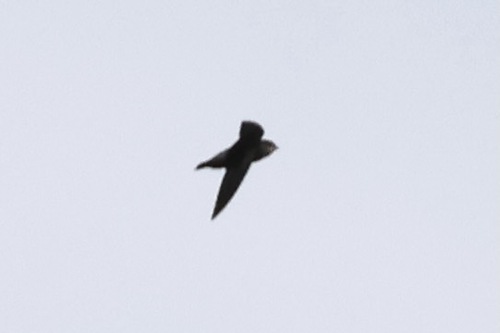
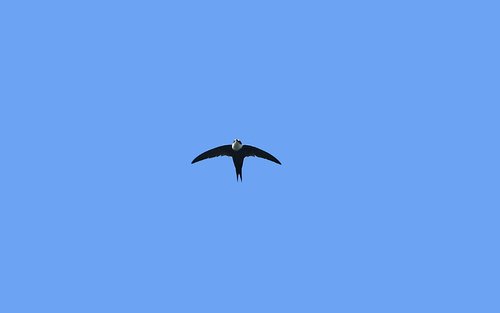
The spot-fronted swift is about 14 cm (5.5 in) long and weighs about 23 g (0.81 oz). The sexes are alike. They are almost entirely blackish brown with grayish underwings and a white chin. They get their English name from bright white spots on either side of the bill and behind the eyes.

The spot-fronted swift has a scattered distribution. In Costa Rica it is mostly found on the Pacific slope of the Cordillera Central and Cordillera de Talamanca. It is known in Panama from only a few locations and in Colombia and Ecuador from a larger number, though still widely separated. It is almost unknown in far western Venezuela and extreme northern Peru. It mostly inhabits montane forest at elevations between 1,100 and 2,200 m (3,600 and 7,200 ft) but has been documented at 300 m (980 ft) in Ecuador.

It is not known whether the spot-fronted swift is resident... Wikipedia →

Sounds

Flight call1:03

Ecuador · 2020

© Nunes-de-Almeida · XC544528 · CC BY-NC-SA 4.0

Call0:27

Colombia · 2016

© Michele Viganò · XC335060 · CC BY-NC-SA 4.0

Flight call0:20

Ecuador · 1995

© Mitch Lysinger · XC260449 · CC BY-NC-SA 4.0

Global Distribution

Parks Where Found

# Park Country Daily sighting probability
1 Bastimentos Island National Marine Park 🇵🇦 Panama
<5%
2 Manuel Antonio National Park 🇨🇷 Costa Rica
<5%
3 La Amistad International Park (Panama) 🇵🇦 Panama
<5%
4 Chirripó National Park 🇨🇷 Costa Rica
<5%
5 Yasuní National Park 🇪🇨 Ecuador
<5%
6 Corcovado National Park 🇨🇷 Costa Rica
<5%
7 Carara National Park 🇨🇷 Costa Rica
<5%
8 Arenal Volcano National Park 🇨🇷 Costa Rica
<5%

Cities Where Found

# City Country Daily sighting probability
1 San José 🇨🇷 Costa Rica
<5%

Before you go

What are the chances of seeing a Spot-fronted Swift in Manuel Antonio National Park?

Rare

Under 5% of wildlife watchers report a Spot-fronted Swift sighting in Manuel Antonio National Park on a given day, based on 16 verified sightings from GBIF citizen-science data from 2019 to 2026. It is the 235th most-seen of the 325 birds we can rate there. Over three days the chance rises to under 5%, and over a week to about 10%, if each day is a fresh chance.

When is the best time to see a Spot-fronted Swift in Manuel Antonio National Park?

Any time of year

In every month with enough records, under 5% of wildlife watchers report a Spot-fronted Swift in Manuel Antonio National Park on a given day, so our monthly data shows no clear season.

What time of day is best to see a Spot-fronted Swift?

Between 6 and 9 am

Across all the parks we cover, that three-hour window holds the most Spot-fronted Swift sightings with a recorded time, and about 8 in 10 of them come between 6 am and 6 pm: it is a daytime animal.

Is Manuel Antonio National Park the best place to see a Spot-fronted Swift?

Among the best

Of the 8 parks where we can rate Spot-fronted Swift sightings, Manuel Antonio National Park ranks 2nd at under 5%, level with the leaders once rounded. The best odds are in Bastimentos Island National Marine Park (Panama, under 5%).

Where does the Spot-fronted Swift sighting chance come from?

GBIF citizen-science records

It is estimated from how often the Spot-fronted Swift is recorded against all the birds logged in Manuel Antonio National Park (16 verified sightings from 2019 to 2026), calibrated against known sighting rates. Figures are rounded to the nearest 10% because citizen-science data supports honest approximations, not decimals, and months with records from fewer than five people show "—". How it works.

← Back to Manuel Antonio National Park