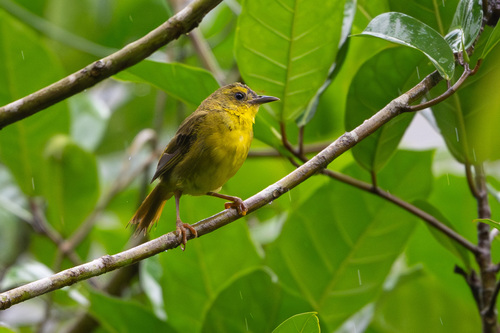
Olive-crowned Yellowthroat

Olive-crowned Yellowthroat

Geothlypis semiflava

Silhouette: Andy Wilson · PhyloPic

LCLeast ConcernNTVUENCR
Daily sighting probability ~10% · With luck
at Gandoca-Manzanillo Wildlife Refuge

In 3 days ~20% in a week ~40%

97 Verified sightings at Gandoca-Manzanillo Wildlife Refuge From 2019 to 2026
2,642 In all 13 parks
June Best month
☀️ Diurnal When it's spotted

About the Olive-crowned Yellowthroat

The olive-crowned yellowthroat (Geothlypis semiflava) is a species of bird in the family Parulidae, the New World warblers. It is found in Colombia, Costa Rica, Ecuador, Honduras, Nicaragua, and Panama. The olive-crowned yellowthroat was formally described in 1860 with its current binomial Geothlypis semiflava.

The species' further taxonomy is unsettled. Most taxonomic systems assign it these three subspecies: The IOC treats G. s. chiriquensis as a separate species, the Chiriqui yellowthroat. This article follows the majority three-subspecies model; there is also a separate article for the "Chiriqui yellowthroat".

The olive-crowned yellowthroat is 11.1 to 13.5 cm (4.4 to 5.3 in) long and... Wikipedia →

Sounds

Song1:18

Ecuador · 2022

© Niels Krabbe · XC712642 · CC BY-NC-SA 4.0

Call0:15

Colombia · 2021

© Sergio Adrian Garcia-Murcia · XC691840 · CC BY-NC-SA 4.0

Alarm call0:10

Ecuador · 1996

© Patricio Mena Valenzuela · XC275579 · CC BY-NC-SA 4.0

Global Distribution

Parks Where Found

# Park Country Daily sighting probability
1 Tenorio Volcano National Park 🇨🇷 Costa Rica
~10%
2 Tortuguero National Park 🇨🇷 Costa Rica
~10%
3 Bastimentos Island National Marine Park 🇵🇦 Panama
~10%
4 La Amistad International Park (Panama) 🇵🇦 Panama
~10%
5 Gandoca-Manzanillo Wildlife Refuge 🇨🇷 Costa Rica
~10%
6 Farallones de Cali National Natural Park 🇨🇴 Colombia
<5%
7 Braulio Carrillo National Park 🇨🇷 Costa Rica
<5%
8 Cahuita National Park 🇨🇷 Costa Rica
<5%
9 Arenal Volcano National Park 🇨🇷 Costa Rica
<5%
10 Rincón de la Vieja National Park 🇨🇷 Costa Rica
<5%
11 Poás Volcano National Park 🇨🇷 Costa Rica
<5%
12 Tapantí-Macizo de la Muerte National Park 🇨🇷 Costa Rica
<5%
13 Monteverde Cloud Forest Reserve 🇨🇷 Costa Rica
<5%

Before you go

What are the chances of seeing an Olive-crowned Yellowthroat in Gandoca-Manzanillo Wildlife Refuge?

With luck

About 10% of wildlife watchers report an Olive-crowned Yellowthroat sighting in Gandoca-Manzanillo Wildlife Refuge on a given day, based on 97 verified sightings from GBIF citizen-science data from 2019 to 2026. It is the 145th most-seen of the 329 birds we can rate there. Over three days the chance rises to about 20%, and over a week to about 40%, if each day is a fresh chance.

When is the best time to see an Olive-crowned Yellowthroat in Gandoca-Manzanillo Wildlife Refuge?

June

In that month about 20% of wildlife watchers report an Olive-crowned Yellowthroat in Gandoca-Manzanillo Wildlife Refuge on a given day, against under 5% in February–March, August and December, the lowest months.

What time of day is best to see an Olive-crowned Yellowthroat?

Between 6 and 9 am

Across all the parks we cover, that three-hour window holds the most Olive-crowned Yellowthroat sightings with a recorded time, and about 9 in 10 of them come between 6 am and 6 pm: it is a daytime animal.

Is Gandoca-Manzanillo Wildlife Refuge the best place to see an Olive-crowned Yellowthroat?

Among the best

Of the 13 parks where we can rate Olive-crowned Yellowthroat sightings, Gandoca-Manzanillo Wildlife Refuge ranks 5th at about 10%, level with the leaders once rounded. The best odds are in Tenorio Volcano National Park (Costa Rica, about 10%), Tortuguero National Park (Costa Rica, about 10%) and Bastimentos Island National Marine Park (Panama, about 10%).

Where does the Olive-crowned Yellowthroat sighting chance come from?

GBIF citizen-science records

It is estimated from how often the Olive-crowned Yellowthroat is recorded against all the birds logged in Gandoca-Manzanillo Wildlife Refuge (97 verified sightings from 2019 to 2026), calibrated against known sighting rates. Figures are rounded to the nearest 10% because citizen-science data supports honest approximations, not decimals, and months with records from fewer than five people show "—". How it works.
← Back to Gandoca-Manzanillo Wildlife Refuge