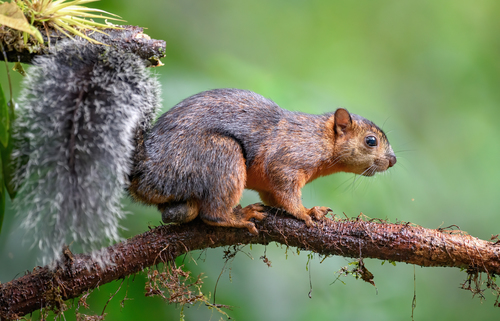
Derby's Woolly Opossum

Derby's Woolly Opossum

Caluromys derbianus

Silhouette: Milena Cavalcanti, Patricia Pilatti & Diego Astúa · PhyloPic

LCLeast ConcernNTVUENCR
Daily sighting probability ~20% · Possible
at Masaya Volcano National Park

In 3 days ~50% in a week ~80%

7 Verified sightings at Masaya Volcano National Park From 2019 to 2026
165 In all 10 parks
March Best month
☀️🌙 Day & Night When it's spotted

About the Derby's Woolly Opossum

Derby's woolly opossum (Caluromys derbianus), or the Central American woolly opossum, is an opossum found in deciduous and moist evergreen forests of Central America, from southern Mexico to western Ecuador and Colombia. It was first described by English naturalist George Robert Waterhouse, and named in honor of Edward Smith-Stanley, 13th Earl of Derby. Derby's woolly opossum is the largest in its genus, with a total length of 60 to 70 centimetres (24 to 28 in) and weight between 200 and 400 grams (7.1 and 14.1 oz). The coat is brown and the underside white-buff to golden-brown. The opossum is nocturnal (active mainly at night), arboreal (tree-living) and solitary. Diet consists of fruits, nectar, small invertebrates and vertebrates. The time when breeding takes place varies geographically. The litter size ranges from one to six. The IUCN classifies this opossum as least concern.

Derby's woolly opossum is one of the three members of Caluromys, and is placed in the family Didelphidae. It was first described by English naturalist George Robert Waterhouse as Didelphis derbianus in 1841. He was named in honor of Edward Smith-Stanley, 13th Earl of Derby, to whose... Wikipedia →

Sounds

Uncertain0:32

Guatemala · 2023

© Enrique Mejía · XC992852 · CC BY-NC-SA 4.0

Global Distribution

Parks Where Found

# Park Country Daily sighting probability
1 Bastimentos Island National Marine Park 🇵🇦 Panama
~30%
2 Masaya Volcano National Park 🇳🇮 Nicaragua
~20%
3 Braulio Carrillo National Park 🇨🇷 Costa Rica
~20%
4 Soberanía National Park 🇵🇦 Panama
~20%
5 Tortuguero National Park 🇨🇷 Costa Rica
~10%
6 Tenorio Volcano National Park 🇨🇷 Costa Rica
~10%
7 La Amistad International Park (Panama) 🇵🇦 Panama
~10%
8 Los Nevados National Natural Park 🇨🇴 Colombia
~10%
9 Corcovado National Park 🇨🇷 Costa Rica
~10%
10 Monteverde Cloud Forest Reserve 🇨🇷 Costa Rica
~10%

Before you go

What are the chances of seeing a Derby's Woolly Opossum in Masaya Volcano National Park?

Possible

About 20% of wildlife watchers report a Derby's Woolly Opossum sighting in Masaya Volcano National Park on a given day, based on 7 verified sightings from GBIF citizen-science data from 2019 to 2026. Over three days the chance rises to about 50%, and over a week to about 80%, if each day is a fresh chance.

When is the best time to see a Derby's Woolly Opossum in Masaya Volcano National Park?

March

In that month about 40% of wildlife watchers report a Derby's Woolly Opossum in Masaya Volcano National Park on a given day, against under 5% in April and August–January, the lowest months. That is one of Masaya Volcano National Park's driest months, with about 20 mm of rain against 390 mm in October.

What time of day is best to see a Derby's Woolly Opossum?

Between 7 and 10 pm

Across all the parks we cover, that three-hour window holds the most Derby's Woolly Opossum sightings with a recorded time, and about 6 in 10 of them come between 6 pm and 6 am: it is seen both by day and at night.

Is Masaya Volcano National Park the best place to see a Derby's Woolly Opossum?

2nd of 10

Of the 10 parks where we can rate Derby's Woolly Opossum sightings, Masaya Volcano National Park ranks 2nd at about 20%. The best odds are in Bastimentos Island National Marine Park (Panama, about 30%).

Where does the Derby's Woolly Opossum sighting chance come from?

GBIF citizen-science records

It is estimated from how often the Derby's Woolly Opossum is recorded against all the mammals logged in Masaya Volcano National Park (7 verified sightings from 2019 to 2026), calibrated against known sighting rates. Figures are rounded to the nearest 10% because citizen-science data supports honest approximations, not decimals, and months with records from fewer than five people show "—". How it works.

← Back to Masaya Volcano National Park