Semiplumbeous Hawk

Semiplumbeous Hawk

Leucopternis semiplumbeus

Silhouette: Sheatherius · PhyloPic

LCLeast ConcernNTVUENCR
Daily sighting probability <5% · Rare
at Parque Natural Metropolitano

In 3 days <5%

7 Verified sightings at Parque Natural Metropolitano From 2019 to 2026
1,353 In all 12 parks
January Best month
☀️ Diurnal When it's spotted

About the Semiplumbeous Hawk

The semiplumbeous hawk (Leucopternis semiplumbeus) is a species of bird of prey in the family Accipitridae. It is found in Colombia, Costa Rica, Ecuador, Honduras, and Panama. Its natural habitat is subtropical or tropical moist lowland forests.

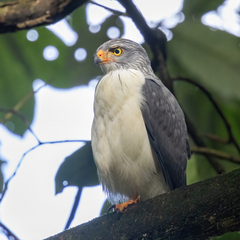
The semiplumbeous hawk is a small bird, averaging about 12–13 inches (30–33 cm) in length (approximately the size of a kestrel or merlin). It is dark gray above with white underparts and a white throat. The semiplumbeous hawk is easily identifiable due to its striking orange cere and black face mask. It has bright yellow eyes and its legs and feet are orange to orange-red in color.

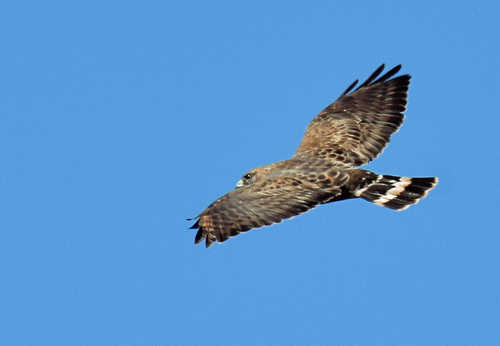
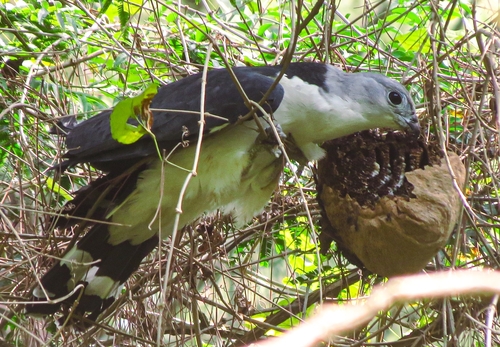
Semiplumbeous hawks are rarely seen in flight. Instead, these hawks typically perch silently on a high branch, waiting for prey. This sit-and-wait strategy of feeding is similar to the feeding behavior of other Leucopternis species. The semiplumbeous hawk often follows swarms of army ants in order to capture antbirds, which, along with other small songbirds, make up a large portion of its diet. It might also feed on bats, lizards and snakes.

During the breeding season, this species is known to be quite vocal and... Wikipedia →

Sounds

Call0:39

Costa Rica · 2019

© Hans Matheve · XC518485 · CC BY-NC-ND 4.0

Song0:34

Costa Rica · 2018

© Patrick ODonnell · XC400568 · CC BY-NC-SA 4.0

Call1:30

Costa Rica · 2019

© Guy Kirwan · XC498113 · CC BY-NC-SA 4.0

Global Distribution

Parks Where Found

# Park Country Daily sighting probability
1 Darién National Park 🇵🇦 Panama
<5%
2 Tortuguero National Park 🇨🇷 Costa Rica
<5%
3 San Lorenzo Protected Forest 🇵🇦 Panama
<5%
4 Soberanía National Park 🇵🇦 Panama
<5%
5 Braulio Carrillo National Park 🇨🇷 Costa Rica
<5%
6 Arenal Volcano National Park 🇨🇷 Costa Rica
<5%
7 Bastimentos Island National Marine Park 🇵🇦 Panama
<5%
8 Cahuita National Park 🇨🇷 Costa Rica
<5%
9 Gandoca-Manzanillo Wildlife Refuge 🇨🇷 Costa Rica
<5%
10 La Amistad International Park (Panama) 🇵🇦 Panama
<5%
11 Tenorio Volcano National Park 🇨🇷 Costa Rica
<5%
12 Parque Natural Metropolitano 🇵🇦 Panama
<5%

Before you go

What are the chances of seeing a Semiplumbeous Hawk in Parque Natural Metropolitano?

Rare

Under 5% of wildlife watchers report a Semiplumbeous Hawk sighting in Parque Natural Metropolitano on a given day, based on 7 verified sightings from GBIF citizen-science data from 2019 to 2026. It is the 313th most-seen of the 328 birds we can rate there. Over three days the chance rises to under 5%, if each day is a fresh chance.

When is the best time to see a Semiplumbeous Hawk in Parque Natural Metropolitano?

Any time of year

In every month with enough records, under 5% of wildlife watchers report a Semiplumbeous Hawk in Parque Natural Metropolitano on a given day, so our monthly data shows no clear season.

What time of day is best to see a Semiplumbeous Hawk?

Between 8 and 11 am

Across all the parks we cover, that three-hour window holds the most Semiplumbeous Hawk sightings with a recorded time, and about 9 in 10 of them come between 6 am and 6 pm: it is a daytime animal.

Is Parque Natural Metropolitano the best place to see a Semiplumbeous Hawk?

Among the best

Of the 12 parks where we can rate Semiplumbeous Hawk sightings, Parque Natural Metropolitano ranks 12th at under 5%, level with the leaders once rounded. The best odds are in Darién National Park (Panama, under 5%), Tortuguero National Park (Costa Rica, under 5%) and San Lorenzo Protected Forest (Panama, under 5%).

Which relatives of the Semiplumbeous Hawk live in Parque Natural Metropolitano?

Same family: Accipitridae

The closest relatives of the Semiplumbeous Hawk that you can see in Parque Natural Metropolitano (family Accipitridae, Hawks, Eagles, and Kites) are Short-tailed Hawk (about 10%) and Broad-winged Hawk (about 10%), with each one's daily chance of a sighting.

Where does the Semiplumbeous Hawk sighting chance come from?

GBIF citizen-science records

It is estimated from how often the Semiplumbeous Hawk is recorded against all the birds logged in Parque Natural Metropolitano (7 verified sightings from 2019 to 2026), calibrated against known sighting rates. Figures are rounded to the nearest 10% because citizen-science data supports honest approximations, not decimals, and months with records from fewer than five people show "—". How it works.

← Back to Parque Natural Metropolitano