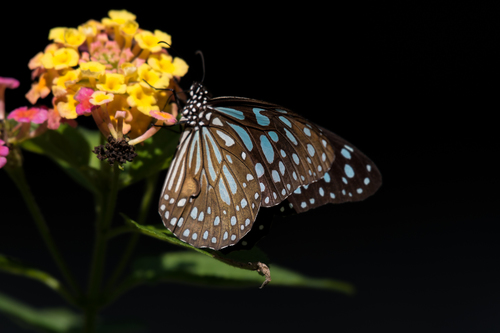
Blue Tiger
Daily sighting probability ~30% · Possible
at Minneriya National Park

In 3 days ~60% in a week ~90%

20 Verified sightings at Minneriya National Park From 2019 to 2026
90 In all 9 parks
June Best month
☀️ Diurnal When it's spotted

About the Blue Tiger

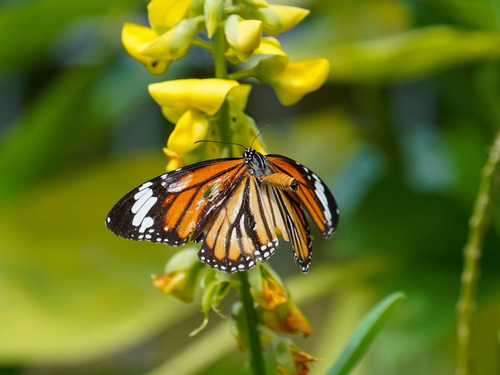
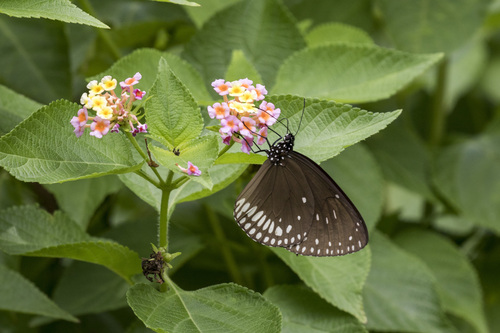
Tirumala limniace, the blue tiger, is a species of butterfly found in South Asia, and Southeast Asia that belongs to the brush-footed butterfly family, Nymphalidae. More specifically it is part of the crows and tigers or danaid group. This butterfly shows gregarious migratory behaviour in southern India. In some places, it may be found in congregations with Danaus genutia, Tirumala septentrionis, Euploea sylvester, Euploea core, Parantica aglea, and at high elevations, with Parantica nilgiriensis, on Crotalaria.

Tirumala limniace is a small butterfly with wide wings. It has a wingspan of 90 to 100 millimeters, with the males being smaller than the females. The upper side of the wing is dark brown to black and patterned with bluish-white, semi-transparent spots and lines. The blue of the bluish-white spots consists of the pigment pterobilin. In general, all butterflies can directly absorb heat from the sun via their wings to facilitate autonomous flight. Studies on blue tiger butterflies show that high-intensity light significantly increased flight activity. Blue tiger butterflies have a wing surface color that is composed of both light and dark colors. The dark areas... Wikipedia →
Global Distribution

Parks Where Found

# Park Country Daily sighting probability
1 Sundarbans National Park 🇮🇳 India
~40%
2 Udawalawe National Park 🇱🇰 Sri Lanka
~30%
3 Kaziranga National Park 🇮🇳 India
~30%
4 Wilpattu National Park 🇱🇰 Sri Lanka
~30%
5 Minneriya National Park 🇱🇰 Sri Lanka
~30%
6 Cuc Phuong National Park 🇻🇳 Vietnam
~20%
7 Keoladeo National Park 🇮🇳 India
~20%
8 Kanha National Park 🇮🇳 India
~20%
9 Taroko National Park 🇹🇼 Taiwan
~10%

Cities Where Found

# City Country Daily sighting probability
1 Kalyan-Dombivli 🇮🇳 India
~40%
2 Mumbai 🇮🇳 India
~30%
3 Surat 🇮🇳 India
~30%
4 Nashik 🇮🇳 India
~30%
5 Thrissur 🇮🇳 India
~30%
6 Kolkata 🇮🇳 India
~30%
7 Chennai 🇮🇳 India
~30%
8 Vasai-Virar 🇮🇳 India
~30%
9 Pune 🇮🇳 India
~30%
10 Salem 🇮🇳 India
~30%

Before you go

What are the chances of seeing a Blue Tiger in Minneriya National Park?

Possible

About 30% of wildlife watchers report a Blue Tiger sighting in Minneriya National Park on a given day, based on 20 verified sightings from GBIF citizen-science data from 2019 to 2026. It is the 6th most-seen of the 44 insects we can rate there. Over three days the chance rises to about 60%, and over a week to about 90%, if each day is a fresh chance.

When is the best time to see a Blue Tiger in Minneriya National Park?

January–February and June

In those months about 40% of wildlife watchers report a Blue Tiger in Minneriya National Park on a given day, against under 5% in September–October and December, the lowest months. Those are among Minneriya National Park's driest months, with about 75 mm of rain a month against 340 mm in November.

What time of day is best to see a Blue Tiger?

Between 10 am and 1 pm

Across all the parks we cover, that three-hour window holds the most Blue Tiger sightings with a recorded time, and about 9 in 10 of them come between 6 am and 6 pm: it is a daytime animal.

Which relatives of the Blue Tiger live in Minneriya National Park?

Same family: Nymphalidae

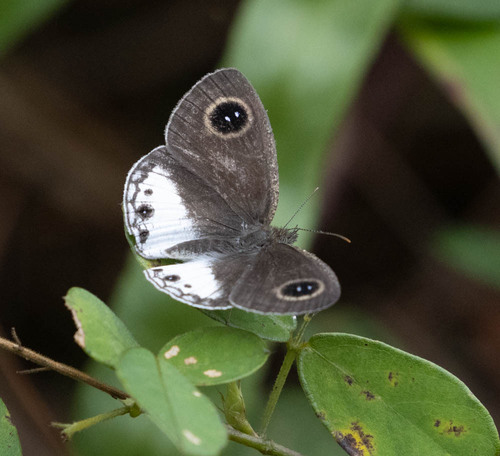
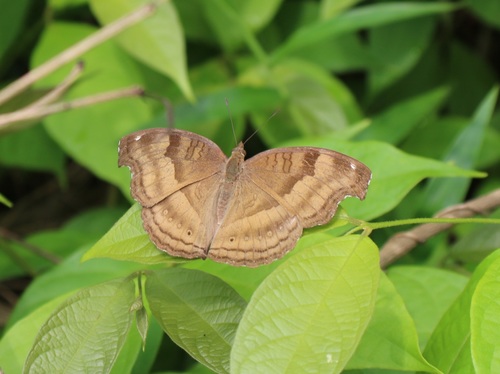
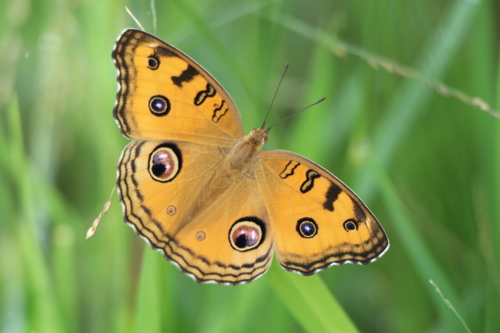
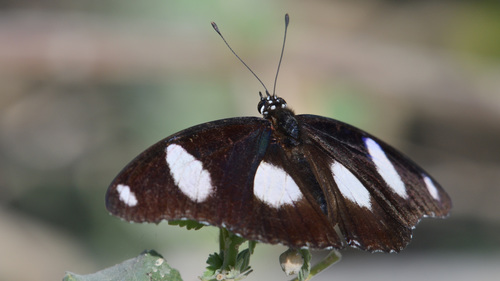
The closest relatives of the Blue Tiger that you can see in Minneriya National Park (family Nymphalidae, Brush-footed Butterflies) are Common Crow (about 30%), White Four Ring (about 30%) and Chocolate Pansy (about 20%), with each one's daily chance of a sighting.

Where does the Blue Tiger sighting chance come from?

GBIF citizen-science records

It is estimated from how often the Blue Tiger is recorded against all the insects logged in Minneriya National Park (20 verified sightings from 2019 to 2026), calibrated against known sighting rates. Figures are rounded to the nearest 10% because citizen-science data supports honest approximations, not decimals, and months with records from fewer than five people show "—". How it works.

← Back to Minneriya National Park