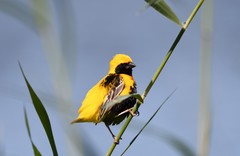
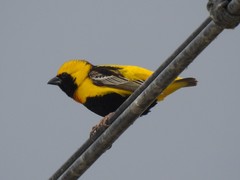
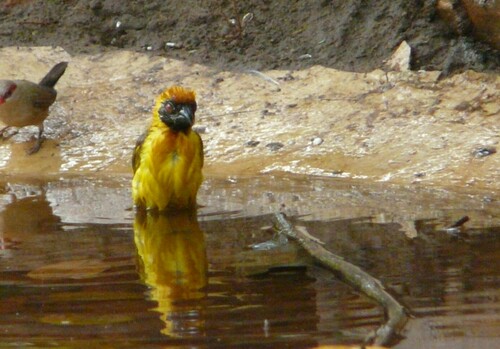
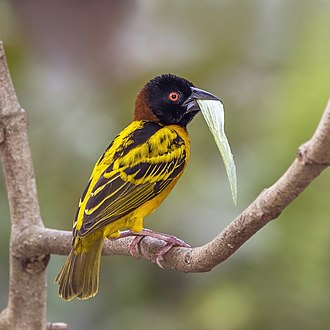
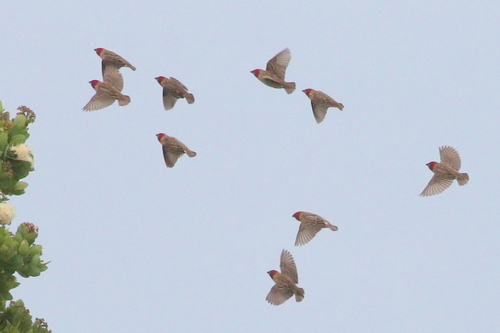
The yellow-crowned bishop (Euplectes afer) is a species of passerine bird in the family Ploceidae native to Africa south of the Sahara. It is highly sexually dimorphic in its breeding season, during which the male adopts a distinctive yellow and black plumage, contrasting with the female's predominantly brown coloration. Four subspecies are recognised.
The yellow-crowned bishop was formally described in 1789 by the German naturalist Johann Friedrich Gmelin in his revised and expanded edition of Carl Linnaeus's Systema Naturae. He placed it with the crossbills in the genus Loxia and coined the binomial name Loxia afra. The specific epithet is from Latin afer meaning "Africa". Gmelin based his account on the "Black-bellied grossbeak" that had been described and illustrated in 1776 by the English naturalist Peter Brown. Gmelin specified the location as Africa but this was restricted to Senegal by Claude Grant and Cyril Mackworth-Praed in 1944. The yellow-crowned bishop is now one of 18 species placed in the genus Euplectes that was introduced in 1829 by the English naturalist William Swainson.
A molecular genetic study published in 2019 found that within the genus Euplectes...