Groundscraper Thrush

Groundscraper Thrush

Psophocichla litsitsirupa

Silhouette: Sheatherius · PhyloPic

LCLeast ConcernNTVUENCR
Daily sighting probability <5% · Rare
at Moremi Game Reserve

In 3 days ~10% in a week ~20%

48 Verified sightings at Moremi Game Reserve From 2019 to 2026
1,297 In all 9 parks
October Best month
☀️ Diurnal When it's spotted

About the Groundscraper Thrush

The groundscraper thrush (Turdus litsitsirupa) is a passerine bird of southern and eastern Africa belonging to the thrush family, Turdidae. It was previously considered the only member of the genus Psophocichla, but phylogenetic analysis supports it belonging in the genus Turdus, where it forms a sister group to the remaining Turdus species.

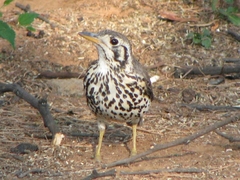
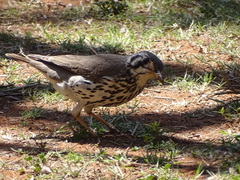
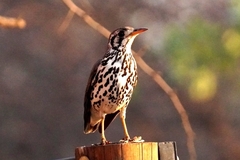
It is 22–24 centimetres (8.7–9.4 in) long with an erect posture, short tail, heavy bill and fairly long legs. The upperparts are plain grey-brown with a chestnut wing-panel. The underparts are white with black spots and the face is white with bold black markings. The underwing has a black and white pattern which is visible during the undulating flight. The bird has a slow whistled song and a clicking call.

It can be tame and will forage in parks, gardens and around picnic sites. The Ethiopian thrush (Turdus simensis) was formerly treated as a fourth subspecies, but is genetically as well as geographically distinct. The cup-shaped nest is built using vegetation and spider-webs and is lined with feathers or leaves. Three or four eggs are laid and are incubated for 14 to 15 days. They are bluish with lilac and red-brown spots and blotches. Wikipedia →

Sounds

Recording0:11

South Africa · 2022

© Dewald du Plessis · iNaturalist · CC BY-NC 4.0

Recording0:28

South Africa · 2017

© Marion Maclean · iNaturalist · CC BY-NC 4.0

Global Distribution

Parks Where Found

# Park Country Daily sighting probability
1 Bale Mountains National Park 🇪🇹 Ethiopia
~60%
2 Waterberg Plateau Park 🇳🇦 Namibia
~30%
3 Pilanesberg National Park 🇿🇦 South Africa
~30%
4 Kgalagadi Transfrontier Park 🇿🇦 South Africa
~20%
5 Etosha National Park 🇳🇦 Namibia
~20%
6 Kruger National Park 🇿🇦 South Africa
~10%
7 Hwange National Park 🇿🇼 Zimbabwe
<5%
8 Chobe National Park 🇧🇼 Botswana
<5%
9 Moremi Game Reserve 🇧🇼 Botswana
<5%

Cities Where Found

# City Country Daily sighting probability
1 Pretoria 🇿🇦 South Africa
<5%
2 Harare 🇿🇼 Zimbabwe
<5%
3 Johannesburg 🇿🇦 South Africa
<5%

Before you go

What are the chances of seeing a Groundscraper Thrush in Moremi Game Reserve?

Rare

Under 5% of wildlife watchers report a Groundscraper Thrush sighting in Moremi Game Reserve on a given day, based on 48 verified sightings from GBIF citizen-science data from 2019 to 2026. It is the 197th most-seen of the 334 birds we can rate there. Over three days the chance rises to about 10%, and over a week to about 20%, if each day is a fresh chance.

When is the best time to see a Groundscraper Thrush in Moremi Game Reserve?

August and October

In those months about 10% of wildlife watchers report a Groundscraper Thrush in Moremi Game Reserve on a given day, against under 5% in September and November–July, the lowest months. Those are among Moremi Game Reserve's driest months, with almost no rain against 150 mm in January.

What time of day is best to see a Groundscraper Thrush?

Between 7 and 10 am

Across all the parks we cover, that three-hour window holds the most Groundscraper Thrush sightings with a recorded time, and about 9 in 10 of them come between 6 am and 6 pm: it is a daytime animal.

Where does the Groundscraper Thrush sighting chance come from?

GBIF citizen-science records

It is estimated from how often the Groundscraper Thrush is recorded against all the birds logged in Moremi Game Reserve (48 verified sightings from 2019 to 2026), calibrated against known sighting rates. Figures are rounded to the nearest 10% because citizen-science data supports honest approximations, not decimals, and months with records from fewer than five people show "—". How it works.

← Back to Moremi Game Reserve