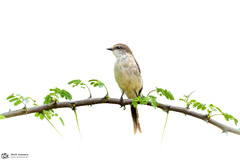
White-bellied Minivet

White-bellied Minivet

Pericrocotus erythropygius

Silhouette: PhyloPic

LCLeast ConcernNTVUENCR Endemic
Daily sighting probability <5% · Rare
at Mudumalai National Park

In 3 days ~10% in a week ~30%

44 Verified sightings at Mudumalai National Park From 2019 to 2026
101 In all 4 parks
February Best month
☀️ Diurnal When it's spotted

About the White-bellied Minivet

The white-bellied minivet (Pericrocotus erythropygius) is a species of minivet found in India, mostly in dry deciduous forest. The origin of the vernacular name of minivets is not known but it seems to be the English adaptation of an Indian name perhaps imitative. The genus Pericrocotus seems to be related to the saffron color of some minivets.

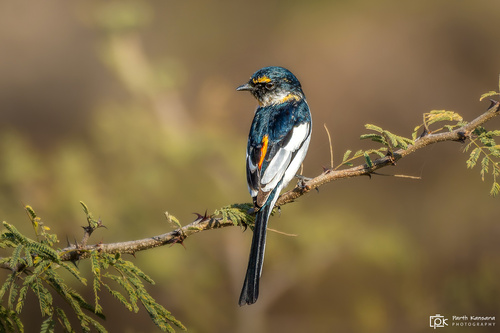
The male white-bellied minivet has a shiny black head, neck, tail and mantle. The species has a white collar, the throat is orange, the rest of the underparts are also white. The rump is orange with white markings on the wings.

The female minivet is duller in appearance, with dark gray upperparts, black wings, white collar, black tail and shiny black lores. The wings have white markings similar to those of the males, and the rump is orange. It measures between 18.5 and 20 cm long.

The white-bellied minivet is native to Nepal and India, mainly in dry deciduous forests. This species inhabits open savanna with sparse acacia shoots, dry grasslands and artificial terrestrial areas such as agricultural land. It occupies an extremely large area of occurrence of over 20,000 km2.

The minivet... Wikipedia →
Sounds

Song and call0:37

India · 2025

© Peter Boesman · XC1030742 · CC BY-NC-ND 4.0

Call0:26

India · 2023

© Barry Edmonston · XC796945 · CC BY-NC-SA 4.0

Call0:25

India · 2014

© Frank Lambert · XC165844 · CC BY-NC-ND 4.0

Global Distribution

Parks Where Found

# Park Country Daily sighting probability
1 Mudumalai National Park 🇮🇳 India
<5%
2 Satpura National Park 🇮🇳 India
<5%
3 Ranthambore National Park 🇮🇳 India
<5%
4 Bandipur National Park 🇮🇳 India
<5%

Cities Where Found

# City Country Daily sighting probability
1 Jaipur 🇮🇳 India
<5%
2 Bhopal 🇮🇳 India
<5%
3 Pune 🇮🇳 India
<5%

Before you go

What are the chances of seeing a White-bellied Minivet in Mudumalai National Park?

Rare

Under 5% of wildlife watchers report a White-bellied Minivet sighting in Mudumalai National Park on a given day, based on 44 verified sightings from GBIF citizen-science data from 2019 to 2026. It is the 163rd most-seen of the 233 birds we can rate there. Over three days the chance rises to about 10%, and over a week to about 30%, if each day is a fresh chance.

When is the best time to see a White-bellied Minivet in Mudumalai National Park?

February, April–May and November

In those months about 10% of wildlife watchers report a White-bellied Minivet in Mudumalai National Park on a given day, against under 5% in March, June–October and December–January, the lowest months.

What time of day is best to see a White-bellied Minivet?

Between 7 and 10 am

Across all the parks we cover, that three-hour window holds the most White-bellied Minivet sightings with a recorded time, and about 8 in 10 of them come between 6 am and 6 pm: it is a daytime animal.

Is Mudumalai National Park the best place to see a White-bellied Minivet?

Yes

Of the 4 parks where we can rate White-bellied Minivet sightings, Mudumalai National Park has the highest daily chance: under 5%. Next come Satpura National Park (India, under 5%) and Ranthambore National Park (India, under 5%).

Which relatives of the White-bellied Minivet live in Mudumalai National Park?

Same genus: Pericrocotus

The closest relatives of the White-bellied Minivet that you can see in Mudumalai National Park (genus Pericrocotus, Minivets) are Small Minivet (about 40%) and Orange Minivet (about 30%), with each one's daily chance of a sighting.

Where does the White-bellied Minivet sighting chance come from?

GBIF citizen-science records

It is estimated from how often the White-bellied Minivet is recorded against all the birds logged in Mudumalai National Park (44 verified sightings from 2019 to 2026), calibrated against known sighting rates. Figures are rounded to the nearest 10% because citizen-science data supports honest approximations, not decimals, and months with records from fewer than five people show "—". How it works.

← Back to Mudumalai National Park