Orange Minivet

Orange Minivet

Pericrocotus flammeus

Silhouette: PhyloPic

LCLeast ConcernNTVUENCR
Daily sighting probability ~30% · Possible
at Mudumalai National Park

In 3 days ~70% in a week ~90%

315 Verified sightings at Mudumalai National Park From 2019 to 2026
5,239 In all 11 parks
August Best month
🌅 Crepuscular When it's spotted

About the Orange Minivet

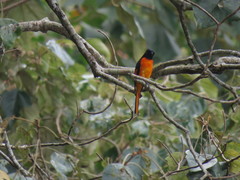
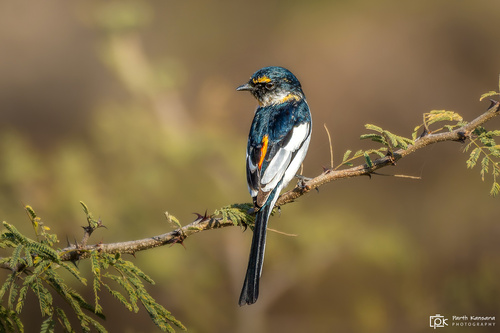
The orange minivet (Pericrocotus flammeus) is a brightly colored bird in the cuckooshrike family, Campephagidae. It is found all along the Western Ghats and west coast of India and Sri Lanka. It was formerly considered a subspecies of the scarlet minivet which is considered to have a wider distribution in eastern and northern India and South-east Asia. Its natural habitats are temperate forests, subtropical or tropical moist lowland forest, and subtropical or tropical moist montane forest. The orange minivet is a species resident in southern India and Sri Lanka, that feeds primarily on insects while foraging in mixed-species bird flocks or in small single-species groups.

The genus name comes from Ancient Greek peri - 'very'; krokotus 'saffron-coloured'. The species name flammeus has its roots in Latin, meaning 'fiery' or 'flame-coloured' (flamma - 'flame'). The English name of this species was changed from scarlet minivet to orange minivet after the former was assigned to Pericrocotus speciosus following the split of these two species. This is a complex of species from South and South-east Asia which needs more detailed work.

The orange... Wikipedia →

Sounds

Call0:24

India · 2016

© Frank Lambert · XC473497 · CC BY-NC-ND 4.0

Song0:33

India · 2017

© Peter Boesman · XC369425 · CC BY-NC-ND 4.0

Call0:08

India · 2017

© Mandar Bhagat · XC364099 · CC BY-NC-ND 4.0

Global Distribution

Parks Where Found

# Park Country Daily sighting probability
1 Sinharaja Forest Reserve 🇱🇰 Sri Lanka
~60%
2 Periyar National Park 🇮🇳 India
~60%
3 Horton Plains National Park 🇱🇰 Sri Lanka
~40%
4 Mudumalai National Park 🇮🇳 India
~30%
5 Nagarhole National Park 🇮🇳 India
~30%
6 Eravikulam National Park 🇮🇳 India
~20%
7 Bandipur National Park 🇮🇳 India
~20%
8 Minneriya National Park 🇱🇰 Sri Lanka
~10%
9 Yala National Park 🇱🇰 Sri Lanka
<5%
10 Udawalawe National Park 🇱🇰 Sri Lanka
<5%
11 Wilpattu National Park 🇱🇰 Sri Lanka
<5%

Cities Where Found

# City Country Daily sighting probability
1 Thrissur 🇮🇳 India
~10%
2 Kozhikode 🇮🇳 India
<5%
3 Colombo [Sri Jayawardenepura Kotte] 🇱🇰 Sri Lanka
<5%

Before you go

What are the chances of seeing an Orange Minivet in Mudumalai National Park?

Possible

About 30% of wildlife watchers report an Orange Minivet sighting in Mudumalai National Park on a given day, based on 315 verified sightings from GBIF citizen-science data from 2019 to 2026. It is the 37th most-seen of the 233 birds we can rate there. Over three days the chance rises to about 70%, and over a week to about 90%, if each day is a fresh chance.

When is the best time to see an Orange Minivet in Mudumalai National Park?

January–February, May, August and October

In those months about 40% of wildlife watchers report an Orange Minivet in Mudumalai National Park on a given day, against about 20% in March and November, the lowest months.

What time of day is best to see an Orange Minivet?

Between 3 and 6 am

Across all the parks we cover, that three-hour window holds the most Orange Minivet sightings with a recorded time, and about half of them come between 6 am and 6 pm: it is most active around dawn and dusk.

Where does the Orange Minivet sighting chance come from?

GBIF citizen-science records

It is estimated from how often the Orange Minivet is recorded against all the birds logged in Mudumalai National Park (315 verified sightings from 2019 to 2026), calibrated against known sighting rates. Figures are rounded to the nearest 10% because citizen-science data supports honest approximations, not decimals, and months with records from fewer than five people show "—". How it works.

← Back to Mudumalai National Park