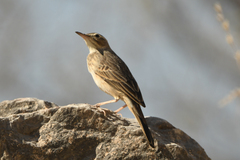
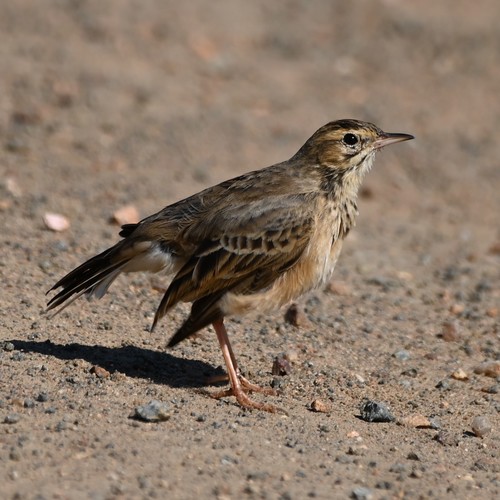
Long-billed Pipit

Long-billed Pipit

Anthus similis

Silhouette: Susan Murphy (original photograph), T. Michael Keesey (vectorization) · PhyloPic

LCLeast ConcernNTVUENCR
Daily sighting probability <5% · Rare
at Nairobi National Park

In 3 days ~10% in a week ~30%

71 Verified sightings at Nairobi National Park From 2019 to 2026
629 In all 14 parks
March Best month
☀️ Diurnal When it's spotted

About the Long-billed Pipit

The long-billed pipit or brown rock pipit (Anthus similis) is a passerine bird which has a wide distribution. A number of subspecies have been created for the populations in Africa, through the Arabian Peninsula and South Asia. The systematics of this complex is yet to be clarified. Most birds are residents or short distance migrants.

This is a complex group with several similar looking birds with very disjunct distributions and the exact patterns of phylogeny are yet to be determined. Several subspecies that were formerly placed within this species have been raised to full species status.

The wood pipit (Anthus nyassae), an inhabitant of miombo woodland in south-central Africa, was formerly treated as a subspecies of this bird but is now usually regarded as a separate species. Some authorities also split Bannerman's pipit (Anthus (similis) bannermani), a bird of mountain grassland in West Africa. The Nicholson's pipit is a recently split non-migratory species from southern Africa.

The nominate race was described by Thomas C. Jerdon in 1840 from peninsular India. This form occurs along the Western Ghats and into the Nilgiris and Palni Hills. A darker race... Wikipedia →

Sounds

Call0:14

Saudi Arabia · 2024

© Mohannad Baghlaf · XC1181713 · CC BY-NC-SA 4.0

Song1:19

Saudi Arabia · 2023

© Abdulrahman Al-Sirhan Alenezi · XC861626 · CC BY-NC-SA 4.0

Song0:08

United Arab Emirates · 2022

© Oscar Campbell · XC715389 · CC BY-NC-ND 4.0

Global Distribution

Parks Where Found

# Park Country Daily sighting probability
1 Arusha National Park 🇹🇿 Tanzania
~10%
2 Masai Mara National Reserve 🇰🇪 Kenya
~10%
3 Kidepo Valley National Park 🇺🇬 Uganda
<5%
4 Nairobi National Park 🇰🇪 Kenya
<5%
5 Ngorongoro Conservation Area 🇹🇿 Tanzania
<5%
6 Amboseli National Park 🇰🇪 Kenya
<5%
7 Lake Nakuru National Park 🇰🇪 Kenya
<5%
8 Ranthambore National Park 🇮🇳 India
<5%
9 Jim Corbett National Park 🇮🇳 India
<5%
10 Akagera National Park 🇷🇼 Rwanda
<5%
11 Serengeti National Park 🇹🇿 Tanzania
<5%
12 Keoladeo National Park 🇮🇳 India
<5%
13 Samburu National Reserve 🇰🇪 Kenya
<5%
14 Periyar National Park 🇮🇳 India
<5%

Cities Where Found

# City Country Daily sighting probability
1 Freetown 🇸🇱 Sierra Leone
~10%
2 Ramallah 🇵🇸 Palestine
<5%
3 Jodhpur 🇮🇳 India
<5%
4 Ludhiana 🇮🇳 India
<5%
5 Kalyan-Dombivli 🇮🇳 India
<5%
6 Vasai-Virar 🇮🇳 India
<5%
7 Abu Dhabi 🇦🇪 United Arab Emirates
<5%
8 New Delhi 🇮🇳 India
<5%

Before you go

What are the chances of seeing a Long-billed Pipit in Nairobi National Park?

Rare

Under 5% of wildlife watchers report a Long-billed Pipit sighting in Nairobi National Park on a given day, based on 71 verified sightings from GBIF citizen-science data from 2019 to 2026. It is the 239th most-seen of the 371 birds we can rate there. Over three days the chance rises to about 10%, and over a week to about 30%, if each day is a fresh chance.

When is the best time to see a Long-billed Pipit in Nairobi National Park?

February–May, August and December

In those months about 10% of wildlife watchers report a Long-billed Pipit in Nairobi National Park on a given day, against under 5% in January, June–July and September–November, the lowest months.

What time of day is best to see a Long-billed Pipit?

Between 8 and 11 am

Across all the parks we cover, that three-hour window holds the most Long-billed Pipit sightings with a recorded time, and about 9 in 10 of them come between 6 am and 6 pm: it is a daytime animal.

Where does the Long-billed Pipit sighting chance come from?

GBIF citizen-science records

It is estimated from how often the Long-billed Pipit is recorded against all the birds logged in Nairobi National Park (71 verified sightings from 2019 to 2026), calibrated against known sighting rates. Figures are rounded to the nearest 10% because citizen-science data supports honest approximations, not decimals, and months with records from fewer than five people show "—". How it works.

← Back to Nairobi National Park