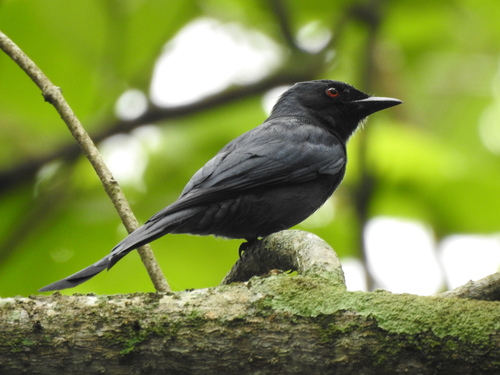
Blue-naped Pitta

Blue-naped Pitta

Pitta nipalensis

Silhouette: Rachael Joakim · PhyloPic

Daily sighting probability ~10% · With luck
at Namdapha National Park

In 3 days ~30% in a week ~50%

134 Verified sightings at Namdapha National Park From 2019 to 2026
238 In all 4 parks
January Best month
☀️ Diurnal When it's spotted

About the Blue-naped Pitta

The blue-naped pitta (Hydrornis nipalensis) is a species of bird in the family Pittidae. It is a brightly colored bird, with a stub-tail. It is blue and green above, with a reddish-yellow coloring below. The bird's nape and hindneck are bright blue, and the tail is brown with a bit of green. The male and female birds are similar, but the female's hindcrown is reddish-brown, not blue, and it has a green hindneck.

It is found in Bangladesh, Bhutan, China, India, Laos, Myanmar, Nepal, and Vietnam. Its natural habitats are subtropical or tropical moist lowland forests and subtropical or tropical moist montane forests. It can be found in bamboo jungles.

It is a terrestrial bird. It usually ventures out into clearings only early in the morning and late in the evening. Its call is a double whistle and can be heard when it is on the ground and from a tree at dawn and dusk. The nesting season is April to August, during which both the male and female birds share the parental duties.

Its diet consists of ground insects and other small animals. Wikipedia →

Sounds

Recording0:32

India · 2025

© Rofikul Islam · iNaturalist · CC BY-NC 4.0

Recording0:13

India · 2023

© dbeadle · iNaturalist · CC BY-NC 4.0

Global Distribution

Parks Where Found

# Park Country Daily sighting probability
1 Namdapha National Park 🇮🇳 India
~10%
2 Royal Manas National Park 🇧🇹 Bhutan
<5%
3 Manas National Park 🇮🇳 India
<5%
4 Kaziranga National Park 🇮🇳 India
<5%

Before you go

What are the chances of seeing a Blue-naped Pitta in Namdapha National Park?

With luck

About 10% of wildlife watchers report a Blue-naped Pitta sighting in Namdapha National Park on a given day, based on 134 verified sightings from GBIF citizen-science data from 2019 to 2026. It is the 117th most-seen of the 298 birds we can rate there. Over three days the chance rises to about 30%, and over a week to about 50%, if each day is a fresh chance.

When is the best time to see a Blue-naped Pitta in Namdapha National Park?

January and February

In those months about 20% of wildlife watchers report a Blue-naped Pitta in Namdapha National Park on a given day, against under 5% in May and October–December, the lowest months. Those are among Namdapha National Park's driest months, with about 80 mm of rain a month against 660 mm in July. June to September have too few records to rate.

What time of day is best to see a Blue-naped Pitta?

Between 6 and 9 am

Across all the parks we cover, that three-hour window holds the most Blue-naped Pitta sightings with a recorded time, and about 9 in 10 of them come between 6 am and 6 pm: it is a daytime animal.

Is Namdapha National Park the best place to see a Blue-naped Pitta?

Yes

Of the 4 parks where we can rate Blue-naped Pitta sightings, Namdapha National Park has the highest daily chance: about 10%. Next come Royal Manas National Park (Bhutan, under 5%) and Manas National Park (India, under 5%).

Which relatives of the Blue-naped Pitta live in Namdapha National Park?

Same order: Passeriformes

The closest relatives of the Blue-naped Pitta that you can see in Namdapha National Park (order Passeriformes, Perching Birds) are Ashy-fronted Bearded Bulbul (about 70%), Streaked Spiderhunter (about 60%) and Bronzed Drongo (about 50%), with each one's daily chance of a sighting.

Where does the Blue-naped Pitta sighting chance come from?

GBIF citizen-science records

It is estimated from how often the Blue-naped Pitta is recorded against all the birds logged in Namdapha National Park (134 verified sightings from 2019 to 2026), calibrated against known sighting rates. Figures are rounded to the nearest 10% because citizen-science data supports honest approximations, not decimals, and months with records from fewer than five people show "—". How it works.

← Back to Namdapha National Park