White-cheecked Hill Partridge

White-cheecked Hill Partridge

Arborophila atrogularis

Silhouette: PhyloPic

LCLeast ConcernNTVUENCR
Daily sighting probability ~10% · With luck
at Namdapha National Park

In 3 days ~30% in a week ~50%

122 Verified sightings at Namdapha National Park From 2019 to 2026
134 In all 2 parks
January Best month
☀️ Diurnal When it's spotted

About the White-cheecked Hill Partridge

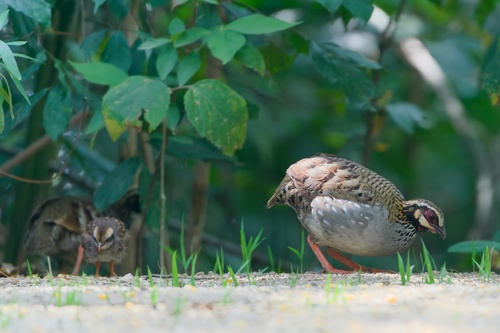
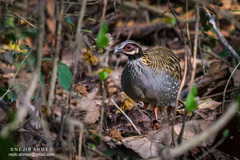
The white-cheeked partridge (Arborophila atrogularis) is a species of partridge in the family Phasianidae, native to Asia. It is found mainly in Northeast India, northern Myanmar, and northeast Bangladesh, inhabiting dense undergrowth in primary and secondary evergreen forest; this sometimes includes adjacent areas of scrub, bamboo, grassland and cultivated land. In India, the species occurs generally at altitudes below 750 m, but may be found at up to 1,220 m in South-East Asia.

The white-cheeked partridge is currently classified as Least Concern by the IUCN. Population numbers are unknown and believed to be decreasing, but not at a rate fast enough to warrant a Near Threatened status. It is threatened habitat loss and hunting. Wikipedia →

Sounds

Song1:01

Bangladesh · 2026

© Ahsan Uddin Chowdhury · XC1153490 · CC BY-NC-SA 4.0

Call0:51

India · 2013

© Frank Lambert · XC156567 · CC BY-NC-ND 4.0

Song1:29

India · 2018

© Peter Boesman · XC426421 · CC BY-NC-ND 4.0

Global Distribution

Parks Where Found

# Park Country Daily sighting probability
1 Namdapha National Park 🇮🇳 India
~10%
2 Manas National Park 🇮🇳 India
<5%

Before you go

What are the chances of seeing a White-cheecked Hill Partridge in Namdapha National Park?

With luck

About 10% of wildlife watchers report a White-cheecked Hill Partridge sighting in Namdapha National Park on a given day, based on 122 verified sightings from GBIF citizen-science data from 2019 to 2026. It is the 122nd most-seen of the 298 birds we can rate there. Over three days the chance rises to about 30%, and over a week to about 50%, if each day is a fresh chance.

When is the best time to see a White-cheecked Hill Partridge in Namdapha National Park?

January and March

In those months about 20% of wildlife watchers report a White-cheecked Hill Partridge in Namdapha National Park on a given day, against under 5% in February, April–May and October–November, the lowest months. Those are among Namdapha National Park's driest months, with about 85 mm of rain a month against 660 mm in July. June to September have too few records to rate.

What time of day is best to see a White-cheecked Hill Partridge?

Between 1 and 4 pm

Across all the parks we cover, that three-hour window holds the most White-cheecked Hill Partridge sightings with a recorded time, and nearly all of them come between 6 am and 6 pm: it is a daytime animal.

Is Namdapha National Park the best place to see a White-cheecked Hill Partridge?

Yes

Of the 2 parks where we can rate White-cheecked Hill Partridge sightings, Namdapha National Park has the highest daily chance: about 10%. Next come Manas National Park (India, under 5%).

Which relatives of the White-cheecked Hill Partridge live in Namdapha National Park?

Same family: Phasianidae

The closest relatives of the White-cheecked Hill Partridge that you can see in Namdapha National Park (family Phasianidae, Pheasants, Grouse, and Allies) are Grey Peacock-Pheasant (about 30%) and Kalij Pheasant (about 10%), with each one's daily chance of a sighting.

Where does the White-cheecked Hill Partridge sighting chance come from?

GBIF citizen-science records

It is estimated from how often the White-cheecked Hill Partridge is recorded against all the birds logged in Namdapha National Park (122 verified sightings from 2019 to 2026), calibrated against known sighting rates. Figures are rounded to the nearest 10% because citizen-science data supports honest approximations, not decimals, and months with records from fewer than five people show "—". How it works.

← Back to Namdapha National Park