
Kalij Pheasant

Kalij Pheasant

Lophura leucomelanos

Silhouette: Sheatherius · PhyloPic

LCLeast ConcernNTVUENCR
Daily sighting probability ~10% · With luck
at Namdapha National Park

In 3 days ~20% in a week ~40%

72 Verified sightings at Namdapha National Park From 2019 to 2026
3,008 In all 8 parks
January Best month
☀️ Diurnal When it's spotted

About the Kalij Pheasant

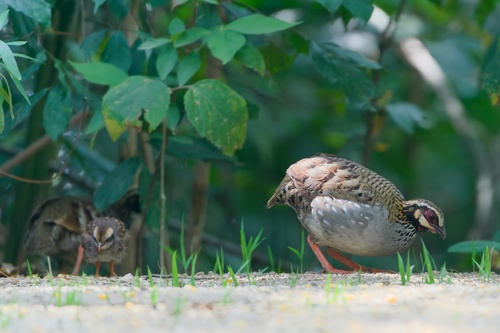
The kalij pheasant (Lophura leucomelanos), or simply kalij, is a pheasant found in forests and thickets, especially in the Himalayan foothills, from India, Nepal, Pakistan to western Thailand. Males are rather variable depending on the subspecies involved, but all have at least partially glossy bluish-black plumage, while females are overall brownish. Both sexes have a bare red face and greyish legs (the latter separating it from the red-legged silver pheasant).

The name is also spelled kaleege in old texts, such as Game Birds of India and Asia by Frank Finn, though no longer in his Indian Sporting Birds. The species was introduced to Hawaii in 1962 as a gamebird. On 21 October 2021, the Government of Jammu and Kashmir declared the kalij pheasant as bird of the Union Territory of Jammu and Kashmir.

The kalij pheasant is closely related to the silver pheasant, and the two are known to hybridize. Wikipedia →

Sounds

Call0:24

India · 2026

© KALYAN SINGH SAJWAN · XC1089089 · CC BY-NC-SA 4.0

Alarm call0:09

Thailand · 2024

© Greg Irving · XC948893 · CC BY-NC-SA 4.0

Call0:12

Nepal · 2023

© Bram Piot · XC836604 · CC BY-NC-SA 4.0

Global Distribution

Parks Where Found

# Park Country Daily sighting probability
1 Jim Corbett National Park 🇮🇳 India
~40%
2 Royal Manas National Park 🇧🇹 Bhutan
~30%
3 Kaeng Krachan National Park 🇹🇭 Thailand
~20%
4 Manas National Park 🇮🇳 India
~20%
5 Kaziranga National Park 🇮🇳 India
~20%
6 Langtang National Park 🇳🇵 Nepal
~20%
7 Namdapha National Park 🇮🇳 India
~10%
8 Chitwan National Park 🇳🇵 Nepal
<5%

Cities Where Found

# City Country Daily sighting probability
1 Dehradun 🇮🇳 India
<5%
2 Kathmandu 🇳🇵 Nepal
<5%

Zoos & Centres Where Found

# Zoo / Centre Country
1 Barcelona Zoo 🇪🇸 Spain In captivity
2 Kyiv Zoo 🇺🇦 Ukraine In captivity
3 Memphis Zoo 🇺🇸 United States In captivity
4 Alipore Zoological Gardens 🇮🇳 India In captivity
5 Saigon Zoo and Botanical Gardens 🇻🇳 Vietnam In captivity
6 Bird Paradise 🇸🇬 Singapore In captivity
7 Aquarama Barcelona 🇪🇸 Spain In captivity
8 Rainforest Wild Asia 🇸🇬 Singapore In captivity
9 Motithang Takin Preserve 🇧🇹 Bhutan In captivity
10 Paphos Zoo 🇨🇾 Cyprus In captivity
11 Міні-зоопарк 🇺🇦 Ukraine In captivity
12 Zoo Koki (Parque zoológico y botánico) 🇪🇸 Spain In captivity

Before you go

What are the chances of seeing a Kalij Pheasant in Namdapha National Park?

With luck

About 10% of wildlife watchers report a Kalij Pheasant sighting in Namdapha National Park on a given day, based on 72 verified sightings from GBIF citizen-science data from 2019 to 2026. It is the 154th most-seen of the 298 birds we can rate there. Over three days the chance rises to about 20%, and over a week to about 40%, if each day is a fresh chance.

When is the best time to see a Kalij Pheasant in Namdapha National Park?

March–April and December–January

In those months about 10% of wildlife watchers report a Kalij Pheasant in Namdapha National Park on a given day, against under 5% in February, May and October–November, the lowest months. Those are among Namdapha National Park's driest months, with about 110 mm of rain a month against 660 mm in July. June to September have too few records to rate.

What time of day is best to see a Kalij Pheasant?

Between 4 and 7 pm

Across all the parks we cover, that three-hour window holds the most Kalij Pheasant sightings with a recorded time, and about 8 in 10 of them come between 6 am and 6 pm: it is a daytime animal.

Which relatives of the Kalij Pheasant live in Namdapha National Park?

Same family: Phasianidae

The closest relatives of the Kalij Pheasant that you can see in Namdapha National Park (family Phasianidae, Pheasants, Grouse, and Allies) are Grey Peacock-Pheasant (about 30%) and White-cheecked Hill Partridge (about 10%), with each one's daily chance of a sighting.

Where does the Kalij Pheasant sighting chance come from?

GBIF citizen-science records

It is estimated from how often the Kalij Pheasant is recorded against all the birds logged in Namdapha National Park (72 verified sightings from 2019 to 2026), calibrated against known sighting rates. Figures are rounded to the nearest 10% because citizen-science data supports honest approximations, not decimals, and months with records from fewer than five people show "—". How it works.

← Back to Namdapha National Park