Shining Flycatcher

Shining Flycatcher

Myiagra alecto

Silhouette: Sheatherius · PhyloPic

LCLeast ConcernNTVUENCR
Daily sighting probability ~20% · Possible
at Nitmiluk National Park

In 3 days ~40% in a week ~70%

62 Verified sightings at Nitmiluk National Park From 2019 to 2026
2,454 In all 5 parks
May Best month
☀️ Diurnal When it's spotted

About the Shining Flycatcher

The shining flycatcher (Myiagra alecto) is a species of bird in the family Monarchidae. It is found in northern Australia, and from the Moluccas to the Bismarck Archipelago. Its natural habitats are subtropical or tropical moist lowland forest and subtropical or tropical mangrove forest.

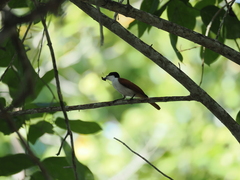
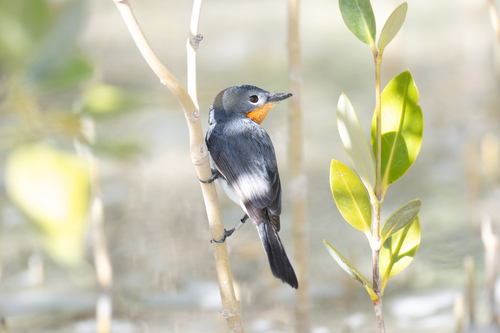
A long-tailed, slender songbird with fine bill. Male entirely glossy blue-black. Female a rich chestnut above, white below, with black crown and face (in poor light, may appear dark above; compare Restless and Paperbark flycatchers). Song a clear whistled "towhit-too-towhit."

The shining flycatcher was originally described in the genus Drymophila and subsequently placed by some authorities in the genus Monarcha. Alternate names include common shining flycatcher, shining monarch, shining monarch flycatcher, shining Myiagra and shining Myiagra-flycatcher.

Found on the Aru Islands (south... Wikipedia →

Sounds

Song0:35

Indonesia · 2026

© Ding Li Yong · XC1166133 · CC BY-NC-ND 4.0

Call0:48

Australia · 2025

© Peter Boesman · XC1066718 · CC BY-NC-ND 4.0

Recording0:45

Australia · 2021

© James Lambert · XC669106 · CC BY-NC-ND 4.0

Global Distribution

Parks Where Found

# Park Country Daily sighting probability
1 Daintree National Park 🇦🇺 Australia
~60%
2 Raja Ampat 🇮🇩 Indonesia
~40%
3 Kakadu National Park 🇦🇺 Australia
~30%
4 Litchfield National Park 🇦🇺 Australia
~30%
5 Nitmiluk National Park 🇦🇺 Australia
~20%

Cities Where Found

# City Country Daily sighting probability
1 Brisbane 🇦🇺 Australia
<5%

Zoos & Centres Where Found

# Zoo / Centre Country
1 Territory Wildlife Park 🇦🇺 Australia In captivity

Before you go

What are the chances of seeing a Shining Flycatcher in Nitmiluk National Park?

Possible

About 20% of wildlife watchers report a Shining Flycatcher sighting in Nitmiluk National Park on a given day, based on 62 verified sightings from GBIF citizen-science data from 2019 to 2026. It is the 41st most-seen of the 103 birds we can rate there. Over three days the chance rises to about 40%, and over a week to about 70%, if each day is a fresh chance.

When is the best time to see a Shining Flycatcher in Nitmiluk National Park?

May

In that month about 30% of wildlife watchers report a Shining Flycatcher in Nitmiluk National Park on a given day, against about 10% in March–April, July–August and November–December, the lowest months. That is one of Nitmiluk National Park's driest months, with almost no rain against 270 mm in January.

What time of day is best to see a Shining Flycatcher?

Between 9 am and noon

Across all the parks we cover, that three-hour window holds the most Shining Flycatcher sightings with a recorded time, and about 9 in 10 of them come between 6 am and 6 pm: it is a daytime animal.

Is Nitmiluk National Park the best place to see a Shining Flycatcher?

5th of 5

Of the 5 parks where we can rate Shining Flycatcher sightings, Nitmiluk National Park ranks 5th at about 20%. The best odds are in Daintree National Park (Australia, about 60%), Raja Ampat (Indonesia, about 40%) and Kakadu National Park (Australia, about 30%). All parks ranked.

Which relatives of the Shining Flycatcher live in Nitmiluk National Park?

Same genus: Myiagra

The closest relatives of the Shining Flycatcher that you can see in Nitmiluk National Park (genus Myiagra, Myiagra Flycatchers) are Leaden Flycatcher (about 40%) and Paperbark Flycatcher (about 20%), with each one's daily chance of a sighting.

Where does the Shining Flycatcher sighting chance come from?

GBIF citizen-science records

It is estimated from how often the Shining Flycatcher is recorded against all the birds logged in Nitmiluk National Park (62 verified sightings from 2019 to 2026), calibrated against known sighting rates. Figures are rounded to the nearest 10% because citizen-science data supports honest approximations, not decimals, and months with records from fewer than five people show "—". How it works.

← Back to Nitmiluk National Park