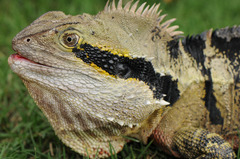
Australian Water Dragon

Australian Water Dragon

Intellagama lesueurii

Silhouette: Michael Scroggie · PhyloPic

LCLeast ConcernNTVUENCR Endemic
Daily sighting probability ~40% · Likely
at Noosa National Park

In 3 days ~80% in a week >90%

40 Verified sightings at Noosa National Park From 2019 to 2026
1,061 In all 7 parks
December Best month
☀️ Diurnal When it's spotted

About the Australian Water Dragon

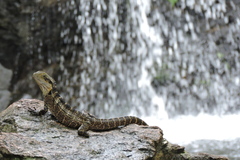
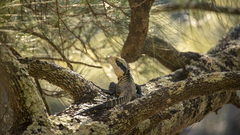
The Australian water dragon (Intellagama lesueurii), which includes the eastern water dragon (Intellagama lesueurii lesueurii) and the Gippsland water dragon (Intellagama lesueurii howittii) subspecies, is a semi aquatic agamid species native to eastern Australia from Victoria northwards to Queensland. There may be a small introduced population on the south-east coast of South Australia.

The Gippsland water dragon is generally the more southern of the two subspecies and the more cold adapted and heat sensitive. Visually distinguishing the Gippsland water dragon from the Eastern water dragon is relatively easy, as long as their skin is reasonably clean and not stained from the water, as identification of the two subspecies depends largely on observable differences in colours and patterns.

The Gippsland water dragon may be distinguished by its green-blue colour, especially during the breeding season, when this overall colouration is quite distinct. Another key difference is the absence of a prominent dark stripe behind the eye in the Gippsland water dragon, which is characteristic of the Eastern water dragon. The gular region of the two subspecies is also quite different, with Intellagama l. howittii having orange-yellow streaked with darker striping, which is sometimes quite striking, particularly in mature males, whereas Intellagama l. lesueurii typically has a pale, unmarked throat that is sometimes immaculate white in mature males. The belly and chest of Intellagama l. howittii are also quite different to Intellagama l. lesueurii, usually being blackish green, especially in mature males, and the limbs are often quite dark, sometimes even black. Whereas in Intellagama l. lesueurii the chest and belly are usually bright to deep red, particularly in mature males. Intellagama l. lesueurii also have relatively strong dark transverse bars across the back, whereas these dark bars are often much reduced in the Gippsland water dragon. Wikipedia →

Sounds

Recording0:09

Australia · 2025

© xitong_zhou · iNaturalist · CC BY-NC 4.0

Global Distribution

Parks Where Found

# Park Country Daily sighting probability
1 Royal National Park 🇦🇺 Australia
~70%
2 Blue Mountains National Park 🇦🇺 Australia
~50%
3 Noosa National Park 🇦🇺 Australia
~40%
4 Daintree National Park 🇦🇺 Australia
~30%
5 Springbrook National Park 🇦🇺 Australia
~30%
6 Lamington National Park 🇦🇺 Australia
~30%
7 Kosciuszko National Park 🇦🇺 Australia
~30%

Cities Where Found

# City Country Daily sighting probability
1 Brisbane 🇦🇺 Australia
~70%
2 Sydney 🇦🇺 Australia
~50%
3 Melbourne 🇦🇺 Australia
~10%

Zoos & Centres Where Found

# Zoo / Centre Country
1 Australia Zoo 🇦🇺 Australia In captivity
2 Beijing Wildlife Park 🇨🇳 China In captivity
3 Out of Africa Wildlife Park 🇺🇸 United States In captivity
4 Berlin Zoological Garden 🇩🇪 Germany In captivity
5 Taronga Zoo 🇦🇺 Australia In captivity
6 Hamilton Zoo 🇳🇿 New Zealand In captivity
7 Wilhelma 🇩🇪 Germany In captivity
8 Currumbin Wildlife Sanctuary 🇦🇺 Australia In captivity
9 Melbourne Zoo 🇦🇺 Australia In captivity
10 Lone Pine Koala Sanctuary 🇦🇺 Australia In captivity
11 Auckland Zoo 🇳🇿 New Zealand In captivity
12 Faunia 🇪🇸 Spain In captivity
13 Hartley’s Crocodile Adventures 🇦🇺 Australia In captivity
14 Moonlit Sanctuary Wildlife Conservation Park 🇦🇺 Australia In captivity
15 Sydney Zoo 🇦🇺 Australia In captivity
16 Adelaide Zoo 🇦🇺 Australia In captivity
17 Reptile Gardens 🇺🇸 United States In captivity
18 Australian Reptile Park 🇦🇺 Australia In captivity
19 Gorge Wildlife Park 🇦🇺 Australia In captivity
20 Symbio Wildlife Park 🇦🇺 Australia In captivity
21 Featherdale Sydney Wildlife Park 🇦🇺 Australia In captivity
22 Ipswich Nature Centre 🇦🇺 Australia In captivity
23 Randers Tropical Zoo 🇩🇰 Denmark In captivity
24 Melbourne Aquarium 🇦🇺 Australia In captivity
25 Sea Life Sydney Aquarium 🇦🇺 Australia In captivity
26 Maritime Aquarium at Norwalk 🇺🇸 United States In captivity
27 Cairns Aquarium 🇦🇺 Australia In captivity
28 Wild Life Sydney 🇦🇺 Australia In captivity
29 Aquarium Berlin 🇩🇪 Germany In captivity
30 Fauna Reserve 🇦🇺 Australia In captivity
31 National Aquarium 🇺🇸 United States In captivity
32 National Aquarium of New Zealand 🇳🇿 New Zealand In captivity
33 Birdworld Kuranda 🇦🇺 Australia In captivity
34 Kuranda Koala Gardens 🇦🇺 Australia In captivity
35 Caversham Wildlife Park 🇦🇺 Australia In captivity
36 Manly Sea Life Sanctuary 🇦🇺 Australia In captivity
37 Ranger Red’s Zoo & Conservation Park 🇦🇺 Australia In captivity
38 The Lair 🇦🇺 Australia In captivity
39 Wildlife Habitat Port Douglas 🇦🇺 Australia In captivity

Before you go

What are the chances of seeing an Australian Water Dragon in Noosa National Park?

Likely

About 40% of wildlife watchers report an Australian Water Dragon sighting in Noosa National Park on a given day, based on 40 verified sightings from GBIF citizen-science data from 2019 to 2026. It is the 2nd most-seen of the 15 reptiles we can rate there. Over three days the chance rises to about 80%, and over a week to over 90%, if each day is a fresh chance.

When is the best time to see an Australian Water Dragon in Noosa National Park?

March, May and December–January

In those months about 50% of wildlife watchers report an Australian Water Dragon in Noosa National Park on a given day, against under 5% in February and July, the lowest months.

What time of day is best to see an Australian Water Dragon?

Between noon and 3 pm

Across all the parks we cover, that three-hour window holds the most Australian Water Dragon sightings with a recorded time, and nearly all of them come between 6 am and 6 pm: it is a daytime animal.

Is Noosa National Park the best place to see an Australian Water Dragon?

3rd of 7

Of the 7 parks where we can rate Australian Water Dragon sightings, Noosa National Park ranks 3rd at about 40%. The best odds are in Royal National Park (Australia, about 70%) and Blue Mountains National Park (Australia, about 50%). All parks ranked.

Which relatives of the Australian Water Dragon live in Noosa National Park?

Same family: Agamidae

The closest relatives of the Australian Water Dragon that you can see in Noosa National Park (family Agamidae, Dragons) are Frill-necked Lizard (about 20%) and Bearded Dragon (about 10%), with each one's daily chance of a sighting.

Where does the Australian Water Dragon sighting chance come from?

GBIF citizen-science records

It is estimated from how often the Australian Water Dragon is recorded against all the reptiles logged in Noosa National Park (40 verified sightings from 2019 to 2026), calibrated against known sighting rates. Figures are rounded to the nearest 10% because citizen-science data supports honest approximations, not decimals, and months with records from fewer than five people show "—". How it works.

← Back to Noosa National Park