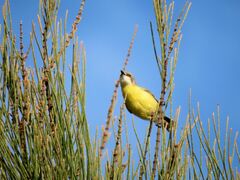
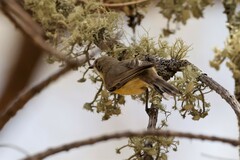
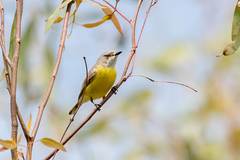
White-throated Gerygone

White-throated Gerygone

Gerygone olivacea

Silhouette: Sheatherius · PhyloPic

LCLeast ConcernNTVUENCR
Daily sighting probability <5% · Rare
at Noosa National Park

In 3 days <5% in a week ~10%

8 Verified sightings at Noosa National Park From 2019 to 2026
420 In all 8 parks
May Best month
☀️ Diurnal When it's spotted

About the White-throated Gerygone

The white-throated gerygone (Gerygone olivacea) is a species of bird in the family Acanthizidae. It is found in Australia and Papua New Guinea. Its natural habitats are temperate forests and subtropical or tropical moist lowland forests. Its common names include white-throated warbler, white-throated flyeater, bush canary, and native canary.

Gerygone comes from the Greek word "gerugonos" meaning "echos". The species name olivacea is latin for 'olive-green', given for its underbelly coloration. There are three recognized subspecies of G. olivacea: Gerygone olivacea ssp. cinerascens, Gerygone olivacea ssp. rogersi, and Gerygone olivacea ssp. olivacea.

The species is distributed through south-eastern New Guinea and northern and eastern Australia. G. olivacea ssp. cinerascens is found in south-eastern New Guinea and the Cape York Peninsula of Australia. G. olivacea ssp. rogersi is found in north-western Australia. G. olivacea ssp. olivacea is found primarily in New South Wales.

The white-throated gerygone is primarily found in open dry eucalyptus woodland and dense riparian vegetation. It occupies tropical, subtropical, and... Wikipedia →

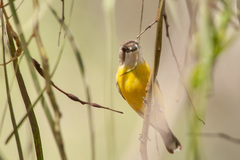
Sounds

Song0:12

Australia · 2026

© Marc Anderson · XC1086636 · CC BY-NC-ND 4.0

Call0:21

Australia · 2016

© Greg McLachlan · XC343752 · CC BY-NC-SA 4.0

Song0:31

Australia · 2021

© Eddy Smith · XC691441 · CC BY-NC-SA 4.0

Global Distribution

Parks Where Found

# Park Country Daily sighting probability
1 Springbrook National Park 🇦🇺 Australia
~10%
2 Nitmiluk National Park 🇦🇺 Australia
~10%
3 Kosciuszko National Park 🇦🇺 Australia
~10%
4 Blue Mountains National Park 🇦🇺 Australia
<5%
5 Kakadu National Park 🇦🇺 Australia
<5%
6 Lamington National Park 🇦🇺 Australia
<5%
7 Noosa National Park 🇦🇺 Australia
<5%
8 Daintree National Park 🇦🇺 Australia
<5%

Cities Where Found

# City Country Daily sighting probability
1 Brisbane 🇦🇺 Australia
<5%
2 Sydney 🇦🇺 Australia
<5%
3 Melbourne 🇦🇺 Australia
<5%

Before you go

What are the chances of seeing a White-throated Gerygone in Noosa National Park?

Rare

Under 5% of wildlife watchers report a White-throated Gerygone sighting in Noosa National Park on a given day, based on 8 verified sightings from GBIF citizen-science data from 2019 to 2026. It is the 120th most-seen of the 128 birds we can rate there. Over three days the chance rises to under 5%, and over a week to about 10%, if each day is a fresh chance.

When is the best time to see a White-throated Gerygone in Noosa National Park?

Any time of year

In every month with enough records, under 5% of wildlife watchers report a White-throated Gerygone in Noosa National Park on a given day, so our monthly data shows no clear season.

What time of day is best to see a White-throated Gerygone?

Between 8 and 11 am

Across all the parks we cover, that three-hour window holds the most White-throated Gerygone sightings with a recorded time, and nearly all of them come between 6 am and 6 pm: it is a daytime animal.

Is Noosa National Park the best place to see a White-throated Gerygone?

7th of 8

Of the 8 parks where we can rate White-throated Gerygone sightings, Noosa National Park ranks 7th at under 5%. The best odds are in Springbrook National Park (Australia, about 10%), Nitmiluk National Park (Australia, about 10%) and Kosciuszko National Park (Australia, about 10%).

Which relatives of the White-throated Gerygone live in Noosa National Park?

Same genus: Gerygone

The closest relatives of the White-throated Gerygone that you can see in Noosa National Park (genus Gerygone, Gerygones) are Mangrove Gerygone (about 10%) and Fairy Gerygone (about 10%), with each one's daily chance of a sighting.

Where does the White-throated Gerygone sighting chance come from?

GBIF citizen-science records

It is estimated from how often the White-throated Gerygone is recorded against all the birds logged in Noosa National Park (8 verified sightings from 2019 to 2026), calibrated against known sighting rates. Figures are rounded to the nearest 10% because citizen-science data supports honest approximations, not decimals, and months with records from fewer than five people show "—". How it works.

← Back to Noosa National Park