
Yellow-crowned Canary

Yellow-crowned Canary

Serinus flavivertex

Silhouette: Sheatherius · PhyloPic

LCLeast ConcernNTVUENCR
Daily sighting probability ~10% · With luck
at Nyungwe National Park

In 3 days ~20% in a week ~50%

113 Verified sightings at Nyungwe National Park From 2019 to 2026
707 In all 11 parks
August Best month
☀️ Diurnal When it's spotted

About the Yellow-crowned Canary

The yellow-crowned canary (Serinus flavivertex) is a small passerine bird in the finch family. It is a resident breeder in eastern Africa. It was formerly considered conspecific with the Cape canary (Serinus canicollis).

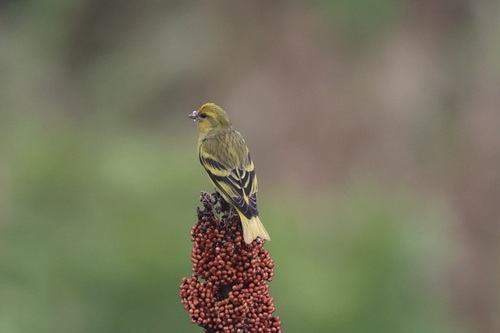
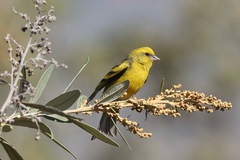
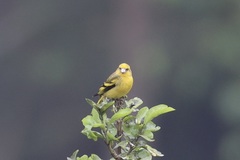
Its habitat is fynbos, grassland and gardens, preferably in highland areas. It builds a compact cup nest in a scrub. The yellow-crowned canary is 11–13 cm in length. The adult male has a green back with black edging to the wings and tail. The underparts, rump and tail sides are yellow, and the lower belly is white. The head is brighter in colour than the Cape canary, yellow in colour, and the face is cinnamon. The juvenile has greenish-yellow underparts with heavy brown streaking.

The yellow-crowned canary is a common and gregarious seedeater. Its call is tsit-it-it, and the song is warbled goldfinch-like trills and whistles given in display flight or from a high perch. Wikipedia →

Sounds

Song0:43

Kenya · 2026

© Ding Li Yong · XC1178104 · CC BY-NC-ND 4.0

Call0:13

Malawi · 2023

© Dries Van de Loock · XC860415 · CC BY-NC-ND 4.0

Song0:09

Kenya · 2022

© Lars Lachmann · XC749274 · CC BY-NC-SA 4.0

Global Distribution

Parks Where Found

# Park Country Daily sighting probability
1 Aberdare National Park 🇰🇪 Kenya
~40%
2 Volcanoes National Park 🇷🇼 Rwanda
~10%
3 Bale Mountains National Park 🇪🇹 Ethiopia
~10%
4 Nyungwe National Park 🇷🇼 Rwanda
~10%
5 Virunga National Park 🇨🇩 Democratic Republic of the Congo
~10%
6 Ngorongoro Conservation Area 🇹🇿 Tanzania
~10%
7 Bwindi Impenetrable National Park 🇺🇬 Uganda
~10%
8 Arusha National Park 🇹🇿 Tanzania
<5%
9 Amboseli National Park 🇰🇪 Kenya
<5%
10 Lake Nakuru National Park 🇰🇪 Kenya
<5%
11 Serengeti National Park 🇹🇿 Tanzania
<5%

Cities Where Found

# City Country Daily sighting probability
1 Addis Ababa 🇪🇹 Ethiopia
~10%
2 Nairobi 🇰🇪 Kenya
<5%

Before you go

What are the chances of seeing a Yellow-crowned Canary in Nyungwe National Park?

With luck

About 10% of wildlife watchers report a Yellow-crowned Canary sighting in Nyungwe National Park on a given day, based on 113 verified sightings from GBIF citizen-science data from 2019 to 2026. It is the 110th most-seen of the 252 birds we can rate there. Over three days the chance rises to about 20%, and over a week to about 50%, if each day is a fresh chance.

When is the best time to see a Yellow-crowned Canary in Nyungwe National Park?

June and August

In those months about 20% of wildlife watchers report a Yellow-crowned Canary in Nyungwe National Park on a given day, against under 5% in May and October–February, the lowest months. Those are among Nyungwe National Park's driest months, with about 70 mm of rain a month against 550 mm in December.

What time of day is best to see a Yellow-crowned Canary?

Between 7 and 10 am

Across all the parks we cover, that three-hour window holds the most Yellow-crowned Canary sightings with a recorded time, and about 8 in 10 of them come between 6 am and 6 pm: it is a daytime animal.

Which relatives of the Yellow-crowned Canary live in Nyungwe National Park?

Same family: Fringillidae

The closest relatives of the Yellow-crowned Canary that you can see in Nyungwe National Park (family Fringillidae, Finches, Euphonias, and Allies) are Streaky Seedeater (about 50%), Western Citril (about 20%) and Thick-billed Seedeater (about 20%), with each one's daily chance of a sighting.

Where does the Yellow-crowned Canary sighting chance come from?

GBIF citizen-science records

It is estimated from how often the Yellow-crowned Canary is recorded against all the birds logged in Nyungwe National Park (113 verified sightings from 2019 to 2026), calibrated against known sighting rates. Figures are rounded to the nearest 10% because citizen-science data supports honest approximations, not decimals, and months with records from fewer than five people show "—". How it works.

← Back to Nyungwe National Park