

Red-necked Grebe

Red-necked Grebe

Podiceps grisegena

Silhouette: Doug Backlund (photo), John E. McCormack, Michael G. Harvey, Brant C. Faircloth, Nicholas G. Crawford, Travis C. Glenn, Robb T. Brumfield & T. Michael Keesey · PhyloPic

LCLeast ConcernNTVUENCR
Daily sighting probability ~10% · With luck
at Olympic National Park

In 3 days ~10% in a week ~30%

251 Verified sightings at Olympic National Park From 2019 to 2026
5,453 In all 22 parks
December Best month
☀️ Diurnal When it's spotted

About the Red-necked Grebe

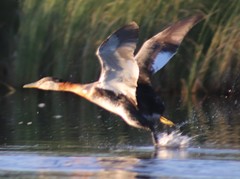
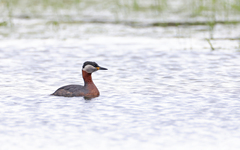
The red-necked grebe (Podiceps grisegena) is an aquatic bird found in the temperate regions of the northern hemisphere. A migratory bird, its wintering habitat is largely restricted to calm waters just beyond the waves around ocean coasts, although some birds may winter on large lakes. Grebes prefer shallow bodies of fresh water such as lakes, marshes or fish-ponds as breeding sites.

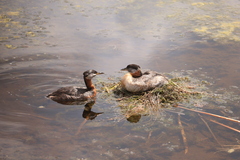
The red-necked grebe is a fairly drab dusky-grey bird in winter. During the breeding season, it acquires the distinctive red neck plumage, black cap and contrasting pale grey face from which its name was derived. It also has an elaborate courtship display and a variety of loud mating calls. Once paired, it builds a nest from water plants on top of floating vegetation in a shallow lake or bog.

Like all grebes, the red-necked is a good swimmer and particularly swift diver, and responds to danger by diving rather than flying. The feet are positioned far back on the body, near the tail, which makes the bird ungainly on land. It dives for fish or picks insects off vegetation; it also swallows its own feathers, possibly to protect the digestive system. Wikipedia →

Sounds

Duet0:34

Estonia · 2025

© Uku Paal · XC1001320 · CC BY-NC-SA 4.0

Song0:15

Sweden · 2022

© Ulf Elman · XC949348 · CC BY-NC-ND 4.0

Copulation0:58

Poland · 2011

© Jarek Matusiak · XC103894 · CC BY-NC-ND 2.5

Global Distribution

Parks Where Found

# Park Country Daily sighting probability
1 Elk Island National Park 🇨🇦 Canada
~70%
2 Riding Mountain National Park 🇨🇦 Canada
~30%
3 Great Bear Rainforest 🇨🇦 Canada
~20%
4 Pacific Rim National Park Reserve 🇨🇦 Canada
~10%
5 Banff National Park 🇨🇦 Canada
~10%
6 Acadia National Park 🇺🇸 United States
~10%
7 Wrangell-St. Elias National Park 🇺🇸 United States
~10%
8 Hortobágy National Park 🇭🇺 Hungary
~10%
9 Jasper National Park 🇨🇦 Canada
~10%
10 Olympic National Park 🇺🇸 United States
~10%
11 Kluane National Park 🇨🇦 Canada
<5%
12 Voyageurs National Park 🇺🇸 United States
<5%
13 Redwood National Park 🇺🇸 United States
<5%
14 Biebrza National Park 🇵🇱 Poland
<5%
15 Cape Breton Highlands National Park 🇨🇦 Canada
<5%
16 Glacier National Park 🇺🇸 United States
<5%
17 Wadden Sea National Park 🇩🇪 Germany
<5%
18 Kiskunság National Park 🇭🇺 Hungary
<5%
19 Kenai Fjords National Park 🇺🇸 United States
<5%
20 Channel Islands National Park 🇺🇸 United States
<5%
21 Yellowstone National Park 🇺🇸 United States
<5%
22 Point Pelee National Park 🇨🇦 Canada
<5%

Cities Where Found

# City Country Daily sighting probability
1 Anchorage 🇺🇸 United States
~50%
2 Edmonton 🇨🇦 Canada
~20%
3 Toronto 🇨🇦 Canada
~10%
4 Copenhagen 🇩🇰 Denmark
~10%
5 Calgary 🇨🇦 Canada
~10%
6 Seattle 🇺🇸 United States
~10%
7 Prague 🇨🇿 Czechia
<5%
8 Bucharest 🇷🇴 Romania
<5%
9 Leeds 🇬🇧 United Kingdom
<5%
10 Kyiv 🇺🇦 Ukraine
<5%

Zoos & Centres Where Found

# Zoo / Centre Country
1 Montreal Biodome 🇨🇦 Canada In captivity
2 Ogród Zoologiczny w Katowicach 🇵🇱 Poland In captivity

Before you go

What are the chances of seeing a Red-necked Grebe in Olympic National Park?

With luck

About 10% of wildlife watchers report a Red-necked Grebe sighting in Olympic National Park on a given day, based on 251 verified sightings from GBIF citizen-science data from 2019 to 2026. It is the 94th most-seen of the 216 birds we can rate there. Over three days the chance rises to about 10%, and over a week to about 30%, if each day is a fresh chance.

When is the best time to see a Red-necked Grebe in Olympic National Park?

December

In that month about 30% of wildlife watchers report a Red-necked Grebe in Olympic National Park on a given day, against under 5% in April to August, the lowest months. That is one of Olympic National Park's wettest months, with about 370 mm of rain against 35 mm in July.

What time of day is best to see a Red-necked Grebe?

Between 11 am and 2 pm

Across all the parks we cover, that three-hour window holds the most Red-necked Grebe sightings with a recorded time, and about 8 in 10 of them come between 6 am and 6 pm: it is a daytime animal.

Where does the Red-necked Grebe sighting chance come from?

GBIF citizen-science records

It is estimated from how often the Red-necked Grebe is recorded against all the birds logged in Olympic National Park (251 verified sightings from 2019 to 2026), calibrated against known sighting rates. Figures are rounded to the nearest 10% because citizen-science data supports honest approximations, not decimals, and months with records from fewer than five people show "—". How it works.

← Back to Olympic National Park