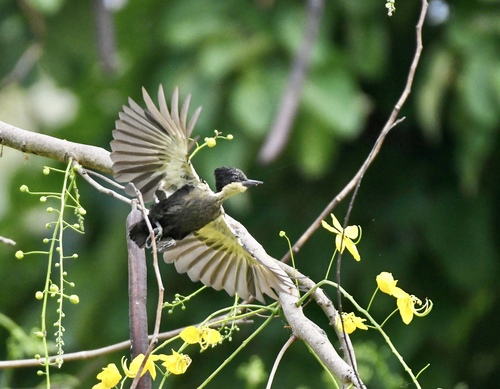
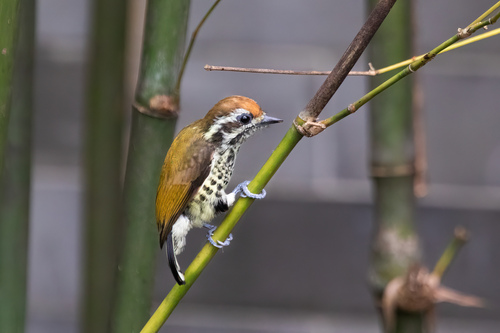
Common Flameback

Common Flameback

Dinopium javanense

Silhouette: Pepe Reigada · PhyloPic

LCLeast ConcernNTVUENCR
Daily sighting probability <5% · Rare
at Periyar National Park

In 3 days ~10% in a week ~30%

97 Verified sightings at Periyar National Park From 2019 to 2026
2,707 In all 13 parks
September Best month
🌅 Crepuscular When it's spotted

About the Common Flameback

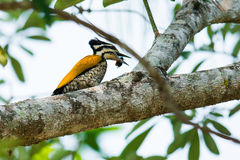
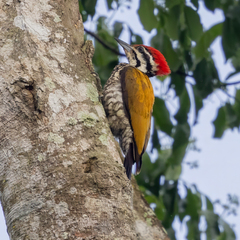
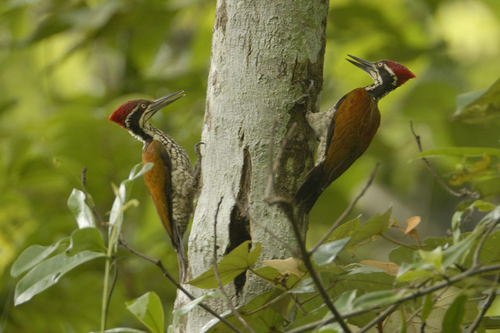
The common flameback (Dinopium javanense), also referred to as the common goldenback, is a small (28–30 cm), three-toed woodpecker in the family Picidae, found throughout South and Southeast Asia. The common flameback is closely related with almost all members of the Dinopium species, which include 4 other species; the Himalayan flameback (D. shorii), the spot-throated flameback (D. everetti), the black-rumped flameback (D. benghalense), and the red-backed flameback (D. psarodes). The olive-backed woodpecker (Gecinulus rafflesii) was formerly classified in Dinopium but is more closely related to the pale-headed woodpecker (Gecinulus grantia), and was thus reclassified into Gecinulus.

The common flameback is most closely related to the Himalayan flameback and the spot-throated flameback, even being lumped with the spot-throated flameback until recently. These two species differ in the degree of spottiness, as despite their names, the common flameback has a higher degree of spotting on the upper breast than the plain upper breast of spot-throated flameback. Additionally, the common flameback shares a unique morphological feature with two other woodpeckers, this being the... Wikipedia →

Sounds

Call0:05

Singapore · 2026

© Joan Theng · XC1186859 · CC BY-NC-SA 4.0

Begging call1:00

Singapore · 2025

© Ding Li Yong · XC1065220 · CC BY-NC-ND 4.0

Flight call0:25

Malaysia · 2024

© Lim Ying Hien · XC918808 · CC BY-NC-ND 4.0

Global Distribution

Parks Where Found

# Park Country Daily sighting probability
1 Cat Tien National Park 🇻🇳 Vietnam
~40%
2 Kaeng Krachan National Park 🇹🇭 Thailand
~30%
3 Bali Barat National Park 🇮🇩 Indonesia
~10%
4 Way Kambas National Park 🇮🇩 Indonesia
~10%
5 Periyar National Park 🇮🇳 India
<5%
6 Khao Luang National Park 🇹🇭 Thailand
<5%
7 Khao Yai National Park 🇹🇭 Thailand
<5%
8 Kinabatangan Wildlife Sanctuary 🇲🇾 Malaysia
<5%
9 Sepilok 🇲🇾 Malaysia
<5%
10 Nagarhole National Park 🇮🇳 India
<5%
11 Doi Inthanon National Park 🇹🇭 Thailand
<5%
12 Mudumalai National Park 🇮🇳 India
<5%
13 Taman Negara National Park 🇲🇾 Malaysia
<5%

Cities Where Found

# City Country Daily sighting probability
1 Kuala Lumpur 🇲🇾 Malaysia
~30%
2 Singapore 🇸🇬 Singapore
~20%
3 Johor Bahru 🇲🇾 Malaysia
~10%
4 Jakarta 🇮🇩 Indonesia
<5%
5 Bangkok 🇹🇭 Thailand
<5%

Zoos & Centres Where Found

# Zoo / Centre Country
1 Gembira Loka Zoo 🇮🇩 Indonesia In captivity

Before you go

What are the chances of seeing a Common Flameback in Periyar National Park?

Rare

Under 5% of wildlife watchers report a Common Flameback sighting in Periyar National Park on a given day, based on 97 verified sightings from GBIF citizen-science data from 2019 to 2026. It is the 139th most-seen of the 227 birds we can rate there. Over three days the chance rises to about 10%, and over a week to about 30%, if each day is a fresh chance.

When is the best time to see a Common Flameback in Periyar National Park?

May, August–September and December–January

In those months about 10% of wildlife watchers report a Common Flameback in Periyar National Park on a given day, against under 5% in February–April, June–July and October–November, the lowest months.

What time of day is best to see a Common Flameback?

Between 2 and 5 am

Across all the parks we cover, that three-hour window holds the most Common Flameback sightings with a recorded time, and about 6 in 10 of them come between 6 pm and 6 am: it is most active around dawn and dusk.

Where does the Common Flameback sighting chance come from?

GBIF citizen-science records

It is estimated from how often the Common Flameback is recorded against all the birds logged in Periyar National Park (97 verified sightings from 2019 to 2026), calibrated against known sighting rates. Figures are rounded to the nearest 10% because citizen-science data supports honest approximations, not decimals, and months with records from fewer than five people show "—". How it works.

← Back to Periyar National Park