Hooded Plover

Hooded Plover

Thinornis cucullatus

Silhouette: Rachel T Mason · PhyloPic

LCNTNear ThreatenedVUENCR Endemic
Daily sighting probability ~10% · With luck
at Phillip Island Nature Park

In 3 days ~20% in a week ~30%

231 Verified sightings at Phillip Island Nature Park From 2019 to 2026
1,078 In all 6 parks
September Best month
☀️ Diurnal When it's spotted

About the Hooded Plover

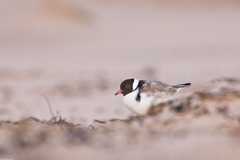
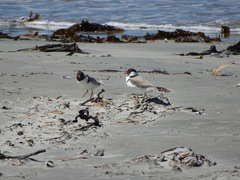
The hooded plover or hooded dotterel (Thinornis cucullatus) is a species of bird in the family Charadriidae. It is endemic to southern Australia, where it inhabits ocean beaches and subcoastal lagoons. The hooded plover was formally described in 1818 by the French ornithologist Louis Pierre Vieillot under the current binomial name Charadrius cucullatus. In the early 2000s the hooded plover was moved from the original genus Charadrius to the genus Thinornis, along with the shore plover. A molecular phylogenetic study published in 2015 found Thinornis was sister to the genus Charadrius. This was confirmed by another study published in 2022. The species is monotypic: no subspecies are recognised.

The hooded plover is medium in size for a plover, stocky, and pale in colour. Its length is 190 to 230 mm (7.5–9.1 in) and its wing...

Wikipedia →

Sounds

Call1:11

Australia · 2016

© Andrew Spencer · XC311796 · CC BY-NC-ND 4.0

Call0:09

Australia · 2023

© Peter Boesman · XC860228 · CC BY-NC-ND 4.0

Call0:07

Australia · 2020

© Marc Anderson · XC606207 · CC BY-NC-ND 4.0

Global Distribution

Parks Where Found

# Park Country Daily sighting probability
1 Maria Island National Park 🇦🇺 Australia
~60%
2 Booderee National Park 🇦🇺 Australia
~30%
3 Great Otway National Park 🇦🇺 Australia
~10%
4 Phillip Island Nature Park 🇦🇺 Australia
~10%
5 Wilsons Promontory National Park 🇦🇺 Australia
~10%
6 Freycinet National Park 🇦🇺 Australia
<5%

Before you go

What are the chances of seeing a Hooded Plover in Phillip Island Nature Park?

With luck

About 10% of wildlife watchers report a Hooded Plover sighting in Phillip Island Nature Park on a given day, based on 231 verified sightings from GBIF citizen-science data from 2019 to 2026. It is the 88th most-seen of the 149 birds we can rate there. Over three days the chance rises to about 20%, and over a week to about 30%, if each day is a fresh chance.

When is the best time to see a Hooded Plover in Phillip Island Nature Park?

July and September–March

In those months about 10% of wildlife watchers report a Hooded Plover in Phillip Island Nature Park on a given day, against under 5% in April–June and August, the lowest months.

What time of day is best to see a Hooded Plover?

Between 2 and 5 pm

Across all the parks we cover, that three-hour window holds the most Hooded Plover sightings with a recorded time, and about 9 in 10 of them come between 6 am and 6 pm: it is a daytime animal.

Which relatives of the Hooded Plover live in Phillip Island Nature Park?

Same family: Charadriidae

The closest relatives of the Hooded Plover that you can see in Phillip Island Nature Park (family Charadriidae, Plovers and Lapwings) are Masked Lapwing (about 80%), Red-Capped Plover (about 20%) and Double-Banded Plover (about 10%), with each one's daily chance of a sighting.

Where does the Hooded Plover sighting chance come from?

GBIF citizen-science records

It is estimated from how often the Hooded Plover is recorded against all the birds logged in Phillip Island Nature Park (231 verified sightings from 2019 to 2026), calibrated against known sighting rates. Figures are rounded to the nearest 10% because citizen-science data supports honest approximations, not decimals, and months with records from fewer than five people show "—". How it works.

← Back to Phillip Island Nature Park