Lesser Stag Beetle

Lesser Stag Beetle

Dorcus parallelipipedus

Daily sighting probability ~40% · Likely
at Plitvice Lakes National Park

In 3 days ~70% in a week >90%

17 Verified sightings at Plitvice Lakes National Park From 2019 to 2026
419 In all 13 parks
July Best month
🌅 Crepuscular When it's spotted

About the Lesser Stag Beetle

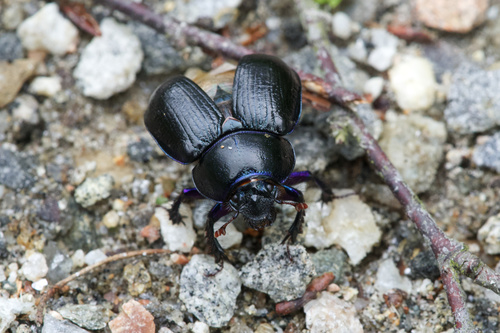
Dorcus parallelipipedus, the lesser stag beetle, is a species of stag beetle found in Europe. Both sexes resemble the female greater stag beetle (Lucanus cervus), though they are a uniformly blackish colour rather than having the chestnut brown wing covers (elytra) of the larger species. Males have distinctly knobbed antennae, and although their jaws are somewhat larger than those of the females, they are nowhere near as large as those of many other male stag beetles. The lesser stag beetle is similar in appearance to the related antelope beetle (Dorcus parallelus) of North America. Adults are from 18 to 32 mm (0.7 to 1.3 in) in length.

Like those of other stag beetles, the white, C-shaped larvae feed on wood. Adults as well as larvae are found in very soft decaying wood of broad-leaved trees, especially ash (Fraxinus excelsior), beech (Fagus sylvatica) and apple (Malus spp). Adults cannot eat solid food, but they can drink tree sap and the liquid of fallen fruits.

Adult beetles can be found in woodland, parkland and hedgerows in the summer, often resting in the sun on trees. After they mate, females lay their eggs in rotting... Wikipedia →

Global Distribution

Parks Where Found

# Park Country Daily sighting probability
1 Plitvice Lakes National Park 🇭🇷 Croatia
~40%
2 Białowieża National Park 🇵🇱 Poland
~30%
3 Triglav National Park 🇸🇮 Slovenia
~30%
4 Biebrza National Park 🇵🇱 Poland
~30%
5 Gauja National Park 🇱🇻 Latvia
~20%
6 Cévennes National Park 🇫🇷 France
~20%
7 Kiskunság National Park 🇭🇺 Hungary
~20%
8 Bavarian Forest National Park 🇩🇪 Germany
~20%
9 Picos de Europa National Park 🇪🇸 Spain
~10%
10 Aigüestortes National Park 🇪🇸 Spain
~10%
11 Fertő-Hanság National Park 🇭🇺 Hungary
~10%
12 Pyrénées National Park 🇫🇷 France
~10%
13 Sierra de Guadarrama National Park 🇪🇸 Spain
~10%

Cities Where Found

# City Country Daily sighting probability
1 Kyiv 🇺🇦 Ukraine
~30%
2 Kharkiv 🇺🇦 Ukraine
~30%
3 Essen 🇩🇪 Germany
~30%
4 Budapest 🇭🇺 Hungary
~20%
5 Vienna 🇦🇹 Austria
~20%
6 Porto 🇵🇹 Portugal
~20%
7 London 🇬🇧 United Kingdom
~20%
8 Kazan 🇷🇺 Russia
~20%
9 Sofia 🇧🇬 Bulgaria
~20%
10 Lyon 🇫🇷 France
~10%

Before you go

What are the chances of seeing a Lesser Stag Beetle in Plitvice Lakes National Park?

Likely

About 40% of wildlife watchers report a Lesser Stag Beetle sighting in Plitvice Lakes National Park on a given day, based on 17 verified sightings from GBIF citizen-science data from 2019 to 2026. It is the 12th most-seen of the 51 insects we can rate there. Over three days the chance rises to about 70%, and over a week to over 90%, if each day is a fresh chance.

When is the best time to see a Lesser Stag Beetle in Plitvice Lakes National Park?

July

In that month about 50% of wildlife watchers report a Lesser Stag Beetle in Plitvice Lakes National Park on a given day, against under 5% in April and October, the lowest months. December has too few records to rate.

What time of day is best to see a Lesser Stag Beetle?

Between 6 and 9 pm

Across all the parks we cover, that three-hour window holds the most Lesser Stag Beetle sightings with a recorded time, and about half of them come between 6 am and 6 pm: it is most active around dawn and dusk.

Is Plitvice Lakes National Park the best place to see a Lesser Stag Beetle?

Yes

Of the 13 parks where we can rate Lesser Stag Beetle sightings, Plitvice Lakes National Park has the highest daily chance: about 40%. Next come Białowieża National Park (Poland, about 30%) and Triglav National Park (Slovenia, about 30%).

Where does the Lesser Stag Beetle sighting chance come from?

GBIF citizen-science records

It is estimated from how often the Lesser Stag Beetle is recorded against all the insects logged in Plitvice Lakes National Park (17 verified sightings from 2019 to 2026), calibrated against known sighting rates. Figures are rounded to the nearest 10% because citizen-science data supports honest approximations, not decimals, and months with records from fewer than five people show "—". How it works.

← Back to Plitvice Lakes National Park