
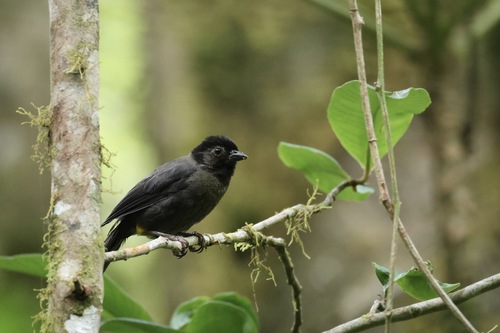
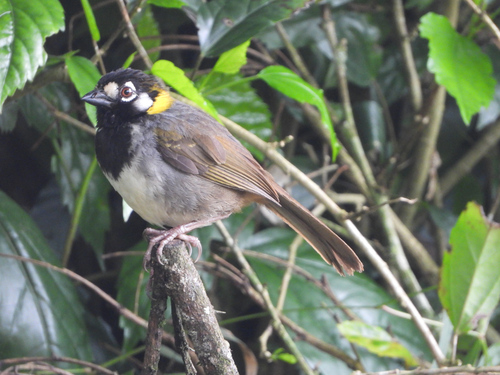
Sooty-capped Bush-Tanager

Sooty-capped Bush-Tanager

Chlorospingus pileatus

Silhouette: L. Shyamal · PhyloPic

LCLeast ConcernNTVUENCR
Daily sighting probability ~10% · With luck
at Poás Volcano National Park

In 3 days ~30% in a week ~60%

446 Verified sightings at Poás Volcano National Park From 2019 to 2026
18,956 In all 9 parks
August Best month
☀️ Diurnal When it's spotted

About the Sooty-capped Bush-Tanager

The sooty-capped chlorospingus (Chlorospingus pileatus) or sooty-capped bush tanager, is a small passerine bird in the family Passerellidae, the New World sparrows. It is found in Costa Rica and Panama. The sooty-capped chlorospingus was formally described in 1865 with its current binomial Chlorospingus pileatus. At the time the Chlorospingus species were members of the family Thraupidae, the "true" tanagers, though their positions within the family were uncertain. Based on studies published in 2002, 2003, and 2007, beginning in 2010 taxonomic systems transferred Chlorospingus to its present sparrow family. The Chlorospingus species were originally called "bush tanagers" or "bush-tanagers". Beginning in 2013 systems began changing the English name of the members of the genus to "chlorospingus" because they were no longer considered tanagers.

The sooty-capped chlorospingus' further taxonomy is unresolved. The IOC, AviList, and BirdLife International's Handbook of the Birds of the World treat it as monotypic. In addition to the systems that do not... Wikipedia →

Sounds

Song0:24

Costa Rica · 2022

© Brendan Sloan · XC731215 · CC BY-NC-ND 4.0

Call0:45

Costa Rica · 2019

© Odirlei Vieira da Fonseca · XC552503 · CC BY-NC-SA 4.0

Dawn song1:19

Panama · 2009

© Andrew Spencer · XC31758 · CC BY-NC-ND 2.5

Global Distribution

Parks Where Found

# Park Country Daily sighting probability
1 Irazú Volcano National Park 🇨🇷 Costa Rica
~80%
2 Los Quetzales National Park 🇨🇷 Costa Rica
~70%
3 Tapantí-Macizo de la Muerte National Park 🇨🇷 Costa Rica
~50%
4 Volcán Barú National Park 🇵🇦 Panama
~20%
5 Poás Volcano National Park 🇨🇷 Costa Rica
~10%
6 Braulio Carrillo National Park 🇨🇷 Costa Rica
~10%
7 Chirripó National Park 🇨🇷 Costa Rica
~10%
8 La Amistad International Park (Panama) 🇵🇦 Panama
~10%
9 Monteverde Cloud Forest Reserve 🇨🇷 Costa Rica
<5%

Before you go

What are the chances of seeing a Sooty-capped Bush-Tanager in Poás Volcano National Park?

With luck

About 10% of wildlife watchers report a Sooty-capped Bush-Tanager sighting in Poás Volcano National Park on a given day, based on 446 verified sightings from GBIF citizen-science data from 2019 to 2026. It is the 60th most-seen of the 356 birds we can rate there. Over three days the chance rises to about 30%, and over a week to about 60%, if each day is a fresh chance.

When is the best time to see a Sooty-capped Bush-Tanager in Poás Volcano National Park?

January, August and October

In those months about 20% of wildlife watchers report a Sooty-capped Bush-Tanager in Poás Volcano National Park on a given day, against about 10% in February–July, September and November–December, the lowest months.

What time of day is best to see a Sooty-capped Bush-Tanager?

Between 6 and 9 am

Across all the parks we cover, that three-hour window holds the most Sooty-capped Bush-Tanager sightings with a recorded time, and about 9 in 10 of them come between 6 am and 6 pm: it is a daytime animal.

Where does the Sooty-capped Bush-Tanager sighting chance come from?

GBIF citizen-science records

It is estimated from how often the Sooty-capped Bush-Tanager is recorded against all the birds logged in Poás Volcano National Park (446 verified sightings from 2019 to 2026), calibrated against known sighting rates. Figures are rounded to the nearest 10% because citizen-science data supports honest approximations, not decimals, and months with records from fewer than five people show "—". How it works.

← Back to Poás Volcano National Park