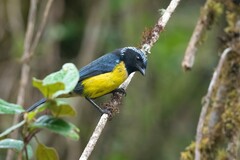
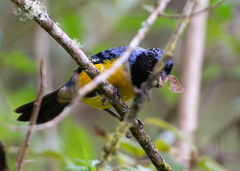
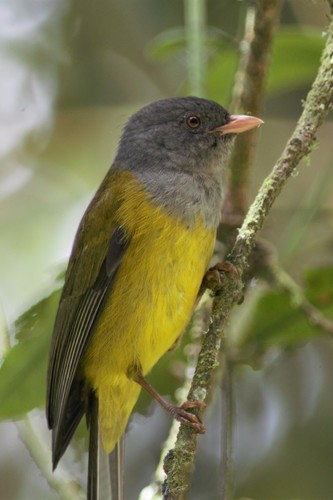
Buff-breasted Mountain-Tanager

Buff-breasted Mountain-Tanager

Dubusia taeniata

Silhouette: Sheatherius · PhyloPic

LCLeast ConcernNTVUENCR
Daily sighting probability ~10% · With luck
at Podocarpus National Park

In 3 days ~30% in a week ~50%

142 Verified sightings at Podocarpus National Park From 2019 to 2026
691 In all 3 parks
August Best month
☀️ Diurnal When it's spotted

About the Buff-breasted Mountain-Tanager

The buff-banded mountain tanager (Dubusia taeniata), formerly known as the buff-breasted mountain tanager, is a species of Neotropical bird in the tanager family Thraupidae. It is found in Bolivia, Colombia, Ecuador, Peru, and Venezuela. Its natural habitat is subtropical or tropical moist montane forests.

The buff-banded mountain tanager was formally described in 1840 by the French ornithologist Auguste Boissonneau from a specimen collected near Bogotá in Colombia. He coined the binomial name Tanagra taeniata. The specific epithet is the Latin word for a "head-band". This species is now placed in the genus Dubusia that was introduced in 1850 by the French naturalist Charles Lucien Bonaparte.

The streak-crowned mountain tanager and Carriker's mountain tanager were previously treated as subspecies of the buff-banded mountain tanager. They are currently recognized as separate species. Before the split the buff-banded mountain tanager was known as the buff-breasted mountain tanager.

Xeno-canto: audio recordings of the buff-breasted mountain tanager Wikipedia →

Sounds

Song0:20

Ecuador · 2026

© Daan van der Hoeven · XC1154897 · CC BY-NC-SA 4.0

Uncertain0:50

Colombia · 2020

© Julio Delgado · XC607006 · CC BY-NC-SA 4.0

Call0:08

Colombia · 2016

© Ross Gallardy · XC353735 · CC BY-NC-SA 4.0

Global Distribution

Parks Where Found

# Park Country Daily sighting probability
1 Chingaza National Natural Park 🇨🇴 Colombia
~20%
2 Podocarpus National Park 🇪🇨 Ecuador
~10%
3 Los Nevados National Natural Park 🇨🇴 Colombia
~10%

Cities Where Found

# City Country Daily sighting probability
1 Quito 🇪🇨 Ecuador
<5%
2 Bogota 🇨🇴 Colombia
<5%

Before you go

What are the chances of seeing a Buff-breasted Mountain-Tanager in Podocarpus National Park?

With luck

About 10% of wildlife watchers report a Buff-breasted Mountain-Tanager sighting in Podocarpus National Park on a given day, based on 142 verified sightings from GBIF citizen-science data from 2019 to 2026. It is the 134th most-seen of the 446 birds we can rate there. Over three days the chance rises to about 30%, and over a week to about 50%, if each day is a fresh chance.

When is the best time to see a Buff-breasted Mountain-Tanager in Podocarpus National Park?

August

In that month about 20% of wildlife watchers report a Buff-breasted Mountain-Tanager in Podocarpus National Park on a given day, against under 5% in December, the lowest month.

What time of day is best to see a Buff-breasted Mountain-Tanager?

Between 7 and 10 am

Across all the parks we cover, that three-hour window holds the most Buff-breasted Mountain-Tanager sightings with a recorded time, and about 9 in 10 of them come between 6 am and 6 pm: it is a daytime animal.

Is Podocarpus National Park the best place to see a Buff-breasted Mountain-Tanager?

2nd of 3

Of the 3 parks where we can rate Buff-breasted Mountain-Tanager sightings, Podocarpus National Park ranks 2nd at about 10%. The best odds are in Chingaza National Natural Park (Colombia, about 20%).

Which relatives of the Buff-breasted Mountain-Tanager live in Podocarpus National Park?

Same family: Thraupidae

The closest relatives of the Buff-breasted Mountain-Tanager that you can see in Podocarpus National Park (family Thraupidae, Tanagers and Allies) are Lacrimose Mountain-Tanager (about 40%), Masked Flowerpiercer (about 40%) and Blue-necked Tanager (about 30%), with each one's daily chance of a sighting.

Where does the Buff-breasted Mountain-Tanager sighting chance come from?

GBIF citizen-science records

It is estimated from how often the Buff-breasted Mountain-Tanager is recorded against all the birds logged in Podocarpus National Park (142 verified sightings from 2019 to 2026), calibrated against known sighting rates. Figures are rounded to the nearest 10% because citizen-science data supports honest approximations, not decimals, and months with records from fewer than five people show "—". How it works.

← Back to Podocarpus National Park