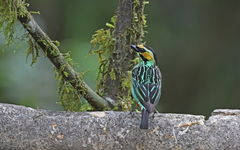
Golden-eared Tanager

Golden-eared Tanager

Tangara chrysotis

Silhouette: Sheatherius · PhyloPic

LCLeast ConcernNTVUENCR
Daily sighting probability ~10% · With luck
at Podocarpus National Park

In 3 days ~40% in a week ~70%

254 Verified sightings at Podocarpus National Park From 2019 to 2026
254 In 1 park
July Best month
☀️ Diurnal When it's spotted

About the Golden-eared Tanager

The golden-eared tanager (Tangara chrysotis) is a species of bird in the tanager family Thraupidae. It is found in the eastern Andes of Bolivia, Colombia, Ecuador and Peru where its natural habitat is subtropical or tropical moist montane forests.

The golden-eared tanager was first described as Calliste chrysotis by Bernard du Bus de Gisignies in 1846, on the basis of a specimen collected from Peru. The generic name Tangara comes from the Tupí word tangara, which means dancer. The specific name chrysotis is from the Ancient Greek χρυσος (khrusos), meaning golden, and ωτις (otis), meaning eared. Golden-eared tanager is the official common name designated by the International Ornithologists' Union (IOC). Other names for the species include golden eared tanager.

The golden-eared tanager is one of 27 species in the genus Tangara. Within the genus, it is put in a species group with the blue-whiskered tanager, green-and-gold tanager, emerald tanager, golden tanager, silver-throated tanager, saffron-crowned tanager, and flame-faced tanager. The golden-eared tanager is sister to a clade formed by the rest of the species in this group. This placement has been supported... Wikipedia →

Sounds

Call0:24

Colombia · 2022

© Mauricio Cuéllar Ramírez · XC750605 · CC BY-NC-SA 4.0

Call0:32

Ecuador · 1998

© Mitch Lysinger · XC261178 · CC BY-NC-SA 4.0

Call0:36

Peru · 2010

© Andrew Spencer · XC45636 · CC BY-NC-ND 2.5

Global Distribution

Parks Where Found

# Park Country Daily sighting probability
1 Podocarpus National Park 🇪🇨 Ecuador
~10%

More parks will be added in future updates.

Before you go

What are the chances of seeing a Golden-eared Tanager in Podocarpus National Park?

With luck

About 10% of wildlife watchers report a Golden-eared Tanager sighting in Podocarpus National Park on a given day, based on 254 verified sightings from GBIF citizen-science data from 2019 to 2026. It is the 84th most-seen of the 446 birds we can rate there. Over three days the chance rises to about 40%, and over a week to about 70%, if each day is a fresh chance.

When is the best time to see a Golden-eared Tanager in Podocarpus National Park?

July and August

In those months about 30% of wildlife watchers report a Golden-eared Tanager in Podocarpus National Park on a given day, against about 10% in November to May, the lowest months.

What time of day is best to see a Golden-eared Tanager?

Between 7 and 10 am

Across all the parks we cover, that three-hour window holds the most Golden-eared Tanager sightings with a recorded time, and about 9 in 10 of them come between 6 am and 6 pm: it is a daytime animal.

Where else can you see a Golden-eared Tanager?

Only Podocarpus National Park, in our data

Podocarpus National Park is the only park on Wallace's Line with enough records to rate Golden-eared Tanager sightings: about 10% of wildlife watchers there report one on a given day.

Which relatives of the Golden-eared Tanager live in Podocarpus National Park?

Same genus: Tangara

The closest relatives of the Golden-eared Tanager that you can see in Podocarpus National Park (genus Tangara, Tangara Tanagers) are Green-and-gold Tanager (about 30%), Paradise Tanager (about 30%) and Blue-and-black Tanager (about 30%), with each one's daily chance of a sighting.

Where does the Golden-eared Tanager sighting chance come from?

GBIF citizen-science records

It is estimated from how often the Golden-eared Tanager is recorded against all the birds logged in Podocarpus National Park (254 verified sightings from 2019 to 2026), calibrated against known sighting rates. Figures are rounded to the nearest 10% because citizen-science data supports honest approximations, not decimals, and months with records from fewer than five people show "—". How it works.

← Back to Podocarpus National Park

