Flame-faced Tanager

Flame-faced Tanager

Tangara parzudakii

Silhouette: Sheatherius · PhyloPic

LCLeast ConcernNTVUENCR
Daily sighting probability <5% · Rare
at Podocarpus National Park

In 3 days ~10%

30 Verified sightings at Podocarpus National Park From 2019 to 2026
50 In all 3 parks
July Best month
☀️ Diurnal When it's spotted

About the Flame-faced Tanager

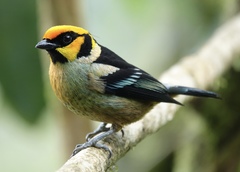
The flame-faced tanager (Tangara parzudakii) is a species of bird in the tanager family Thraupidae. It is endemic to South America and is found in the eastern Andes of Colombia, Ecuador, Peru and Venezuela. Its natural habitat is subtropical or tropical moist montane forests. It is a distinctive-looking species with black and opalescent green upperparts, opalescent green and buff underparts, and a deep red and yellow face. The subspecies lunigera lacks the deep red on the face, which is replaced with orangish-red.

It is omnivorous and feeds on fruit and arthropods. Foraging is conducted nearly exclusively on mossy branches. Breeding occurs in the rainy season. Eggs are laid in clutches of two, and are white with pale brown flecking concentrated on the larger end. Fledglings are fed by both parents. The flame-faced tanager is listed as being of least concern by the International Union for Conservation of Nature (IUCN) on the IUCN Red List. However, it is facing population declines due to habitat destruction.

The flame-faced tanager was first described as Tanagra Parzudakii by Frédéric Lafresnaye in 1843, on the basis of specimens collected around Santa... Wikipedia →

Sounds

Call0:22

Ecuador · 2024

© Manuel Sánchez-Nivicela · XC1142545 · CC BY-NC-ND 4.0

Begging call0:16

Peru · 2011

© Andrew Spencer · XC97802 · CC BY-NC-ND 2.5

Call0:18

Ecuador · 2020

© Manuel Sanchez-Nivicela · XC949171 · CC BY-NC-ND 4.0

Global Distribution

Parks Where Found

# Park Country Daily sighting probability
1 Podocarpus National Park 🇪🇨 Ecuador
<5%
2 Chingaza National Natural Park 🇨🇴 Colombia
<5%
3 Los Nevados National Natural Park 🇨🇴 Colombia
<5%

Before you go

What are the chances of seeing a Flame-faced Tanager in Podocarpus National Park?

Rare

Under 5% of wildlife watchers report a Flame-faced Tanager sighting in Podocarpus National Park on a given day, based on 30 verified sightings from GBIF citizen-science data from 2019 to 2026. It is the 274th most-seen of the 446 birds we can rate there. Over three days the chance rises to about 10%, if each day is a fresh chance.

When is the best time to see a Flame-faced Tanager in Podocarpus National Park?

July

In that month about 10% of wildlife watchers report a Flame-faced Tanager in Podocarpus National Park on a given day, against under 5% in August to June, the lowest months.

What time of day is best to see a Flame-faced Tanager?

Between 7 and 10 am

Across all the parks we cover, that three-hour window holds the most Flame-faced Tanager sightings with a recorded time, and about 9 in 10 of them come between 6 am and 6 pm: it is a daytime animal.

Is Podocarpus National Park the best place to see a Flame-faced Tanager?

Yes

Of the 3 parks where we can rate Flame-faced Tanager sightings, Podocarpus National Park has the highest daily chance: under 5%. Next come Chingaza National Natural Park (Colombia, under 5%) and Los Nevados National Natural Park (Colombia, under 5%).

Which relatives of the Flame-faced Tanager live in Podocarpus National Park?

Same genus: Tangara

The closest relatives of the Flame-faced Tanager that you can see in Podocarpus National Park (genus Tangara, Tangara Tanagers) are Green-and-gold Tanager (about 30%), Paradise Tanager (about 30%) and Blue-and-black Tanager (about 30%), with each one's daily chance of a sighting.

Where does the Flame-faced Tanager sighting chance come from?

GBIF citizen-science records

It is estimated from how often the Flame-faced Tanager is recorded against all the birds logged in Podocarpus National Park (30 verified sightings from 2019 to 2026), calibrated against known sighting rates. Figures are rounded to the nearest 10% because citizen-science data supports honest approximations, not decimals, and months with records from fewer than five people show "—". How it works.

← Back to Podocarpus National Park