
Beryl-spangled Tanager

Beryl-spangled Tanager

Tangara nigroviridis

Silhouette: Sheatherius · PhyloPic

LCLeast ConcernNTVUENCR
Daily sighting probability ~10% · With luck
at Podocarpus National Park

In 3 days ~10% in a week ~30%

73 Verified sightings at Podocarpus National Park From 2019 to 2026
1,031 In all 5 parks
December Best month
☀️ Diurnal When it's spotted

About the Beryl-spangled Tanager

The beryl-spangled tanager (Tangara nigroviridis) is a small songbird of the northern Andes. First described by Frédéric de Lafresnaye in 1843, the beryl-spangled tanager is one of 28 tanager species in the genus Tangara.

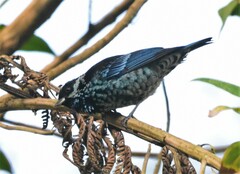
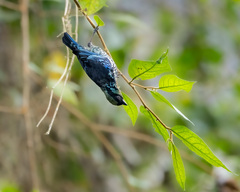
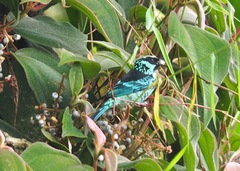
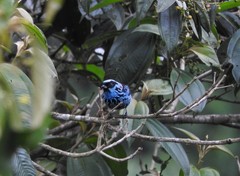
It is a small songbird, measuring 13 cm (5.1 in) in length. Its plumage is largely turquoise, though heavily marked with black spots and scales. Its breast and belly are primarily black, with opalescent greenish spotting.

The beryl-spangled tanager is found on the eastern slopes of the Andes from Venezuela, through Colombia, Ecuador, and Peru, to Bolivia. In Ecuador, it is found at elevations ranging from 700–2,500 m (2,300–8,200 ft), while in Peru it ranges somewhat higher – from 1,500–2,900 m (4,900–9,500 ft). It occurs in humid montane forest and second growth.

Robert Ridgely & Guy Tudor, Birds of South America Vol. 1 (Univ. Texas Press, 1989). Wikipedia →

Sounds

Call1:26

Ecuador · 2018

© Manuel Sánchez-Nivicela · XC1048670 · CC BY-NC-ND 4.0

Begging call0:11

Ecuador · 2006

© Olaf Jahn · XC262569 · CC BY-NC-SA 4.0

Song?0:54

Ecuador · 2008

© Mitch Lysinger · XC261182 · CC BY-NC-SA 4.0

Global Distribution

Parks Where Found

# Park Country Daily sighting probability
1 Los Nevados National Natural Park 🇨🇴 Colombia
~10%
2 Farallones de Cali National Natural Park 🇨🇴 Colombia
~10%
3 Henri Pittier National Park 🇻🇪 Venezuela
~10%
4 Podocarpus National Park 🇪🇨 Ecuador
~10%
5 Chingaza National Natural Park 🇨🇴 Colombia
<5%

Before you go

What are the chances of seeing a Beryl-spangled Tanager in Podocarpus National Park?

With luck

About 10% of wildlife watchers report a Beryl-spangled Tanager sighting in Podocarpus National Park on a given day, based on 73 verified sightings from GBIF citizen-science data from 2019 to 2026. It is the 187th most-seen of the 446 birds we can rate there. Over three days the chance rises to about 10%, and over a week to about 30%, if each day is a fresh chance.

When is the best time to see a Beryl-spangled Tanager in Podocarpus National Park?

December

In that month about 20% of wildlife watchers report a Beryl-spangled Tanager in Podocarpus National Park on a given day, against under 5% in January–February, June–August and October–November, the lowest months.

What time of day is best to see a Beryl-spangled Tanager?

Between 8 and 11 am

Across all the parks we cover, that three-hour window holds the most Beryl-spangled Tanager sightings with a recorded time, and about 9 in 10 of them come between 6 am and 6 pm: it is a daytime animal.

Which relatives of the Beryl-spangled Tanager live in Podocarpus National Park?

Same genus: Tangara

The closest relatives of the Beryl-spangled Tanager that you can see in Podocarpus National Park (genus Tangara, Tangara Tanagers) are Green-and-gold Tanager (about 30%), Paradise Tanager (about 30%) and Blue-and-black Tanager (about 30%), with each one's daily chance of a sighting.

Where does the Beryl-spangled Tanager sighting chance come from?

GBIF citizen-science records

It is estimated from how often the Beryl-spangled Tanager is recorded against all the birds logged in Podocarpus National Park (73 verified sightings from 2019 to 2026), calibrated against known sighting rates. Figures are rounded to the nearest 10% because citizen-science data supports honest approximations, not decimals, and months with records from fewer than five people show "—". How it works.

← Back to Podocarpus National Park