Bay-headed Tanager

Bay-headed Tanager

Tangara gyrola

Silhouette: Sheatherius · PhyloPic

LCLeast ConcernNTVUENCR
Daily sighting probability ~20% · Possible
at Podocarpus National Park

In 3 days ~50% in a week ~80%

297 Verified sightings at Podocarpus National Park From 2019 to 2026
14,865 In all 29 parks
September Best month
☀️ Diurnal When it's spotted

About the Bay-headed Tanager

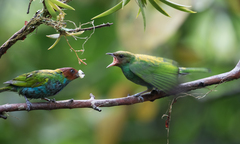
The bay-headed tanager (Tangara gyrola) is a medium-sized passerine bird. This tanager is a resident breeder in Costa Rica, Panama, South America south to Ecuador, Bolivia, and north-western Brazil, and on Trinidad. The bay-headed tanager was formally described by the Swedish naturalist Carl Linnaeus in 1758 in the tenth edition of his Systema Naturae under the binomial name Fringilla gyrola. The specific epithet is a diminutive of the Latin gyrus meaning "ring". Linnaeus based his own description on the "red-headed green-finch" that had been described and illustrated by the English naturalist George Edwards in 1743 in his A Natural History of Uncommon Birds. The type locality is Suriname. The bay-headed tanager is now placed in the genus Tangara that was introduced by the French zoologist Mathurin Jacques Brisson in 1760.

Nine subspecies are recognised: Wikipedia →

Sounds

Call0:48

Ecuador · 2025

© Manuel Sánchez-Nivicela · XC1104064 · CC BY-NC-ND 4.0

Flight call0:04

Ecuador · 2023

© Manuel Sanchez-Nivicela · XC937237 · CC BY-NC-ND 4.0

Begging call0:11

Panama · 2020

© Kent Livezey · XC592206 · CC BY-NC-SA 4.0

Global Distribution

Parks Where Found

# Park Country Daily sighting probability
1 Chagres National Park 🇵🇦 Panama
~70%
2 Henri Pittier National Park 🇻🇪 Venezuela
~50%
3 Farallones de Cali National Natural Park 🇨🇴 Colombia
~30%
4 Chirripó National Park 🇨🇷 Costa Rica
~30%
5 Arenal Volcano National Park 🇨🇷 Costa Rica
~30%
6 Darién National Park 🇵🇦 Panama
~20%
7 Brownsberg Nature Park 🇸🇷 Suriname
~20%
8 Podocarpus National Park 🇪🇨 Ecuador
~20%
9 Piedras Blancas National Park 🇨🇷 Costa Rica
~20%
10 Tapantí-Macizo de la Muerte National Park 🇨🇷 Costa Rica
~20%
11 La Amistad International Park (Panama) 🇵🇦 Panama
~10%
12 Poás Volcano National Park 🇨🇷 Costa Rica
~10%
13 Carara National Park 🇨🇷 Costa Rica
~10%
14 Braulio Carrillo National Park 🇨🇷 Costa Rica
~10%
15 Corcovado National Park 🇨🇷 Costa Rica
~10%
16 Sierra de la Macarena National Park 🇨🇴 Colombia
<5%
17 Tenorio Volcano National Park 🇨🇷 Costa Rica
<5%
18 Volcán Barú National Park 🇵🇦 Panama
<5%
19 Los Nevados National Natural Park 🇨🇴 Colombia
<5%
20 Yasuní National Park 🇪🇨 Ecuador
<5%
21 Amboró National Park 🇧🇴 Bolivia
<5%
22 Marino Ballena National Park 🇨🇷 Costa Rica
<5%
23 Manu National Park 🇵🇪 Peru
<5%
24 Rincón de la Vieja National Park 🇨🇷 Costa Rica
<5%
25 Chingaza National Natural Park 🇨🇴 Colombia
<5%
26 Tayrona National Natural Park 🇨🇴 Colombia
<5%
27 Soberanía National Park 🇵🇦 Panama
<5%
28 Monteverde Cloud Forest Reserve 🇨🇷 Costa Rica
<5%
29 Los Quetzales National Park 🇨🇷 Costa Rica
<5%

Cities Where Found

# City Country Daily sighting probability
1 Medellín 🇨🇴 Colombia
<5%
2 Caracas 🇻🇪 Venezuela
<5%
3 Cali 🇨🇴 Colombia
<5%
4 Valencia 🇻🇪 Venezuela
<5%

Zoos & Centres Where Found

# Zoo / Centre Country
1 Basel Zoo 🇨🇭 Switzerland In captivity
2 Tierpark Berlin 🇩🇪 Germany In captivity
3 California Academy of Sciences 🇺🇸 United States In captivity
4 Woodland Park Zoo 🇺🇸 United States In captivity
5 Eindhoven Zoo 🇳🇱 Netherlands In captivity
6 La Paz Waterfall Gardens 🇨🇷 Costa Rica In captivity
7 Dallas World Aquarium 🇺🇸 United States In captivity
8 National Aquarium 🇺🇸 United States In captivity

Before you go

What are the chances of seeing a Bay-headed Tanager in Podocarpus National Park?

Possible

About 20% of wildlife watchers report a Bay-headed Tanager sighting in Podocarpus National Park on a given day, based on 297 verified sightings from GBIF citizen-science data from 2019 to 2026. It is the 62nd most-seen of the 446 birds we can rate there. Over three days the chance rises to about 50%, and over a week to about 80%, if each day is a fresh chance.

When is the best time to see a Bay-headed Tanager in Podocarpus National Park?

July and September

In those months about 30% of wildlife watchers report a Bay-headed Tanager in Podocarpus National Park on a given day, against about 10% in May–June, August and October, the lowest months.

What time of day is best to see a Bay-headed Tanager?

Between 8 and 11 am

Across all the parks we cover, that three-hour window holds the most Bay-headed Tanager sightings with a recorded time, and about 9 in 10 of them come between 6 am and 6 pm: it is a daytime animal.

Which relatives of the Bay-headed Tanager live in Podocarpus National Park?

Same genus: Tangara

The closest relatives of the Bay-headed Tanager that you can see in Podocarpus National Park (genus Tangara, Tangara Tanagers) are Green-and-gold Tanager (about 30%), Paradise Tanager (about 30%) and Blue-and-black Tanager (about 30%), with each one's daily chance of a sighting.

Where does the Bay-headed Tanager sighting chance come from?

GBIF citizen-science records

It is estimated from how often the Bay-headed Tanager is recorded against all the birds logged in Podocarpus National Park (297 verified sightings from 2019 to 2026), calibrated against known sighting rates. Figures are rounded to the nearest 10% because citizen-science data supports honest approximations, not decimals, and months with records from fewer than five people show "—". How it works.

← Back to Podocarpus National Park

