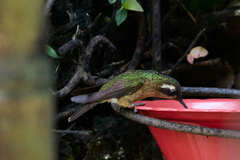

Speckled Hummingbird

Speckled Hummingbird

Adelomyia melanogenys

Silhouette: Ferran Sayol · PhyloPic

LCLeast ConcernNTVUENCR
Daily sighting probability ~10% · With luck
at Podocarpus National Park

In 3 days ~40% in a week ~70%

220 Verified sightings at Podocarpus National Park From 2019 to 2026
1,217 In all 6 parks
October Best month
☀️ Diurnal When it's spotted

About the Speckled Hummingbird

The speckled hummingbird (Adelomyia melanogenys) is a species of hummingbird. It is the only member of the genus Adelomyia. It inhabits Neotropical montane cloud forests at elevations of 1,000–2,500 meters and is confined to the Andes of Argentina, Bolivia, Peru, Ecuador, Colombia and Venezuela; as well as to some isolated montane forests in western Ecuador and Venezuela. In Ecuador, it ranges across both the eastern and western slopes of the Andes and occupies a broad altitudinal range from subtropical forests (1400 m) to cloud forests (3000 m). In addition, one isolated population inhabits the Chongón Colonche cordillera in the coastal evergreen montane forest (600 m) located ca. 130 km away from the Andes.

The speckled hummingbird is a monomorphic species, making females and males indistinguishable. Adults measure approximately 8 cm, or 3 inches, in length (from bill to tip of tail). The upper plumage is a glossy green/bronze. The underside is pale, with green and bronze specks. It has a black cheek patch below its eye with a white stripe above.

While the speckled hummingbird is the only species in its genus, evidence suggests that populations... Wikipedia →

Sounds

Call0:29

Ecuador · 2024

© Manuel Sánchez-Nivicela · XC1152558 · CC BY-NC-ND 4.0

Song0:29

Colombia · 2022

© Frank Lambert · XC1031704 · CC BY-NC-ND 4.0

Uncertain0:14

Colombia · 2021

© Mauricio Cuellar Ramirez (@Birding.travel) · XC614059 · CC BY-NC-SA 4.0

Global Distribution

Parks Where Found

# Park Country Daily sighting probability
1 Podocarpus National Park 🇪🇨 Ecuador
~10%
2 Los Nevados National Natural Park 🇨🇴 Colombia
~10%
3 Farallones de Cali National Natural Park 🇨🇴 Colombia
~10%
4 Henri Pittier National Park 🇻🇪 Venezuela
~10%
5 Chingaza National Natural Park 🇨🇴 Colombia
<5%
6 Manu National Park 🇵🇪 Peru
<5%

Cities Where Found

# City Country Daily sighting probability
1 Quito 🇪🇨 Ecuador
<5%
2 Cali 🇨🇴 Colombia
<5%

Before you go

What are the chances of seeing a Speckled Hummingbird in Podocarpus National Park?

With luck

About 10% of wildlife watchers report a Speckled Hummingbird sighting in Podocarpus National Park on a given day, based on 220 verified sightings from GBIF citizen-science data from 2019 to 2026. It is the 85th most-seen of the 446 birds we can rate there. Over three days the chance rises to about 40%, and over a week to about 70%, if each day is a fresh chance.

When is the best time to see a Speckled Hummingbird in Podocarpus National Park?

October

In that month about 30% of wildlife watchers report a Speckled Hummingbird in Podocarpus National Park on a given day, against under 5% in February and May, the lowest months.

What time of day is best to see a Speckled Hummingbird?

Between 10 am and 1 pm

Across all the parks we cover, that three-hour window holds the most Speckled Hummingbird sightings with a recorded time, and about 9 in 10 of them come between 6 am and 6 pm: it is a daytime animal.

Which relatives of the Speckled Hummingbird live in Podocarpus National Park?

Same family: Trochilidae

The closest relatives of the Speckled Hummingbird that you can see in Podocarpus National Park (family Trochilidae, Hummingbirds) are Collared Inca (about 40%), Amethyst-throated Sunangel (about 40%) and Chestnut-breasted Coronet (about 40%), with each one's daily chance of a sighting.

Where does the Speckled Hummingbird sighting chance come from?

GBIF citizen-science records

It is estimated from how often the Speckled Hummingbird is recorded against all the birds logged in Podocarpus National Park (220 verified sightings from 2019 to 2026), calibrated against known sighting rates. Figures are rounded to the nearest 10% because citizen-science data supports honest approximations, not decimals, and months with records from fewer than five people show "—". How it works.

← Back to Podocarpus National Park