

White-banded Swallow

White-banded Swallow

Atticora fasciata

Silhouette: Sheatherius · PhyloPic

LCLeast ConcernNTVUENCR
Daily sighting probability <5% · Rare
at Podocarpus National Park

In 3 days ~10% in a week ~20%

58 Verified sightings at Podocarpus National Park From 2019 to 2026
3,911 In all 7 parks
May Best month
☀️ Diurnal When it's spotted

About the White-banded Swallow

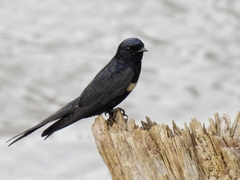
The white-banded swallow (Atticora fasciata) is a species of bird in the family Hirundinidae. It is black with white thighs, a white breast, and has white bars on the edges of its wings. It has a distinct, deeply forked tail.

It is found in Bolivia, Brazil, Colombia, Ecuador, French Guiana, Guyana, Peru, Suriname, and Venezuela, in tropical lowlands. It is non-migratory. Its natural habitats are rivers and forested areas. It nests in burrows and does not use artificial cavities.

The white-banded swallow is evaluated as of least-concern by the International Union for Conservation of Nature (IUCN). The white-banded swallow was formally described in 1789 by the German naturalist Johann Friedrich Gmelin in his revised and expanded edition of Carl Linnaeus's Systema Naturae. He placed it with the swallows in the genus Hirundo and coined the binomial name Hirundo fasciata. Gmelin based his entry on "L'hirondelle à ceinture blanche" from Cayenne in French Guiana that had been described in 1779 by the French polymath, the Comte de Buffon. The bird was illustrated with an engraving by François-Nicolas Martinet. The white-banded swallow is now one of three species placed in the... Wikipedia →

Sounds

Flight call0:25

Brazil · 2026

© JAYRSON ARAUJO DE OLIVEIRA · XC1183904 · CC BY-NC-SA 4.0

Song1:22

Colombia · 2022

© Frank Lambert · XC1043178 · CC BY-NC-ND 4.0

Call0:11

Colombia · 2021

© Mauricio Cuellar Ramirez (@Birding.travel) · XC618927 · CC BY-NC-SA 4.0

Global Distribution

Parks Where Found

# Park Country Daily sighting probability
1 Cuyabeno Wildlife Reserve 🇪🇨 Ecuador
~30%
2 Manu National Park 🇵🇪 Peru
~30%
3 Yasuní National Park 🇪🇨 Ecuador
~30%
4 Tambopata National Reserve 🇵🇪 Peru
~30%
5 Sierra de la Macarena National Park 🇨🇴 Colombia
~20%
6 Amacayacu National Natural Park 🇨🇴 Colombia
~10%
7 Podocarpus National Park 🇪🇨 Ecuador
<5%

Before you go

What are the chances of seeing a White-banded Swallow in Podocarpus National Park?

Rare

Under 5% of wildlife watchers report a White-banded Swallow sighting in Podocarpus National Park on a given day, based on 58 verified sightings from GBIF citizen-science data from 2019 to 2026. It is the 210th most-seen of the 446 birds we can rate there. Over three days the chance rises to about 10%, and over a week to about 20%, if each day is a fresh chance.

When is the best time to see a White-banded Swallow in Podocarpus National Park?

March, May–June and August

In those months about 10% of wildlife watchers report a White-banded Swallow in Podocarpus National Park on a given day, against under 5% in April, July and September–February, the lowest months.

What time of day is best to see a White-banded Swallow?

Between 10 am and 1 pm

Across all the parks we cover, that three-hour window holds the most White-banded Swallow sightings with a recorded time, and about 8 in 10 of them come between 6 am and 6 pm: it is a daytime animal.

Is Podocarpus National Park the best place to see a White-banded Swallow?

7th of 7

Of the 7 parks where we can rate White-banded Swallow sightings, Podocarpus National Park ranks 7th at under 5%. The best odds are in Cuyabeno Wildlife Reserve (Ecuador, about 30%), Manu National Park (Peru, about 30%) and Yasuní National Park (Ecuador, about 30%).

Which relatives of the White-banded Swallow live in Podocarpus National Park?

Same family: Hirundinidae

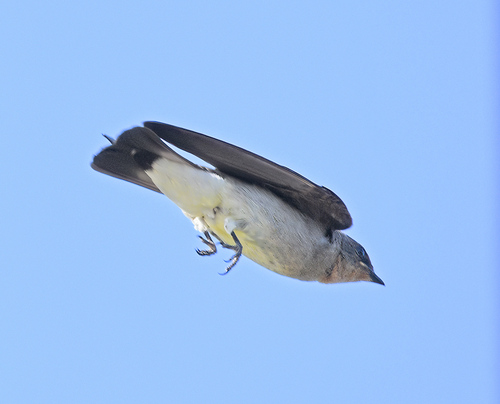
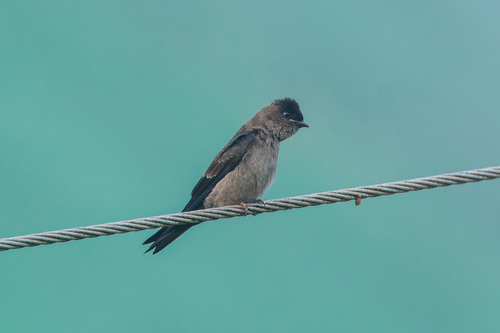
The closest relatives of the White-banded Swallow that you can see in Podocarpus National Park (family Hirundinidae, Swallows and Martins) are Blue-and-white Swallow (about 30%), Brown-bellied Swallow (about 10%) and Pale-footed Swallow (about 10%), with each one's daily chance of a sighting.

Where does the White-banded Swallow sighting chance come from?

GBIF citizen-science records

It is estimated from how often the White-banded Swallow is recorded against all the birds logged in Podocarpus National Park (58 verified sightings from 2019 to 2026), calibrated against known sighting rates. Figures are rounded to the nearest 10% because citizen-science data supports honest approximations, not decimals, and months with records from fewer than five people show "—". How it works.

← Back to Podocarpus National Park