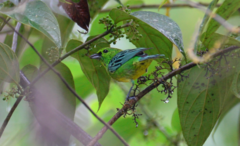
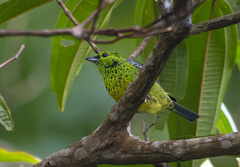
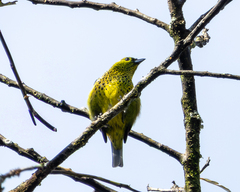
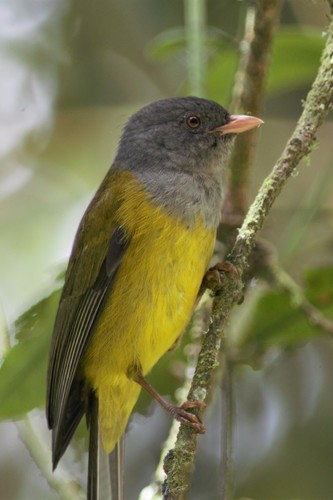
Yellow-bellied Tanager

Yellow-bellied Tanager

Ixothraupis xanthogastra

Silhouette: Sheatherius · PhyloPic

Daily sighting probability ~10% · With luck
at Podocarpus National Park

In 3 days ~30% in a week ~50%

147 Verified sightings at Podocarpus National Park From 2019 to 2026
639 In all 5 parks
September Best month
☀️ Diurnal When it's spotted

About the Yellow-bellied Tanager

The yellow-bellied tanager (Ixothraupis xanthogastra) is a species of bird in the family Thraupidae. It is across northern and western South America, being found from Venezuela east into Colombia, Ecuador, and Peru, south into Brazil and Bolivia, and east into Guyana. It mostly inhabits lowland tropical forests, woodland edges, and secondary growth. It is, on average, it is 11–12.2 cm (4.3–4.8 in) long and weighs 14.1–17.9 g (0.5–0.6 oz). It is largely green with a pattern of black spots, with a clean yellow belly and unspotted flanks. It is classified as being of least concern by the IUCN.

The yellow-bellied tanager was formally described by the English ornithologist Philip Sclater in 1851 as Calliste xanthogastra based on specimens from the Rio Negro of Peru. The specific epithet is derived from the Greek words meaning "yellow-bellied". The species was formerly placed in the genus Tangara.

The yellow-bellied tanager has two recognized subspecies: Wikipedia →

Sounds

Call0:52

Ecuador · 2023

© rudy gelis · XC827187 · CC BY-NC-SA 4.0

Begging call0:57

Venezuela · 2007

© Andrew Spencer · XC10141 · CC BY-NC-ND 2.5

Song0:44

Ecuador · 2012

© Charlie Vogt · XC93171 · CC BY-NC-ND 2.5

Global Distribution

Parks Where Found

# Park Country Daily sighting probability
1 Podocarpus National Park 🇪🇨 Ecuador
~10%
2 Manu National Park 🇵🇪 Peru
~10%
3 Sierra de la Macarena National Park 🇨🇴 Colombia
<5%
4 Yasuní National Park 🇪🇨 Ecuador
<5%
5 Tambopata National Reserve 🇵🇪 Peru
<5%

Before you go

What are the chances of seeing a Yellow-bellied Tanager in Podocarpus National Park?

With luck

About 10% of wildlife watchers report a Yellow-bellied Tanager sighting in Podocarpus National Park on a given day, based on 147 verified sightings from GBIF citizen-science data from 2019 to 2026. It is the 135th most-seen of the 446 birds we can rate there. Over three days the chance rises to about 30%, and over a week to about 50%, if each day is a fresh chance.

When is the best time to see a Yellow-bellied Tanager in Podocarpus National Park?

February and September

In those months about 20% of wildlife watchers report a Yellow-bellied Tanager in Podocarpus National Park on a given day, against under 5% in June and August, the lowest months.

What time of day is best to see a Yellow-bellied Tanager?

Between 8 and 11 am

Across all the parks we cover, that three-hour window holds the most Yellow-bellied Tanager sightings with a recorded time, and about 9 in 10 of them come between 6 am and 6 pm: it is a daytime animal.

Is Podocarpus National Park the best place to see a Yellow-bellied Tanager?

Yes

Of the 5 parks where we can rate Yellow-bellied Tanager sightings, Podocarpus National Park has the highest daily chance: about 10%. Next come Manu National Park (Peru, about 10%) and Sierra de la Macarena National Park (Colombia, under 5%).

Where does the Yellow-bellied Tanager sighting chance come from?

GBIF citizen-science records

It is estimated from how often the Yellow-bellied Tanager is recorded against all the birds logged in Podocarpus National Park (147 verified sightings from 2019 to 2026), calibrated against known sighting rates. Figures are rounded to the nearest 10% because citizen-science data supports honest approximations, not decimals, and months with records from fewer than five people show "—". How it works.

← Back to Podocarpus National Park