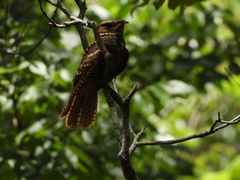
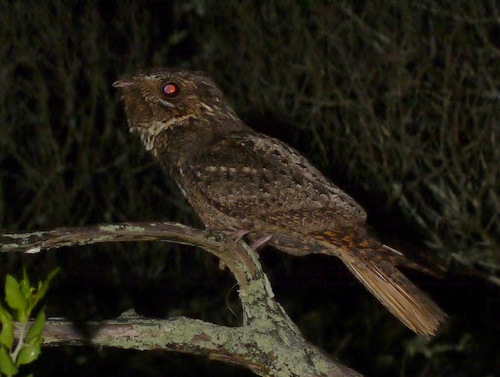
Chuck-will's-widow

Chuck-will's-widow

Antrostomus carolinensis

Silhouette: Sheatherius · PhyloPic

LCNTNear ThreatenedVUENCR
Daily sighting probability ~10% · With luck
at Point Pelee National Park

In 3 days ~40% in a week ~70%

20 Verified sightings at Point Pelee National Park From 2019 to 2026
779 In all 10 parks
May Best month
☀️🌙 Day & Night When it's spotted

About the Chuck-will's-widow

The chuck-will's-widow (Antrostomus carolinensis) is a nocturnal bird of the nightjar family Caprimulgidae. It is mostly found in the southeastern United States (with disjunct populations in Long Island, New York; Ontario, Canada; and Cape Cod, Massachusetts) near swamps, rocky uplands, and pine woods. It migrates to the West Indies, Central America, and northwestern South America.

The chuck-will's-widow was formally described in 1789 by the German naturalist Johann Friedrich Gmelin in his revised and expanded edition of Carl Linnaeus's Systema Naturae. He placed it with all the other nightjars in the genus Caprimulgus and coined the binomial name Caprimulgus carolinensis. Gmelin based his description on those of earlier authors including the "Goat-sucker of Carolina" that had been described and illustrated by the English naturalist Mark Catesby in his The Natural History of Carolina, Florida and the Bahama Islands that was published between 1729 and 1732. Chuck-will's-widow is now placed with 11 other species in the genus Antrostomus that was erected by the French naturalist Charles Bonaparte in 1838. The generic name combines the Ancient Greek antron meaning "cavern... Wikipedia →

Sounds

Song0:43

United States · 2024

© Sue Riffe · XC941312 · CC BY-NC-SA 4.0

Call0:22

United States · 2022

© Jorge de Leon Cardozo & Susan Hochgraf · XC728671 · CC BY-NC-SA 4.0

Uncertain0:38

United States · 2022

© Laura Shields · XC724591 · CC BY-NC-SA 4.0

Global Distribution

Parks Where Found

# Park Country Daily sighting probability
1 Point Pelee National Park 🇨🇦 Canada
~10%
2 Everglades National Park 🇺🇸 United States
<5%
3 Big Cypress National Preserve 🇺🇸 United States
<5%
4 Arenal Volcano National Park 🇨🇷 Costa Rica
<5%
5 Congaree National Park 🇺🇸 United States
<5%
6 Great Smoky Mountains National Park 🇺🇸 United States
<5%
7 Tenorio Volcano National Park 🇨🇷 Costa Rica
<5%
8 Merritt Island National Wildlife Refuge 🇺🇸 United States
<5%
9 Braulio Carrillo National Park 🇨🇷 Costa Rica
<5%
10 Soberanía National Park 🇵🇦 Panama
<5%

Cities Where Found

# City Country Daily sighting probability
1 Miami 🇺🇸 United States
<5%
2 Houston 🇺🇸 United States
<5%
3 Havana 🇨🇺 Cuba
<5%
4 Boston 🇺🇸 United States
<5%
5 Austin 🇺🇸 United States
<5%
6 San Antonio 🇺🇸 United States
<5%
7 Dallas 🇺🇸 United States
<5%
8 Orlando 🇺🇸 United States
<5%
9 Panama City 🇵🇦 Panama
<5%

Zoos & Centres Where Found

# Zoo / Centre Country
1 Parque Zoológico Miguel Ángel de Quevedo 🇲🇽 Mexico In captivity

Before you go

What are the chances of seeing a Chuck-will's-widow in Point Pelee National Park?

With luck

About 10% of wildlife watchers report a Chuck-will's-widow sighting in Point Pelee National Park on a given day, based on 20 verified sightings from GBIF citizen-science data from 2019 to 2026. It is the 96th most-seen of the 278 birds we can rate there. Over three days the chance rises to about 40%, and over a week to about 70%, if each day is a fresh chance.

When is the best time to see a Chuck-will's-widow in Point Pelee National Park?

May

In that month about 20% of wildlife watchers report a Chuck-will's-widow in Point Pelee National Park on a given day, against under 5% in June to April, the lowest months.

What time of day is best to see a Chuck-will's-widow?

Between 7 and 10 pm

Across all the parks we cover, that three-hour window holds the most Chuck-will's-widow sightings with a recorded time, and about 6 in 10 of them come between 6 pm and 6 am: it is seen both by day and at night.

Is Point Pelee National Park the best place to see a Chuck-will's-widow?

Yes

Of the 10 parks where we can rate Chuck-will's-widow sightings, Point Pelee National Park has the highest daily chance: about 10%. Next come Everglades National Park (United States, under 5%) and Big Cypress National Preserve (United States, under 5%).

Where does the Chuck-will's-widow sighting chance come from?

GBIF citizen-science records

It is estimated from how often the Chuck-will's-widow is recorded against all the birds logged in Point Pelee National Park (20 verified sightings from 2019 to 2026), calibrated against known sighting rates. Figures are rounded to the nearest 10% because citizen-science data supports honest approximations, not decimals, and months with records from fewer than five people show "—". How it works.
← Back to Point Pelee National Park