

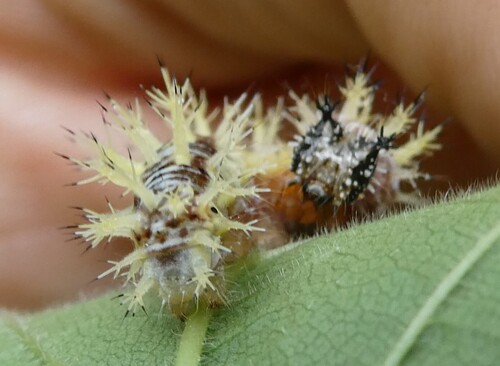
Pandorus Sphinx

Pandorus Sphinx

Eumorpha pandorus

Daily sighting probability ~10% · With luck
at Point Pelee National Park

In 3 days ~20% in a week ~40%

9 Verified sightings at Point Pelee National Park From 2019 to 2026
67 In all 3 parks
August Best month
☀️ Diurnal When it's spotted

About the Pandorus Sphinx

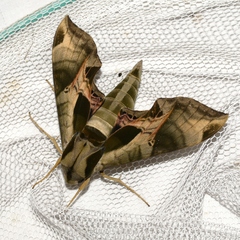
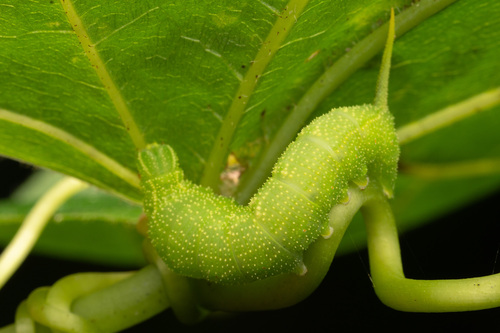
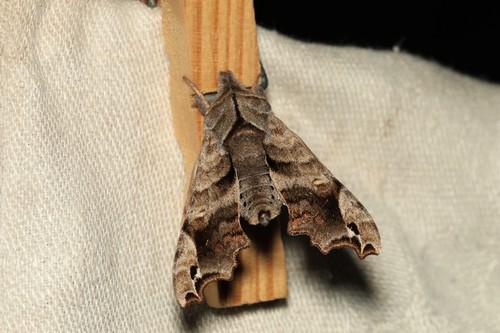
Eumorpha pandorus, the Pandora sphinx moth or Pandorus sphinx moth, is a North American moth in the family Sphingidae. The species was first described by Jacob Hübner in 1821. The pandora sphinx moth has a wingspan of 3.25–4.6 inches (8.3–11.7 cm). Its wings are opaque and have a greenish-olive background on the dorsal surfaces. The wings are narrow and are held deltaform at rest. Females generally have a larger abdomen than males. There are green markings on the dorsal forewing with a two-toned double spot extending from the base along the forewing's inner margin. When the wings are folded, the latter spot aligns with a dark mark on the moth's body that covers each tegula. A green marking with a pale outline is visible near the apex of the forewing. The dorsal surfaces of the hindwings, when extended, reveal black patches on a white background that becomes greenish-olive near the termens. Pink is present around the torni of the hindwings and in isolated areas on the dorsal forewings. Small dark eyespots on the hindwings and the forewings, there found in the discal position bearing two tiny "pupils," are visible even when the wings are folded. The ventral... Wikipedia →

Global Distribution

Parks Where Found

# Park Country Daily sighting probability
1 Great Smoky Mountains National Park 🇺🇸 United States
~10%
2 Shenandoah National Park 🇺🇸 United States
~10%
3 Point Pelee National Park 🇨🇦 Canada
~10%

Cities Where Found

# City Country Daily sighting probability
1 Baltimore 🇺🇸 United States
~10%
2 Detroit 🇺🇸 United States
~10%
3 Washington 🇺🇸 United States
~10%
4 Toronto 🇨🇦 Canada
<5%
5 Philadelphia 🇺🇸 United States
<5%
6 Houston 🇺🇸 United States
<5%
7 Montreal 🇨🇦 Canada
<5%
8 Austin 🇺🇸 United States
<5%
9 Boston 🇺🇸 United States
<5%
10 New York City 🇺🇸 United States
<5%

Before you go

What are the chances of seeing a Pandorus Sphinx in Point Pelee National Park?

With luck

About 10% of wildlife watchers report a Pandorus Sphinx sighting in Point Pelee National Park on a given day, based on 9 verified sightings from GBIF citizen-science data from 2019 to 2026. It is the 105th most-seen of the 196 insects we can rate there. Over three days the chance rises to about 20%, and over a week to about 40%, if each day is a fresh chance.

When is the best time to see a Pandorus Sphinx in Point Pelee National Park?

August and September

In those months about 20% of wildlife watchers report a Pandorus Sphinx in Point Pelee National Park on a given day, against under 5% in October to May, the lowest months.

What time of day is best to see a Pandorus Sphinx?

Between 8 and 11 am

Across all the parks we cover, that three-hour window holds the most Pandorus Sphinx sightings with a recorded time, and about 9 in 10 of them come between 6 am and 6 pm: it is a daytime animal.

Is Point Pelee National Park the best place to see a Pandorus Sphinx?

Among the best

Of the 3 parks where we can rate Pandorus Sphinx sightings, Point Pelee National Park ranks 3rd at about 10%, level with the leaders once rounded. The best odds are in Great Smoky Mountains National Park (United States, about 10%) and Shenandoah National Park (United States, about 10%).

Which relatives of the Pandorus Sphinx live in Point Pelee National Park?

Same family: Sphingidae

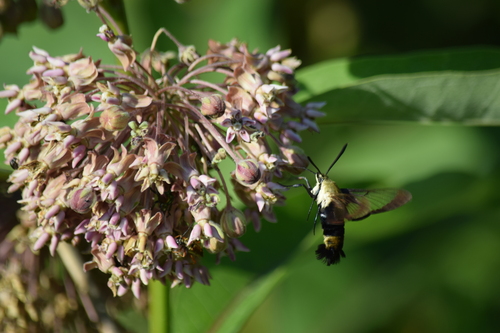
The closest relatives of the Pandorus Sphinx that you can see in Point Pelee National Park (family Sphingidae, Sphinx Moths) are Virginia Creeper Sphinx (about 10%), Lettered Sphinx (about 10%) and Snowberry Clearwing (about 10%), with each one's daily chance of a sighting.

Where does the Pandorus Sphinx sighting chance come from?

GBIF citizen-science records

It is estimated from how often the Pandorus Sphinx is recorded against all the insects logged in Point Pelee National Park (9 verified sightings from 2019 to 2026), calibrated against known sighting rates. Figures are rounded to the nearest 10% because citizen-science data supports honest approximations, not decimals, and months with records from fewer than five people show "—". How it works.

← Back to Point Pelee National Park