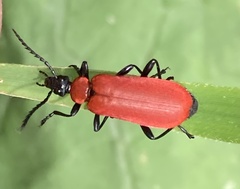
Black-Headed Cardinal Beetle

Black-Headed Cardinal Beetle

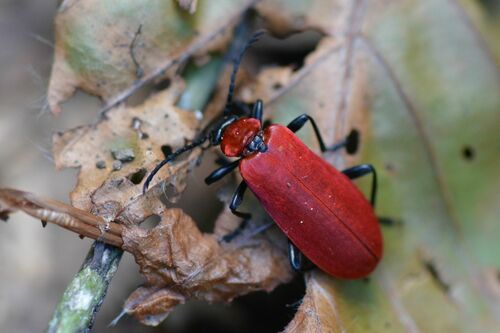
Pyrochroa coccinea

Daily sighting probability ~10% · With luck
at Pyrénées National Park

In 3 days ~20% in a week ~30%

19 Verified sightings at Pyrénées National Park From 2019 to 2026
77 In all 5 parks
June Best month
☀️ Diurnal When it's spotted

About the Black-Headed Cardinal Beetle

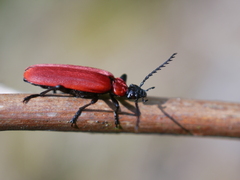
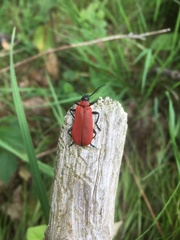
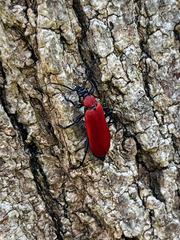
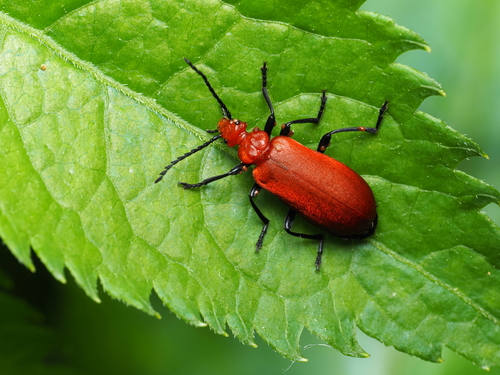
Pyrochroa coccinea, commonly known as the Black-headed cardinal beetle, is a species of cardinal beetle in the family Pyrochroidae. It is found mainly in wooded areas and pastures throughout central Europe, including southern Great Britain. Similar to other species of ambrosia beetles, P. coccinea live and reproduce on wooden logs in early stages of decomposition. Larvae develop over the span of many years, with overlapping generations often inhabiting a single wooden territory. Adults, however, are short-lived and exist during a brief season. They typically show up in April, become more populous in May and early June, and become very rare in the remaining months.

In Europe, Pyrochroa coccinea is found in mainly the central regions but its presence also expands south to the Pyrenees, central Italy, and Greece; north to southern Scandinavia and the United Kingdom; and east to Ukraine, western Russia, and Kazakhstan.

Pyrochroa coccinea is widespread in southern England and is most commonly found in the southeastern regions. It is found more locally and sporadically in northern regions toward the Lake District and expands well into the Welsh Border Counties. This... Wikipedia →
Global Distribution

Parks Where Found

# Park Country Daily sighting probability
1 Białowieża National Park 🇵🇱 Poland
~20%
2 Bavarian Forest National Park 🇩🇪 Germany
~10%
3 Pyrénées National Park 🇫🇷 France
~10%
4 Cévennes National Park 🇫🇷 France
~10%
5 Wadden Sea National Park 🇩🇪 Germany
~10%

Cities Where Found

# City Country Daily sighting probability
1 Kharkiv 🇺🇦 Ukraine
~10%
2 Warsaw 🇵🇱 Poland
~10%
3 Berlin 🇩🇪 Germany
~10%
4 Prague 🇨🇿 Czechia
~10%
5 Vienna 🇦🇹 Austria
~10%
6 Essen 🇩🇪 Germany
~10%
7 Copenhagen 🇩🇰 Denmark
~10%
8 Brussels 🇧🇪 Belgium
~10%
9 Amsterdam 🇳🇱 Netherlands
~10%
10 Kyiv 🇺🇦 Ukraine
~10%

Before you go

What are the chances of seeing a Black-Headed Cardinal Beetle in Pyrénées National Park?

With luck

About 10% of wildlife watchers report a Black-Headed Cardinal Beetle sighting in Pyrénées National Park on a given day, based on 19 verified sightings from GBIF citizen-science data from 2019 to 2026. It is the 458th most-seen of the 1277 insects we can rate there. Over three days the chance rises to about 20%, and over a week to about 30%, if each day is a fresh chance.

When is the best time to see a Black-Headed Cardinal Beetle in Pyrénées National Park?

April to June

In those months about 10% of wildlife watchers report a Black-Headed Cardinal Beetle in Pyrénées National Park on a given day, against under 5% in July to March, the lowest months.

What time of day is best to see a Black-Headed Cardinal Beetle?

Between 1 and 4 pm

Across all the parks we cover, that three-hour window holds the most Black-Headed Cardinal Beetle sightings with a recorded time, and about 9 in 10 of them come between 6 am and 6 pm: it is a daytime animal.

Is Pyrénées National Park the best place to see a Black-Headed Cardinal Beetle?

3rd of 5

Of the 5 parks where we can rate Black-Headed Cardinal Beetle sightings, Pyrénées National Park ranks 3rd at about 10%. The best odds are in Białowieża National Park (Poland, about 20%) and Bavarian Forest National Park (Germany, about 10%).

Where does the Black-Headed Cardinal Beetle sighting chance come from?

GBIF citizen-science records

It is estimated from how often the Black-Headed Cardinal Beetle is recorded against all the insects logged in Pyrénées National Park (19 verified sightings from 2019 to 2026), calibrated against known sighting rates. Figures are rounded to the nearest 10% because citizen-science data supports honest approximations, not decimals, and months with records from fewer than five people show "—". How it works.

← Back to Pyrénées National Park