European Common Frog

European Common Frog

Rana temporaria

Silhouette: Beth Reinke · PhyloPic

LCLeast ConcernNTVUENCR
Daily sighting probability ~70% · Very likely
at Pyrénées National Park

In 3 days >90%

1,100 Verified sightings at Pyrénées National Park From 2019 to 2026
2,768 In all 18 parks
August Best month
☀️ Diurnal When it's spotted

About the European Common Frog

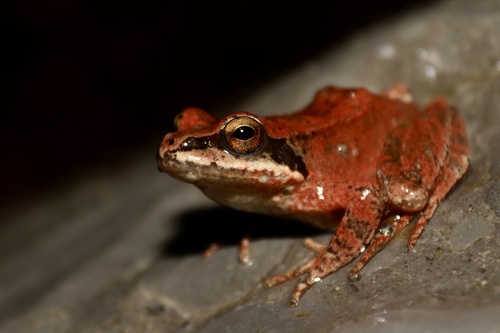
The common frog or grass frog (Rana temporaria), also known as the European common frog, European common brown frog, European grass frog, European Holarctic true frog, European pond frog, European brown frog, or simply the frog, is a semi-aquatic amphibian of the family Ranidae, found throughout much of Europe as far north as Scandinavia and as far east as the Urals, except for most of the Iberian Peninsula, southern Italy, and the southern Balkans. The farthest west it can be found is Ireland. It is also found in Asia, and eastward to Japan. The nominative, and most common, subspecies Rana temporaria temporaria is a largely terrestrial frog native to Europe. It is distributed throughout northern Europe and can be found from Ireland to as far east as Japan.

Common frogs undergo metamorphosis through three distinct life stages — aquatic larva, terrestrial juvenile, and adult. They have plump bodies with rounded snouts, webbed feet, and long hind legs adapted for swimming and hopping on land. They are often confused with the common toad (Bufo bufo), but can be easily distinguished by their longer legs, hopping movements, and moist skin; toads have shorter legs, crawl and have a dry 'warty' skin. The two species also lay their eggs differently, frogs lay their eggs in clumps, whereas toads lay theirs in long strings.

The common frog is very similar to its close relative the moor frog (Rana arvalis). Where both species occur together, the most reliable way to distinguish them is to look at their metatarsal tubercles, which are small spurs on the hind feet next to the innermost toe. In the common frog, this spur is soft and small, less than a third of the length of the innermost toe, whereas in the moor frog, it is hard and approximately half the length of the innermost toe. The two species also have different calls, and during the breeding season, moor frog males may turn blue, while common frog males at most get a faint blue tint. Wikipedia →

Sounds

Advertisement call0:21

France · 2023

© Olivier SWIFT · XC1087327 · CC BY-NC-SA 4.0

Territorial call0:34

Netherlands · 2021

© Joost van Bruggen · XC893469 · CC BY-NC-ND 4.0

Advertisement call0:10

Russian Federation · 2019

© Albert Lastukhin · XC892096 · CC BY-NC-ND 4.0

Global Distribution

Parks Where Found

# Park Country Daily sighting probability
1 Aigüestortes National Park 🇪🇸 Spain
~90%
2 Mercantour National Park 🇫🇷 France
~80%
3 Pyrénées National Park 🇫🇷 France
~70%
4 Białowieża National Park 🇵🇱 Poland
~70%
5 Gauja National Park 🇱🇻 Latvia
~70%
6 Hohe Tauern National Park 🇦🇹 Austria
~60%
7 Vanoise National Park 🇫🇷 France
~60%
8 Cairngorms National Park 🇬🇧 United Kingdom
~60%
9 Snowdonia National Park 🇬🇧 United Kingdom
~50%
10 Tatra National Park 🇸🇰 Slovakia
~50%
11 Triglav National Park 🇸🇮 Slovenia
~50%
12 Ecrins National Park 🇫🇷 France
~50%
13 Bavarian Forest National Park 🇩🇪 Germany
~50%
14 Ordesa y Monte Perdido National Park 🇪🇸 Spain
~40%
15 Cévennes National Park 🇫🇷 France
~40%
16 Biebrza National Park 🇵🇱 Poland
~30%
17 Plitvice Lakes National Park 🇭🇷 Croatia
~20%
18 Wadden Sea National Park 🇩🇪 Germany
~20%

Cities Where Found

# City Country Daily sighting probability
1 Liverpool 🇬🇧 United Kingdom
~50%
2 Manchester 🇬🇧 United Kingdom
~50%
3 Birmingham 🇬🇧 United Kingdom
~40%
4 London 🇬🇧 United Kingdom
~40%
5 Leeds 🇬🇧 United Kingdom
~40%
6 Copenhagen 🇩🇰 Denmark
~30%
7 Helsinki 🇫🇮 Finland
~30%
8 Hamburg 🇩🇪 Germany
~20%
9 Munich 🇩🇪 Germany
~20%
10 Essen 🇩🇪 Germany
~20%

Zoos & Centres Where Found

# Zoo / Centre Country
1 Wrocław Zoological Garden 🇵🇱 Poland In captivity
2 Parque Faunístico de Lacuniacha 🇪🇸 Spain In captivity
3 Africarium 🇵🇱 Poland In captivity
4 terrarium ogrodu zoologicznego we Wrocławiu 🇵🇱 Poland In captivity
5 Willows Animal Sanctuary 🇬🇧 United Kingdom In captivity

Before you go

What are the chances of seeing a European Common Frog in Pyrénées National Park?

Very likely

About 70% of wildlife watchers report a European Common Frog sighting in Pyrénées National Park on a given day, based on 1,100 verified sightings from GBIF citizen-science data from 2019 to 2026. It is the most-seen of the 11 amphibians we can rate there. Over three days the chance rises to over 90%, if each day is a fresh chance.

When is the best time to see a European Common Frog in Pyrénées National Park?

July and August

In those months about 80% of wildlife watchers report a European Common Frog in Pyrénées National Park on a given day, against about 30% in November and December, the lowest months.

What time of day is best to see a European Common Frog?

Between noon and 3 pm

Across all the parks we cover, that three-hour window holds the most European Common Frog sightings with a recorded time, and about 8 in 10 of them come between 6 am and 6 pm: it is a daytime animal.

Which relatives of the European Common Frog live in Pyrénées National Park?

Same genus: Rana

The closest relatives of the European Common Frog that you can see in Pyrénées National Park (genus Rana, Pond Frogs) are Pyrenean frog (about 10%) and Agile Frog (about 10%), with each one's daily chance of a sighting.

Where does the European Common Frog sighting chance come from?

GBIF citizen-science records

It is estimated from how often the European Common Frog is recorded against all the amphibians logged in Pyrénées National Park (1,100 verified sightings from 2019 to 2026), calibrated against known sighting rates. Figures are rounded to the nearest 10% because citizen-science data supports honest approximations, not decimals, and months with records from fewer than five people show "—". How it works.

← Back to Pyrénées National Park