Crocodile Monitor

Crocodile Monitor

Varanus salvadorii

Silhouette: Steven Traver · PhyloPic

LCLeast ConcernNTVUENCR
Daily sighting probability ~10% · With luck
at Raja Ampat

In 3 days ~30% in a week ~60%

5 Verified sightings at Raja Ampat From 2019 to 2026
5 In 1 park
February Best month
☀️🌙 Day & Night When it's spotted

About the Crocodile Monitor

The crocodile monitor (Varanus salvadorii), also known as the Papuan monitor or Salvadori's monitor, is a species of monitor lizard endemic to New Guinea. It is the largest monitor lizard in New Guinea and is one of the longest lizards, verified at up to 255 cm (100 in). Its tail is exceptionally long, with some specimens having been claimed to exceed the length of the Komodo dragon, however less massive.

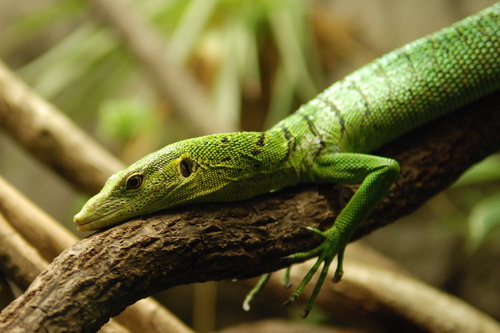
The crocodile monitor is an arboreal lizard with a dark green body marked with bands of yellowish spots. It has a characteristic blunt snout and a very long prehensile tail. It lives among the mangrove swamps and coastal rainforests of the southeastern part of New Guinea, feeding opportunistically on everything from birds and small mammals to eggs, other reptiles, amphibians and carrion. Its large, backwards-curving teeth are better adapted than those of most monitors for seizing fast-moving prey. Like all monitors, it has anatomical features that enable it to breathe more easily when running than other lizards, and is sometimes considered one of the most agile monitor species.

Crocodile monitors are threatened by deforestation and poaching, and are protected by CITES. Little is known of its reproduction and development, as it is difficult to breed in captivity. Attempts at captive breeding have been mostly unsuccessful. In New Guinea, the lizard is sometimes hunted and skinned by tribesmen to make drums. It is described as an evil spirit that "climbs trees, walks upright, breathes fire, and kills men", yet the local people maintain that it gives warnings if crocodiles are nearby. Wikipedia →

Global Distribution

Parks Where Found

# Park Country Daily sighting probability
1 Raja Ampat 🇮🇩 Indonesia
~10%

More parks will be added in future updates.

Zoos & Centres Where Found

# Zoo / Centre Country
1 Moscow Zoo 🇷🇺 Russia In captivity
2 Shedd Aquarium 🇺🇸 United States In captivity
3 Leipzig Zoological Garden 🇩🇪 Germany In captivity
4 Shanghai Wild Animal Park 🇨🇳 China In captivity
5 Toledo Zoo 🇺🇸 United States In captivity
6 Wildlife World Zoo 🇺🇸 United States In captivity
7 Central Florida Zoo and Botanical Gardens 🇺🇸 United States In captivity
8 Guadalajara Zoo 🇲🇽 Mexico In captivity
9 Wrocław Zoological Garden 🇵🇱 Poland In captivity
10 Moody Gardens 🇺🇸 United States In captivity
11 Night Safari 🇸🇬 Singapore In captivity
12 Zoologischer Garten Leipzig 🇩🇪 Germany In captivity
13 Fort Worth Zoo 🇺🇸 United States In captivity
14 Gatorland 🇺🇸 United States In captivity
15 Oregon Zoo 🇺🇸 United States In captivity
16 Memphis Zoo 🇺🇸 United States In captivity
17 Singapore Zoo 🇸🇬 Singapore In captivity
18 Virginia Zoological Park 🇺🇸 United States In captivity
19 Houston Zoo 🇺🇸 United States In captivity
20 Honolulu Zoo 🇺🇸 United States In captivity
21 Faunia 🇪🇸 Spain In captivity
22 River Wonders 🇸🇬 Singapore In captivity
23 Leningrad Zoo 🇷🇺 Russia In captivity
24 Safari Masai Mara 🇲🇽 Mexico In captivity
25 Cherkasy Zoo 🇺🇦 Ukraine In captivity
26 Everglades Alligator Farm 🇺🇸 United States In captivity
27 Bioparc Fuengirola 🇪🇸 Spain In captivity
28 Africarium 🇵🇱 Poland In captivity
29 Shanghai Ocean Aquarium 🇨🇳 China In captivity
30 Tula Exotarium 🇷🇺 Russia In captivity
31 Snakeroom Serpentarium 🇪🇸 Spain In captivity
32 terrarium ogrodu zoologicznego we Wrocławiu 🇵🇱 Poland In captivity
33 Wolfgang-Köhler-Primaten-Forschungszentrum 🇩🇪 Germany In captivity

Before you go

What are the chances of seeing a Crocodile Monitor in Raja Ampat?

With luck

About 10% of wildlife watchers report a Crocodile Monitor sighting in Raja Ampat on a given day, based on 5 verified sightings from GBIF citizen-science data from 2019 to 2026. It is the 30th most-seen of the 33 reptiles we can rate there. Over three days the chance rises to about 30%, and over a week to about 60%, if each day is a fresh chance.

When is the best time to see a Crocodile Monitor in Raja Ampat?

February

In that month about 40% of wildlife watchers report a Crocodile Monitor in Raja Ampat on a given day, against under 5% in March–June, September–October and December–January, the lowest months.

What time of day is best to see a Crocodile Monitor?

Between midnight and 3 am

Across all the parks we cover, that three-hour window holds the most Crocodile Monitor sightings with a recorded time, and about half of them come between 6 am and 6 pm: it is seen both by day and at night.

Where else can you see a Crocodile Monitor?

Only Raja Ampat, in our data

Raja Ampat is the only park on Wallace's Line with enough records to rate Crocodile Monitor sightings: about 10% of wildlife watchers there report one on a given day.

Where does the Crocodile Monitor sighting chance come from?

GBIF citizen-science records

It is estimated from how often the Crocodile Monitor is recorded against all the reptiles logged in Raja Ampat (5 verified sightings from 2019 to 2026), calibrated against known sighting rates. Figures are rounded to the nearest 10% because citizen-science data supports honest approximations, not decimals, and months with records from fewer than five people show "—". How it works.

← Back to Raja Ampat