Red Avadavat

Red Avadavat

Amandava amandava

Silhouette: Sheatherius · PhyloPic

LCLeast ConcernNTVUENCR
Daily sighting probability <5% · Rare
at Ranthambore National Park

In 3 days <5%

8 Verified sightings at Ranthambore National Park From 2019 to 2026
812 In all 11 parks
November Best month
☀️ Diurnal When it's spotted

About the Red Avadavat

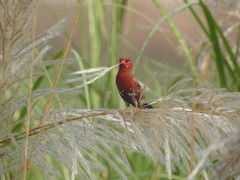
The red avadavat (Amandava amandava), red munia or strawberry finch, is a sparrow-sized bird of the family Estrildidae. It is found in the open fields and grasslands of tropical Asia and is popular as a cage bird due to the colourful plumage of the males in their breeding season. It breeds in the Indian subcontinent in the monsoon season. The species name of amandava and the common name of avadavat are derived from the city of Ahmedabad in Gujarat, India, from where these birds were exported into the pet trade in former times.

The red avadavat was formally described by the Swedish naturalist Carl Linnaeus in 1758 in the tenth edition of his Systema Naturae under the binomial name Fringilla amandava. Linnaeus based his description on "The Amaduvads Cock and Hen" that has been described and illustrated in 1738 by the English naturalist Eleazar Albin. Linnaeus specified the locality as East India but this was restricted to Kolkata (Calcutta) by E. C. Stuart Baker in 1921. This species is now placed in the genus Amandava that was introduced in 1836 by the English zoologist Edward Blyth.

The red avadavat were earlier included in the genus Estrilda by Jean Delacour. This placement... Wikipedia →

Sounds

Subsong1:05

Thailand · 2021

© Ding Li Yong · XC698326 · CC BY-NC-ND 4.0

Call0:08

Italy · 2018

© Mathieu Waldeck · XC508653 · CC BY-NC-SA 4.0

Song0:22

Laos · 2020

© Bram Piot · XC552807 · CC BY-NC-SA 4.0

Global Distribution

Parks Where Found

# Park Country Daily sighting probability
1 Royal Bardia National Park 🇳🇵 Nepal
~10%
2 Keoladeo National Park 🇮🇳 India
~10%
3 Chitwan National Park 🇳🇵 Nepal
~10%
4 Kanha National Park 🇮🇳 India
<5%
5 Satpura National Park 🇮🇳 India
<5%
6 Bandhavgarh National Park 🇮🇳 India
<5%
7 Jim Corbett National Park 🇮🇳 India
<5%
8 Monfragüe National Park 🇪🇸 Spain
<5%
9 Nagarhole National Park 🇮🇳 India
<5%
10 Ranthambore National Park 🇮🇳 India
<5%
11 Doñana National Park 🇪🇸 Spain
<5%

Cities Where Found

# City Country Daily sighting probability
1 Vasai-Virar 🇮🇳 India
~40%
2 Kalyan-Dombivli 🇮🇳 India
~20%
3 Nagpur 🇮🇳 India
~10%
4 Raipur 🇮🇳 India
~10%
5 Bhubaneshwar 🇮🇳 India
~10%
6 Kathmandu 🇳🇵 Nepal
~10%
7 Berhampore 🇮🇳 India
~10%
8 Lucknow 🇮🇳 India
~10%
9 Riyadh 🇸🇦 Saudi Arabia
~10%
10 Luxor 🇪🇬 Egypt
~10%

Zoos & Centres Where Found

# Zoo / Centre Country
1 ZooParc de Beauval 🇫🇷 France In captivity
2 Skansen 🇸🇪 Sweden In captivity
3 Aquamarine Fukushima 🇯🇵 Japan In captivity
4 Helsingborgs Djur- och Lekpark 🇸🇪 Sweden In captivity
5 Baltic Sea Science Center 🇸🇪 Sweden In captivity

Before you go

What are the chances of seeing a Red Avadavat in Ranthambore National Park?

Rare

Under 5% of wildlife watchers report a Red Avadavat sighting in Ranthambore National Park on a given day, based on 8 verified sightings from GBIF citizen-science data from 2019 to 2026. It is the 233rd most-seen of the 251 birds we can rate there. Over three days the chance rises to under 5%, if each day is a fresh chance.

When is the best time to see a Red Avadavat in Ranthambore National Park?

Any time of year

In every month with enough records, under 5% of wildlife watchers report a Red Avadavat in Ranthambore National Park on a given day, so our monthly data shows no clear season.

What time of day is best to see a Red Avadavat?

Between 7 and 10 am

Across all the parks we cover, that three-hour window holds the most Red Avadavat sightings with a recorded time, and about 9 in 10 of them come between 6 am and 6 pm: it is a daytime animal.

Where does the Red Avadavat sighting chance come from?

GBIF citizen-science records

It is estimated from how often the Red Avadavat is recorded against all the birds logged in Ranthambore National Park (8 verified sightings from 2019 to 2026), calibrated against known sighting rates. Figures are rounded to the nearest 10% because citizen-science data supports honest approximations, not decimals, and months with records from fewer than five people show "—". How it works.

← Back to Ranthambore National Park