Banded Thintail

Banded Thintail

Meliscaeva cinctella

Daily sighting probability ~10% · With luck
at Redwood National Park

In 3 days ~20% in a week ~40%

6 Verified sightings at Redwood National Park From 2019 to 2026
249 In all 11 parks
September Best month
☀️ Diurnal When it's spotted

About the Banded Thintail

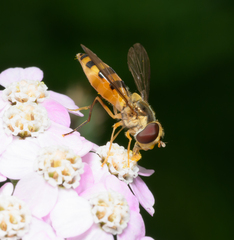
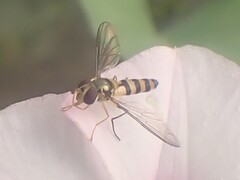
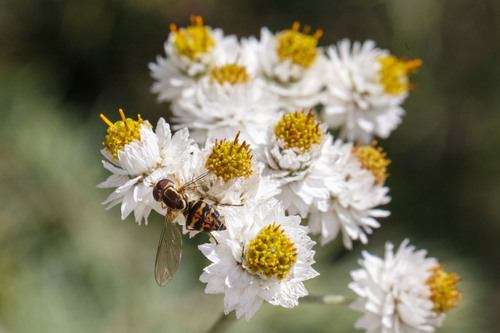
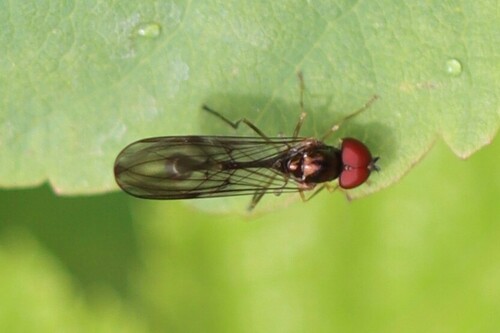
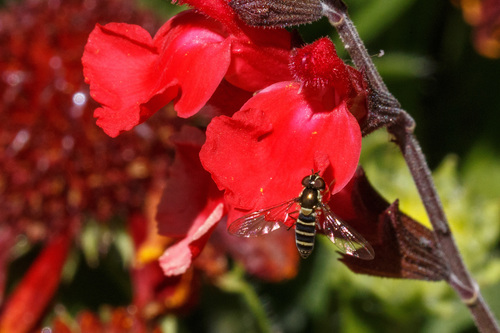
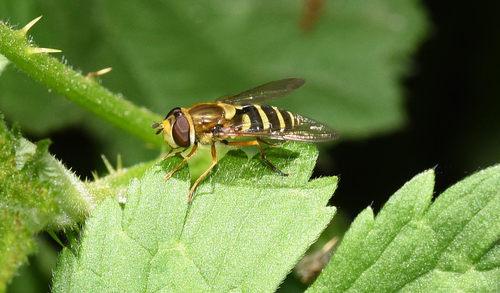
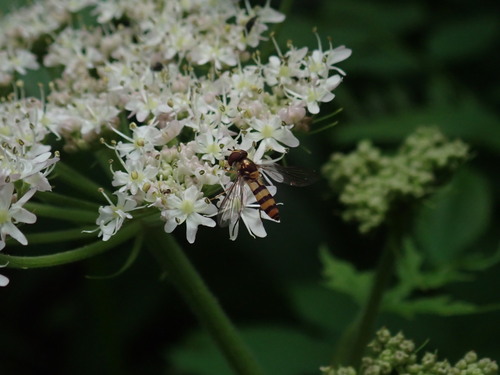
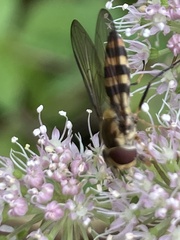
Meliscaeva cinctella is a Holarctic species of hoverfly. For terms see Morphology of Diptera Wing length 7–9.75 mm. Elongated body. Lunula black with a black mark above it. Face entirely yellow. The alula is a narrow, rectangule. Tergite 2 with broad, square yellow marks. Tergites 3 and 4 with broad yellow bands which extend to the abdominal margin and have little points (one pointing forwards and the other backwards).

See references for determination. The male genitalia are figured by Hippa (1968). Larva described and figured by Rotheray (1994). Palearctic: Fennoscandia South to Iberia the Mediterranean basin. Ireland East through most of Europe, Turkey and European Russian then East to Siberia and the Russian Far East to the Pacific coast (Kuril Isles). Nearctic: Alaska south to California and Colorado.

The species' habitat includes deciduous and coniferous forest, hedgerows and suburban gardens and parks. Flowers visited include white umbellifers, Acer pseudoplatanus, Crataegus, Euphorbia, Ilex, Ligustrum, Lonicera periclymenum, Origanum vulgare, Polygonum cuspidatum, Potentilla erecta, Prunus spinosa, Ranunculus, Rhododendron... Wikipedia →
Global Distribution

Parks Where Found

# Park Country Daily sighting probability
1 Pacific Rim National Park Reserve 🇨🇦 Canada
~20%
2 Great Bear Rainforest 🇨🇦 Canada
~10%
3 Acadia National Park 🇺🇸 United States
~10%
4 Snowdonia National Park 🇬🇧 United Kingdom
~10%
5 Gros Morne National Park 🇨🇦 Canada
~10%
6 Great Smoky Mountains National Park 🇺🇸 United States
~10%
7 Redwood National Park 🇺🇸 United States
~10%
8 Cairngorms National Park 🇬🇧 United Kingdom
~10%
9 Bavarian Forest National Park 🇩🇪 Germany
<5%
10 Pyrénées National Park 🇫🇷 France
<5%
11 Olympic National Park 🇺🇸 United States
<5%

Cities Where Found

# City Country Daily sighting probability
1 Vancouver 🇨🇦 Canada
<5%
2 Birmingham 🇬🇧 United Kingdom
<5%
3 Seattle 🇺🇸 United States
<5%
4 Moscow 🇷🇺 Russia
<5%

Before you go

What are the chances of seeing a Banded Thintail in Redwood National Park?

With luck

About 10% of wildlife watchers report a Banded Thintail sighting in Redwood National Park on a given day, based on 6 verified sightings from GBIF citizen-science data from 2019 to 2026. It is the 80th most-seen of the 101 insects we can rate there. Over three days the chance rises to about 20%, and over a week to about 40%, if each day is a fresh chance.

When is the best time to see a Banded Thintail in Redwood National Park?

September

In that month about 20% of wildlife watchers report a Banded Thintail in Redwood National Park on a given day, against under 5% in August and October–June, the lowest months. That is one of Redwood National Park's driest months, with about 50 mm of rain against 360 mm in January.

What time of day is best to see a Banded Thintail?

Between 11 am and 2 pm

Across all the parks we cover, that three-hour window holds the most Banded Thintail sightings with a recorded time, and about 9 in 10 of them come between 6 am and 6 pm: it is a daytime animal.

Which relatives of the Banded Thintail live in Redwood National Park?

Same family: Syrphidae

The closest relatives of the Banded Thintail that you can see in Redwood National Park (family Syrphidae, Hover Flies) are Western Calligrapher (about 10%), American Dainty (about 10%) and Melanostoma mellina (about 10%), with each one's daily chance of a sighting.

Where does the Banded Thintail sighting chance come from?

GBIF citizen-science records

It is estimated from how often the Banded Thintail is recorded against all the insects logged in Redwood National Park (6 verified sightings from 2019 to 2026), calibrated against known sighting rates. Figures are rounded to the nearest 10% because citizen-science data supports honest approximations, not decimals, and months with records from fewer than five people show "—". How it works.

← Back to Redwood National Park