Common Murre

Common Murre

Uria aalge

Silhouette: PhyloPic

LCLeast ConcernNTVUENCR
Daily sighting probability ~10% · With luck
at Redwood National Park

In 3 days ~30% in a week ~60%

310 Verified sightings at Redwood National Park From 2019 to 2026
5,464 In all 13 parks
August Best month
☀️ Diurnal When it's spotted

About the Common Murre

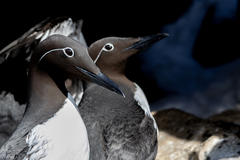
The common murre or common guillemot (Uria aalge) is a large auk, one of several species called murre or guillemot. It has a circumpolar distribution, occurring in low-Arctic and boreal waters in the North Atlantic and North Pacific. It spends most of its time at sea, only coming to land to breed on rocky cliff shores or islands.

Common murres are fast in direct flight but are not very agile. They are highly mobile underwater using their wings to 'fly' through the water column, where they typically dive to depths of 30–60 m (100–195 ft). Depths of up to 180 m (590 ft) have been recorded.

Common murres breed in colonies at high densities. Nesting pairs may be in bodily contact with their neighbours. They make no nest; their single egg is incubated between the adult's feet on a bare rock ledge on a cliff face. Eggs hatch after ~30 days' incubation. The chick is born downy and can regulate its body temperature after 10 days. Some 20 days after hatching, the chick leaves its nesting ledge and heads for the sea, unable to fly, but gliding for some distance with fluttering wings, accompanied by its male parent. Male guillemots spend more time diving, and dive more deeply than females during this time. Chicks are capable of diving as soon as they hit the water. The female stays at the nest site for some 14 days after the chick has left.

Both male and female common murres moult after breeding and become flightless for 1–2 months. Some populations have short migration distances, instead remaining close to the breeding site year-round. Such populations return to the nest site from autumn onwards. Adult birds balance their energetic budgets during the winter by reducing the time that they spend flying and are able to forage nocturnally. Wikipedia →

Sounds

Call0:16

France · 2025

Sonothèque ADVL · XC1041354 · CC0

Recording0:48

United Kingdom · 2021

© David Darrell-Lambert · XC663742 · CC BY-NC-SA 4.0

Alarm call0:14

United Kingdom · 2021

© Mark Smiles · XC662272 · CC BY-NC-SA 4.0

Global Distribution

Parks Where Found

# Park Country Daily sighting probability
1 Kenai Fjords National Park 🇺🇸 United States
~60%
2 Great Bear Rainforest 🇨🇦 Canada
~20%
3 Olympic National Park 🇺🇸 United States
~10%
4 Redwood National Park 🇺🇸 United States
~10%
5 Pacific Rim National Park Reserve 🇨🇦 Canada
~10%
6 Vatnajokull National Park 🇮🇸 Iceland
~10%
7 Wadden Sea National Park 🇩🇪 Germany
~10%
8 Svalbard 🇳🇴 Norway
~10%
9 Katmai National Park 🇺🇸 United States
<5%
10 Channel Islands National Park 🇺🇸 United States
<5%
11 Acadia National Park 🇺🇸 United States
<5%
12 Snowdonia National Park 🇬🇧 United Kingdom
<5%
13 Cape Breton Highlands National Park 🇨🇦 Canada
<5%

Cities Where Found

# City Country Daily sighting probability
1 Dublin 🇮🇪 Ireland
~10%
2 Seattle 🇺🇸 United States
<5%
3 Rotterdam [The Hague] 🇳🇱 Netherlands
<5%
4 San Francisco 🇺🇸 United States
<5%
5 San Diego 🇺🇸 United States
<5%
6 Liverpool 🇬🇧 United Kingdom
<5%
7 Los Angeles 🇺🇸 United States
<5%
8 Vancouver 🇨🇦 Canada
<5%
9 Boston 🇺🇸 United States
<5%

Zoos & Centres Where Found

# Zoo / Centre Country
1 Zhuhai Chimelong Ocean Kingdom 🇨🇳 China In captivity
2 Chimelong Spaceship 🇨🇳 China In captivity
3 SeaWorld San Diego 🇺🇸 United States In captivity
4 SeaWorld Abu Dhabi 🇦🇪 United Arab Emirates In captivity
5 Copenhagen Zoo 🇩🇰 Denmark In captivity
6 Lisbon Oceanarium 🇵🇹 Portugal In captivity
7 Omaha’s Henry Doorly Zoo and Aquarium 🇺🇸 United States In captivity
8 Lisbon Zoo 🇵🇹 Portugal In captivity
9 Point Defiance Zoo & Aquarium 🇺🇸 United States In captivity
10 Valencia Bioparc 🇪🇸 Spain In captivity
11 L'Oceanogràfic 🇪🇸 Spain In captivity
12 Oregon Coast Aquarium 🇺🇸 United States In captivity
13 Georgia Aquarium 🇺🇸 United States In captivity
14 Alaska SeaLife Center 🇺🇸 United States In captivity
15 Monterey Bay Aquarium 🇺🇸 United States In captivity
16 Seattle Aquarium 🇺🇸 United States In captivity
17 Oceanium 🇳🇱 Netherlands In captivity
18 Hatfield Visitors Center 🇺🇸 United States In captivity
19 Centro de Recuperação de Animais Silvestres 🇵🇹 Portugal In captivity
20 Montreal Biodome 🇨🇦 Canada In captivity
21 Oregon Undersea Gardens 🇺🇸 United States In captivity
22 Sæheimar Aquarium 🇮🇸 Iceland In captivity
23 Seattle Marine Aquarium 🇺🇸 United States In captivity
24 The National Aquarium Abu Dhabi 🇦🇪 United Arab Emirates In captivity

Before you go

What are the chances of seeing a Common Murre in Redwood National Park?

With luck

About 10% of wildlife watchers report a Common Murre sighting in Redwood National Park on a given day, based on 310 verified sightings from GBIF citizen-science data from 2019 to 2026. It is the 68th most-seen of the 226 birds we can rate there. Over three days the chance rises to about 30%, and over a week to about 60%, if each day is a fresh chance.

When is the best time to see a Common Murre in Redwood National Park?

August

In that month about 30% of wildlife watchers report a Common Murre in Redwood National Park on a given day, against under 5% in November to January, the lowest months. That is one of Redwood National Park's driest months, with about 10 mm of rain against 360 mm in January.

What time of day is best to see a Common Murre?

Between noon and 3 pm

Across all the parks we cover, that three-hour window holds the most Common Murre sightings with a recorded time, and about 9 in 10 of them come between 6 am and 6 pm: it is a daytime animal.

Is Redwood National Park the best place to see a Common Murre?

4th of 13

Of the 13 parks where we can rate Common Murre sightings, Redwood National Park ranks 4th at about 10%. The best odds are in Kenai Fjords National Park (United States, about 60%), Great Bear Rainforest (Canada, about 20%) and Olympic National Park (United States, about 10%).

Which relatives of the Common Murre live in Redwood National Park?

Same family: Alcidae

The closest relatives of the Common Murre that you can see in Redwood National Park (family Alcidae, Auks, Murres, and Puffins) are Marbled Murrelet (about 10%) and Pigeon Guillemot (about 10%), with each one's daily chance of a sighting.

Where does the Common Murre sighting chance come from?

GBIF citizen-science records

It is estimated from how often the Common Murre is recorded against all the birds logged in Redwood National Park (310 verified sightings from 2019 to 2026), calibrated against known sighting rates. Figures are rounded to the nearest 10% because citizen-science data supports honest approximations, not decimals, and months with records from fewer than five people show "—". How it works.

← Back to Redwood National Park